New Pamban Bridge: Engineering, Innovation and Challenges Explained by Former RVNL Director Rajesh Prasad

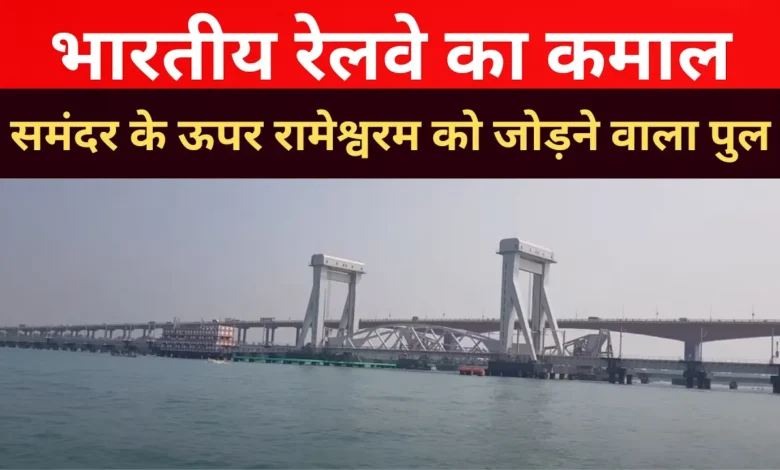
The New Pamban Bridge, completed in 2025, marks a major milestone in India’s railway infrastructure. Built across the sea to connect the mainland with Rameswaram, the bridge combines modern engineering, automation, corrosion-resistant construction and advanced safety systems.
In a special News Station interview, Rajesh Prasad, former Director of Rail Vikas Nigam Limited (RVNL), discussed the history of the iconic Pamban Bridge, the challenges involved in constructing its modern replacement and the technologies adopted to ensure a long service life.
Siddharatha, News Station: Why is the New Pamban Bridge considered such a special railway infrastructure project?
Rajesh Prasad: To understand the importance of Pamban, we first need to understand its history. Rameswaram is an important pilgrimage destination, and historically it became separated from the mainland following a cyclone in the late 15th century.
During the British period, the railway connection to Rameswaram and Dhanushkodi became strategically important because it facilitated the movement of passengers and goods towards Ceylon, now Sri Lanka. The famous Boat Mail service connected rail and sea transport.
The original Pamban Bridge was constructed between 1912 and 1914. It had a 225-foot Scherzer rolling lift span and numerous approach spans. It was an extraordinary engineering achievement for its time.
The bridge faced its biggest test during the devastating cyclone of December 1964. Around 120 approach spans were displaced. However, remarkably, the Scherzer span survived. At that time, the Madurai Divisional Engineer was E. Sreedharan, who later became famous as the Metro Man. The damaged spans were restored in just 46 days using steam cranes mounted on boats.
Siddharatha: What eventually made the old bridge unsuitable for continued railway operations?
Rajesh Prasad: The old bridge had crossed a century of service. It operated in an extremely aggressive marine environment, where saltwater and wind accelerated corrosion. It was originally a meter-gauge, single-track and non-electrified railway structure, later converted to broad gauge.
The bridge was also monitored through sensors, including monitoring undertaken with the involvement of IIT Madras. As its condition deteriorated, restrictions were imposed. The speed was reduced to around 10 kmph before the old bridge was finally closed in January 2023.
The original Scherzer mechanism was manually operated. Opening and closing the span could take roughly 45 minutes to an hour. That was no longer appropriate for a modern railway system carrying increasing traffic.
Siddharatha: How different is the New Pamban Bridge from the old structure?
Rajesh Prasad: The difference is substantial. The old bridge had a Scherzer rolling lift span, where the structure opened through a cantilever-type mechanism. The New Pamban Bridge uses a vertical lift span.
The new system is stronger and more stable because the lift span is supported differently and does not have the same cantilever action. Its operation is also completely automated. What previously took around 45 minutes to an hour can now be completed in approximately 3–5 minutes.
The navigation clearance has also increased from about 19 metres to 22 metres. Raising the bridge further was difficult because the railway stations and approaches on either side are at fixed levels. Increasing the clearance by three metres also helps reduce exposure to saline water spray and consequently assists corrosion protection.
Another major difference is that the new bridge’s substructure and lift span have been designed for a double-line configuration, providing scope for future expansion.
The bridge has also been electrified and integrated with modern signalling, interlocking and SCADA-based control systems.
Siddharatha: How does the automation improve safety?
Rajesh Prasad: Safety was one of the fundamental design objectives. The lift span is connected to the signalling and SCADA system. The train is permitted to proceed only after the bridge has returned to its proper position and the required locking and electrical conditions have been confirmed.
The system is therefore designed on a fail-safe principle.
Sensors also monitor environmental conditions. For example, if wind speed reaches a critical threshold, the system can respond automatically rather than depending entirely on manual intervention.
The lift span and its associated towers together involve a massive structure weighing approximately 1,250 tonnes. Stainless steel reinforcement has also been used extensively to improve durability in the marine environment.
Siddharatha: What were the major construction challenges?
Rajesh Prasad: The biggest challenge was that this was essentially a major construction project in the sea. The project timeline coincided with COVID-19, which significantly affected execution. In addition, rough sea conditions, high winds and the area’s vulnerability to cyclones regularly restricted marine construction.
Approximately 25–30 percent of the year could be affected by rough sea conditions when marine work became difficult or impossible.
Logistics were another major challenge. Fabrication facilities were located around 35 km away. Large components had to be fabricated, transported by road, moved through marine routes and then reassembled at the bridge site.
The project therefore required meticulous planning and mechanisation.
A floating batching plant was established on a barge. Movable piling rigs were used in the sea, allowing construction activity to progressively move forward. Special launching arrangements were developed for approach girders and track components.
For the 72-metre lift span, temporary steel-casing piers were created to facilitate installation and later dismantled.
Siddharatha: Corrosion is one of the biggest threats to structures in a marine environment. How was it addressed?
Rajesh Prasad: Corrosion protection was considered from the design stage itself.
One of the most important measures was the extensive use of stainless steel reinforcement. The project also used specially rolled steel plates to reduce the number of joints. The lift span was fabricated as a fully welded structure.
HSFG bolts were given zinc-flake coating. Sharp edges were rounded to reduce stress concentration. The design also sought to prevent water stagnation in structural members.
The railway level was raised by three metres to reduce saltwater splashing.
A durable painting system was adopted, similar to the system used on the Chenab Bridge. The objective was to achieve a long service life with appropriate maintenance.
Structural health monitoring was another important innovation. The project adopted an indigenous approach, with Indian institutions involved in developing and implementing monitoring systems.
Siddharatha: Was the bridge designed to protect against an accident similar to the Baltimore bridge collapse?
Rajesh Prasad: Yes. The Baltimore bridge incident in March 2024 highlighted the importance of protecting bridge piers from vessel impact.
At Pamban, fender piles and a protective arrangement were provided around the vulnerable areas. The objective is that a vessel approaching the bridge would encounter the protective system before directly impacting the main piers.
This was an important disaster-management consideration for a bridge located on an active navigation route.
Siddharatha: How much indigenous technology was used?
Rajesh Prasad: The project represents a strong example of Make in India. Around 90–95 percent of the components and systems were sourced or developed indigenously, according to the project team.
The project involved several major technical institutions and agencies. IIT Bombay was involved in proof checking and design adequacy. IIT Madras worked on superstructure design, while IIT Guwahati was associated with track and sleeper-related aspects.
The Welding Research Institute in Tiruchirappalli played an important role in weld inspection and quality assurance.
The project also involved consultants, contractors, railway authorities, RDSO, Southern Railway, RVNL and the Commissioner of Railway Safety.
Coordination among these agencies was critical because every component—from steel fabrication and bearings to electromechanical systems and track—had to work as one integrated system.
Siddharatha: What are the biggest lessons from the New Pamban Bridge project?
Rajesh Prasad: The biggest lesson is how to execute a complex infrastructure project safely and with quality under highly challenging conditions.
The project demonstrated the importance of technology, mechanisation, indigenous solutions, detailed planning and continuous coordination.
We also learned that knowledge gained from one project must be transferred to future projects. Project management is not simply about completing one bridge; it is about documenting the experience so that future engineers can benefit.
A maintenance manual was also prepared and handed over to the railway system. Structural health monitoring, corrosion protection and the use of non-corrosive materials are lessons that can be applied to other railway bridges.
I believe the New Pamban Bridge is a live example of how engineering innovation can be combined with indigenous capability to execute a complex infrastructure project.
Siddharatha: Finally, what makes your association with the project particularly significant?
Rajesh Prasad: A project of this scale is never the achievement of one individual. It is the result of an entire team—engineers, project managers, contractors, consultants, railway officials and technical institutions.
The New Pamban Bridge gave us the opportunity to work with technology, innovation and challenging marine conditions simultaneously. It was a unique experience, and I feel privileged to have been associated with such an iconic project.
The experience gained at Pamban will certainly be valuable for future railway bridges and other complex infrastructure projects in India.