Mumbai Ahmedabad Bullet Train Project Crosses Major Construction Milestones
349 km viaduct, 443 km pier work completed as tunnels, stations and track systems advance rapidly across Gujarat and Maharashtra

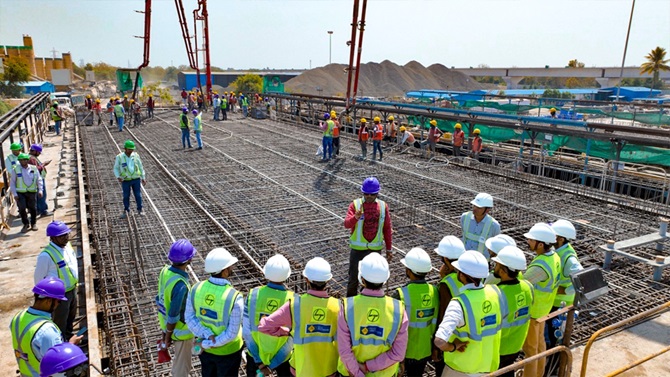
The Mumbai–Ahmedabad Bullet Train Project continues to make rapid progress, with major civil, track, station, and tunnel works advancing across Gujarat and Maharashtra as of May 4, 2026. The ambitious high-speed rail corridor, India’s first bullet train project, is steadily moving towards completion with several critical milestones already achieved.
According to the latest project update, out of the total 508-km corridor, approximately 349 km of viaduct construction and 443 km of pier work have been completed. The project has also achieved significant progress in bridge construction, with 17 river bridges, five pre-stressed concrete (PSC) bridges, and 13 steel bridges already completed.
Noise mitigation infrastructure is also progressing rapidly. More than 5.7 lakh noise barriers have been installed along a 288-km stretch to reduce sound impact in populated areas along the corridor. Track-related works are advancing simultaneously, with 374 track kilometres, equivalent to 187 route kilometres, of reinforced concrete (RC) track bed construction completed so far.
Officials stated that 191 route km of track slabs have already been manufactured, while 74 route km of track slabs have been laid and injected with Cement Asphalt Mortar (CAM), an essential component for ensuring stability and smooth high-speed train operations.
Electrification works are also underway at a fast pace. More than 7,700 Overhead Equipment (OHE) masts have been installed, covering nearly 179 route km of the mainline viaduct. In another important development, the stringing of top conductors has now begun, marking progress towards operational readiness of the rail system.
Tunnel construction, considered one of the most challenging aspects of the project, has also recorded key breakthroughs. Work on the only mountain tunnel in Gujarat has been completed successfully. In Maharashtra’s Palghar district, which includes seven mountain tunnels, breakthroughs have already been achieved in two tunnels.
The underground section between Bandra-Kurla Complex (BKC) and Shilphata in Maharashtra is also moving forward steadily. Out of the planned 21-km tunnel stretch, around 5 km has already been excavated using the New Austrian Tunnelling Method (NATM). The remaining 16 km will be excavated using Tunnel Boring Machines (TBMs). Officials confirmed that all major components of two TBMs have been received, while assembly and lowering operations are currently underway at Vikhroli and Sawli in Maharashtra.
Work at the rolling stock depots is also progressing. At the Surat Rolling Stock Depot, installation of the wheel lathe has been completed, while machinery installation and track works are ongoing. Meanwhile, at the Sabarmati Rolling Stock Depot, steel structure installation is currently in progress.
Construction of stations along the high-speed corridor has entered an advanced phase. The foundation work for all eight stations in Gujarat—Vapi, Bilimora, Surat, Bharuch, Anand-Nadiad, Vadodara, Ahmedabad, and Sabarmati—has been completed. Superstructure construction at these stations is progressing rapidly, while finishing works have already started at seven locations.
In Maharashtra, construction activities have commenced at all three elevated stations. At the underground Mumbai bullet train station, slab casting works are currently underway, marking another major milestone for the project’s urban infrastructure component.
The Mumbai–Ahmedabad Bullet Train project is expected to revolutionise rail travel in India by significantly reducing travel time between the two major financial and commercial hubs. The corridor will introduce Japan’s Shinkansen technology and modern high-speed rail infrastructure to the country.
Officials believe the project is not only transforming transportation but also generating employment, boosting manufacturing, and promoting advanced engineering capabilities in India. With steady progress across civil structures, tunnels, stations, depots, and track systems, the project continues to move closer to becoming India’s first operational high-speed rail network.