Railways Lines Up ₹1.80 Lakh Crore PPP Pipeline; Panel Seeks Faster Approvals, Better Risk Sharing

The Standing Committee on Railways has backed a wider role for private investment in railway infrastructure, while calling for a calibrated, project-specific approach to Public-Private Partnership (PPP) projects, faster regulatory approvals and balanced risk-sharing mechanisms to protect both investors and the long-term financial interests of Indian Railways.
In its latest report, the Committee noted that Extra Budgetary Resources (EBR), including PPP-based funding, have met or exceeded targets in recent years. However, it observed that internal revenue generation has remained largely stagnant, making Indian Railways dependent on Gross Budgetary Support (GBS) along with EBR to finance ongoing and expansion projects.
The Committee appreciated the Ministry of Railways for exercising financial prudence by limiting borrowings under EBR to avoid additional lease liabilities and repayment burdens. At the same time, it stressed that critical railway and capacity-enhancement projects should not be delayed because of funding constraints.
The panel recommended that the Railways identify commercially viable and revenue-generating projects for private participation and develop appropriate risk-sharing mechanisms to provide greater confidence to private investors. It also called for streamlining approval and regulatory processes to attract credible private investment.
₹1.80 Lakh Crore PPP Pipeline
The Ministry of Railways has expanded its PPP framework under the Participative Policy, 2012, which provides for private and strategic participation in railway connectivity and infrastructure development.
The policy includes models such as Non-Government Rail, Joint Venture, Customer Funded, Build-Operate-Transfer and BOT-Annuity arrangements. To further expand private participation, the Railway Board has added the Development Partner Model (DPM) and Hybrid Annuity Model (HAM).
According to the Ministry, 18 projects worth ₹16,686 crore have already been completed through PPP, while seven projects worth ₹16,362 crore are currently under implementation, including coal and port connectivity projects.
The Railways has additionally identified 54 projects with a total estimated cost of ₹1,80,703 crore for execution under the PPP mode.
| Major PPP Segment | Key Projects / Scope | Investment |
|---|---|---|
| New railway lines | Godda–Pakur/Nagarnabi, Manuguru–Ramagundam, Gadchiroli–Sirpur, Jajpur–Keonjhar Road–Dhamra Port | Major projects across network |
| Doubling & additional lines | Itarsi–Manikpur 3rd line, Haridaspur–Vizianagaram 4th line, Guntakal–Wadi 3rd & 4th lines | ₹9,562 cr; ₹8,321 cr; ₹4,364 cr |
| Station redevelopment | Vijayawada, Chennai Central, Bengaluru, Andheri, Dadar, Bhopal, Coimbatore, Vadodara and others | Multiple projects |
| Gati Shakti Cargo Terminals | 65, 50 and 40 locations | ₹11,311 cr |
| Private wagon & container rakes | Wagon and container rake induction | ₹4,208 cr |
| MEMU manufacturing | 100 MEMU rakes at Kazipet | ₹8,200 cr |
| Maintenance infrastructure | 8 locomotive, 7 trainset and 16 wagon maintenance depots | ₹37,000 cr |
| Renewable energy | 1,000 MW RTC renewable, 800 MW solar and 500 MW solar projects | ₹27,800 cr |
| Power projects | 800 MW thermal and 400 MW hydro projects | ₹15,700 cr |
| Other infrastructure | Budget hotel at Kevadia, Gujarat | ₹53 cr |
| Total PPP pipeline | 54 projects | ₹1,80,703 cr |
The pipeline covers projects across railway connectivity, capacity augmentation, station redevelopment, freight infrastructure, rolling stock, maintenance facilities, energy and tourism-related infrastructure.
Among the major railway connectivity proposals are the ₹4,165-crore Godda–Pakur/Nagarnabi new line, ₹4,014-crore Manuguru–Ramagundam new line, ₹2,987-crore Jajpur–Keonjhar Road–Dhamra Port new line and ₹4,342-crore Gadchiroli–Sirpur new line.
Several major capacity augmentation projects are also proposed under the PPP pipeline. These include the ₹9,562-crore Itarsi–Manikpur third line, ₹8,321-crore Haridaspur–Vizianagaram fourth line and ₹4,364-crore Guntakal–Wadi third and fourth lines.
Major Station Redevelopment Projects
Private participation is also being considered for redevelopment of several major railway stations. The list includes Vijayawada, Avadi, Tambaram, Andheri, Bengaluru, Kalyan, Chennai Central, Dadar, Coimbatore, Bhopal and Vadodara.
The Vijayawada station redevelopment project has an estimated cost of ₹742 crore, while Andheri is estimated at ₹1,057 crore and Bengaluru at ₹850 crore. Chennai Central is estimated at ₹500 crore, with several other station redevelopment projects in the ₹300–₹500 crore range.
Focus on Freight and Cargo Infrastructure
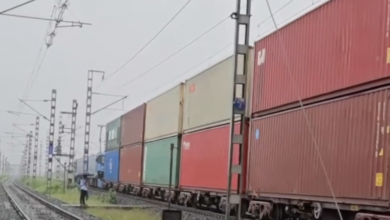
The PPP pipeline places significant emphasis on strengthening rail freight infrastructure. Gati Shakti Cargo Terminal projects covering 65 locations have an estimated cost of ₹4,550 crore, while projects covering another 50 locations are estimated at ₹3,675 crore. A further 40 locations have been identified with an estimated investment of ₹3,086 crore.
The Ministry is also seeking private participation in wagon and container rake induction. The pipeline includes private induction of 50, 40 and 30 wagon rakes, as well as 36, 30 and 25 private container rakes.
The Committee believes greater private participation in freight infrastructure can help expand railway capacity and improve logistics efficiency.
Large Investment in Maintenance and Manufacturing
The PPP pipeline also includes major investments in rolling-stock manufacturing and maintenance infrastructure.
A project for manufacturing 100 MEMU rakes at Kazipet has an estimated cost of ₹8,200 crore. Eight locomotive mega maintenance depots are proposed at an estimated cost of ₹9,600 crore, while seven trainset maintenance depots are estimated at ₹21,000 crore. Another ₹6,400 crore is proposed for 16 wagon maintenance depots.
Private Participation in Energy Projects
The Railways is also looking beyond conventional railway infrastructure for private investment. The PPP pipeline includes a 1,000 MW round-the-clock renewable power project estimated at ₹20,000 crore, along with an 800 MW solar project at Madhogarh and Orai estimated at ₹4,800 crore and a 500 MW solar project at Pavagada estimated at ₹3,000 crore.
The pipeline further includes an 800 MW thermal power project at Nabinagar, estimated at ₹10,900 crore, and a 400 MW hydro power project at Anjaw with an estimated cost of ₹4,800 crore.
Panel Wants Stronger PPP Monitoring
While appreciating the expansion of PPP models, the Committee cautioned that creating a large project pipeline alone would not guarantee successful private participation.
It called for a dedicated monitoring framework to ensure timely resolution of contractual, regulatory, financial and implementation-related bottlenecks. Such a mechanism, it said, would help ensure that projects progress according to schedule.
The Committee also recommended periodic and model-specific evaluation of different PPP models. Successful projects should be studied to identify best practices, which could then be incorporated into other PPP arrangements to improve their commercial viability and effectiveness in mobilising private capital.
Greater Role for States and Local Bodies
The Committee also stressed the importance of greater participation by State Governments and local bodies, particularly in new railway lines and gauge conversion projects.
According to the Committee, states and local authorities have a direct interest in regional development and can therefore play an important role in resolving issues involving land acquisition, statutory clearances and utility shifting.
Their participation could help remove several implementation bottlenecks and accelerate the execution of railway connectivity projects.
The Committee’s recommendations point towards a broader transformation in the way railway infrastructure is financed and developed. With a ₹1.80 lakh crore PPP pipeline covering 54 projects, Indian Railways is seeking to leverage private capital across connectivity, freight, stations, rolling stock, maintenance and energy.
However, the Committee has made clear that the success of the strategy will depend on transparent regulations, balanced risk allocation, faster approvals, effective monitoring and careful protection of Indian Railways’ financial interests.