CJI Surya Kant Declines Meeting with Rahul Gandhi and Mallikarjun Kharge, Says Issues Are Sub Judice

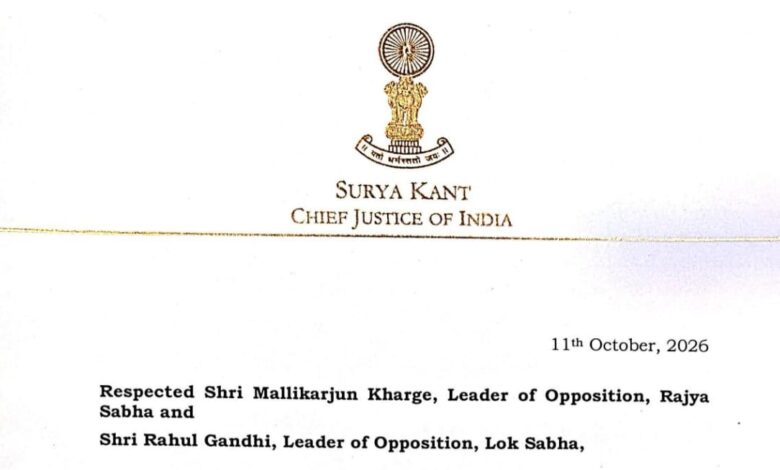
Chief Justice of India (CJI) Surya Kant has declined a request by Congress leaders Rahul Gandhi and Mallikarjun Kharge for a meeting to submit a memorandum concerning the Chief Election Commissioner and Election Commission of India, alleged arbitrary arrests of students, the closure of metro stations and the cancellation of trains. In a two-page letter dated October 11, the CJI explained that the issues raised by the Opposition leaders were already pending before the Supreme Court and that discussing them in a meeting outside judicial proceedings would be inconsistent with the principle of separation of powers.
The letter was addressed to Kharge, Leader of the Opposition in the Rajya Sabha, and Gandhi, Leader of the Opposition in the Lok Sabha. The two leaders had sought an appointment on Monday, October 12, between 4 pm and 5 pm, to submit their memorandum.
While declining the requested meeting, the CJI emphasised that the Supreme Court remains committed to protecting citizens’ Fundamental Rights and advised the leaders to approach the Court through established judicial procedures.
CJI Cites Separation of Powers and Judicial Propriety
In his letter, CJI Surya Kant stated that the issues highlighted in the proposed memorandum were already sub judice before the Supreme Court of India.
He observed that convening a meeting to discuss matters pending before the Court would be contrary to the principle of separation of powers, which forms an intrinsic part of the basic structure of the Constitution. Such a meeting, he added, would also be incompatible with established judicial ethics and propriety.
The CJI’s response underlined the distinction between the administrative functions of the judiciary and its judicial responsibilities. He explained that the Supreme Court is not constitutionally endowed with administrative powers to address the issues raised in the memorandum.
However, he clarified that the Court is duty-bound to consider grievances affecting citizens through its judicial jurisdiction, including the powers available under Article 32 of the Constitution and its authority of judicial review.
The letter therefore directed the Opposition leaders towards legal remedies rather than an administrative meeting with the head of the judiciary.
Memorandum Raised Four Major Concerns
According to the letter, Gandhi and Kharge intended to submit a memorandum raising four principal issues.
The first concerned the Chief Election Commissioner and the Election Commission of India. The second related to what the Opposition leaders described as the arbitrary arrest of several students.
The memorandum also sought to raise concerns over the closure of metro stations and the cancellation of trains, among other matters.
These issues had attracted political attention amid demonstrations and disputes surrounding electoral processes, public order and restrictions affecting movement in the national capital.
The Opposition leaders’ request sought an appointment with the CJI to present their concerns collectively. However, the Chief Justice maintained that matters already before the judiciary should be addressed through appropriate legal proceedings rather than discussed in an administrative meeting.
The letter did not adjudicate the merits of the allegations raised in the proposed memorandum. Instead, it focused on the appropriate constitutional and procedural route for seeking relief.
Supreme Court Reaffirms Commitment to Fundamental Rights
Despite declining the meeting, CJI Surya Kant reiterated the Supreme Court’s commitment to protecting the Fundamental Rights of every Indian citizen.
The letter stated that citizens are entitled to seek enforcement of their rights at all times through procedures established by law. It suggested that invoking the Court’s judicial powers would be more appropriate than submitting a memorandum through the administrative side.
The CJI also referred to Article 32 of the Constitution, which provides a constitutional remedy for the enforcement of Fundamental Rights. The provision enables citizens to approach the Supreme Court when they seek protection against violations of such rights.
His response thus emphasised that declining a meeting did not mean closing the doors of the judiciary to the concerns raised by the Opposition leaders. Instead, the Court indicated that those concerns should be presented in the form of appropriate petitions and considered through judicial processes.
CJI Offers Early Hearing for Appropriate Petition
An important aspect of the letter was the assurance that a petition concerning these issues could receive an early hearing.
CJI Surya Kant noted that some matters highlighting similar issues were scheduled for hearing on Tuesday, October 13, 2026.
He informed Gandhi and Kharge that, if so advised, they could submit their petition on Monday, October 12, either physically at the Supreme Court between 10:30 am and 4:30 pm or through the e-filing facility, which permits filings at any time.
The CJI further assured the leaders that any such petition would be heard at the earliest possible opportunity, in accordance with the law.
This part of the letter outlined a judicial route for bringing the concerns before the Court without arranging a separate meeting with the Chief Justice.
However, an assurance of an early hearing does not, by itself, determine whether the Court will grant relief. Any petition would remain subject to applicable legal requirements and judicial consideration.
Political Concerns and Constitutional Procedure
The CJI’s response places the proposed memorandum within a broader debate about how political representatives can raise concerns relating to citizens’ rights and government action.
For the Opposition, the issues identified in the memorandum included alleged arbitrary arrests, restrictions affecting public transport and questions concerning the Election Commission. The leaders sought to bring these concerns to the attention of the country’s highest judicial authority.
The Chief Justice, however, drew a clear distinction between acknowledging grievances and discussing pending cases outside formal judicial proceedings. His position was that the constitutional framework requires the judiciary to deal with such matters through established legal procedures, safeguarding judicial independence and propriety.
The letter also highlights the importance of Article 32 as a mechanism through which citizens can seek enforcement of Fundamental Rights.
What Happens Next?
Following the CJI’s response, the next step available to the Opposition leaders is to pursue an appropriate legal remedy before the Supreme Court, as advised in the letter.
With related matters reportedly scheduled for hearing on October 13, the possibility of judicial consideration could bring some of the concerns raised in the memorandum before the Court through formal proceedings.
The development does not amount to a judicial finding on the allegations concerning student arrests, metro station closures, train cancellations or the Election Commission. Those questions would need to be examined through the relevant proceedings and evidence.
CJI Surya Kant’s October 11 letter ultimately conveyed two key messages: pending cases must be handled through judicial procedures rather than administrative meetings, and citizens retain the right to seek enforcement of their Fundamental Rights through the legal remedies available under the Constitution.
By declining the meeting while offering the possibility of an early hearing, the Chief Justice reaffirmed the distinction between the administrative and judicial sides of the Supreme Court and directed the Opposition leaders towards the constitutional process for obtaining legal relief.