
Cyclone Murasu Crosses South Andhra Pradesh Coast Near Ongole; Winds Gusting at 120 Kmph
Severe Cyclonic Storm Murasu crossed the South Andhra Pradesh coast between Nellore and Narsapur, close to Ongole, between 3:30 am and 5:30 am on November 3. The cyclone brought sustained winds of 100-110 kmph, with gusts reaching 120 kmph, as it made landfall along the coast.

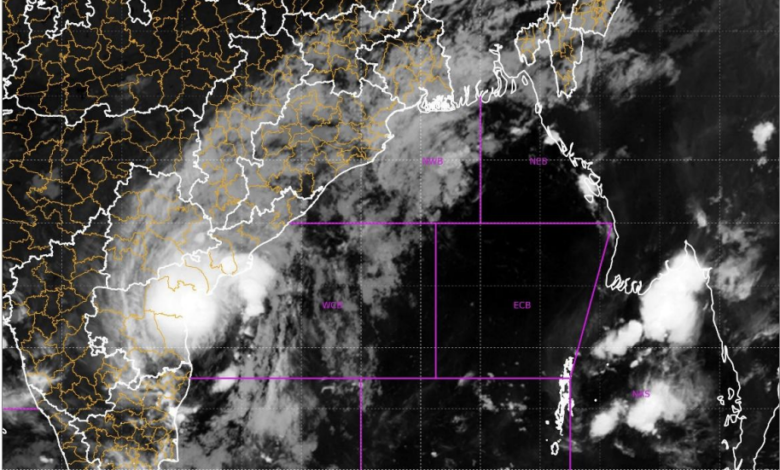
The landfall of Severe Cyclonic Storm Murasu took place along the South Andhra Pradesh coast early on November 3, according to the latest update from the India Meteorological Department (IMD). The cyclone moved north-northwestwards and crossed the coastline between Nellore and Narsapur, close to Ongole, during the period from 0330 hours to 0530 hours IST.
The IMD reported that the cyclone crossed the coast near latitude 15.53°N and longitude 80.22°E, with maximum sustained wind speeds of 100-110 kmph and gusts reaching 120 kmph.
The landfall update follows IMD Bulletin No. 18, issued at 5:00 am IST on November 3, which had reported that the major portion of the cyclone’s wall cloud had entered the land in its forward sector and that its eye was also entering the coastline.
According to the earlier bulletin, at around 4:30 am, the system was centred over the Westcentral Bay of Bengal, very close to the South Andhra Pradesh coast, near latitude 15.45°N and longitude 80.25°E.
At that time, the cyclone was positioned approximately 20 km east-southeast of Ongole, 60 km south-southwest of Bapatla, 70 km north-northeast of Kavali, 110 km north-northeast of Nellore and 130 km southwest of Machilipatnam.
Cyclone Murasu brings winds gusting up to 120 kmph
Cyclone Murasu moved north-northwestwards before crossing the South Andhra Pradesh coast. During landfall, the maximum sustained wind speed near the centre was estimated at 100-110 kmph, with gusts reaching 120 kmph.
The IMD had warned that similar wind conditions were likely along and off the South Andhra Pradesh coast during the landfall period.
Such high-speed winds can damage vulnerable structures, uproot trees, disrupt power and communication infrastructure and affect road and other essential services. Coastal communities and residents in exposed areas were among those facing the impact of the severe weather system.
Storm surge threat across Bapatla, Krishna and Prakasam
Before landfall, the IMD had forecast a storm surge of approximately 1.0-1.5 metres above the astronomical tide, with the potential to inundate low-lying coastal areas of South Andhra Pradesh until the morning of November 3.
The maximum peak surge was expected over Bapatla, Krishna and Prakasam districts, with the surge forecast to gradually decrease thereafter.
The storm surge, combined with heavy rainfall and strong winds, raised the risk of temporary inundation in vulnerable coastal locations.
Heavy rainfall recorded in coastal districts
Heavy spells of rainfall were likely over South Coastal Andhra Pradesh during the 12 hours following the 5:00 am bulletin, according to the IMD.
Rainfall observations between 8:30 am on November 2 and 4:00 am on November 3 showed significant precipitation at several locations. Kothapatnam in Prakasam district recorded the highest rainfall at 164 mm.
Other significant rainfall observations included Chirala in Bapatla district at 73 mm, Narsapur in West Godavari district at 70.5 mm, Naguluppalapadu in Prakasam district at 70.27 mm, Santhanutalapadu in Prakasam district at 67.53 mm and Kalipatnam in West Godavari district at 66.25 mm.
The heavy rainfall increased the possibility of waterlogging and flooding, particularly in low-lying areas and locations with saturated soil.
Moderate flash flood risk across six districts
The IMD also issued a flash flood risk outlook valid until 11:30 pm on November 3. Moderate flash flood risk was forecast over selected watersheds and adjoining neighbourhoods in Bapatla, Guntur, Krishna, Palnadu, Prakasam and SPSR Nellore districts.
The department warned that surface runoff and inundation could occur in areas where the soil was already fully saturated, as well as in low-lying locations, due to additional rainfall expected over the following 24 hours.
With Cyclone Murasu having crossed the South Andhra Pradesh coast near Ongole, the IMD continued to monitor the system through satellite imagery and Doppler weather radar observations. Residents in the affected districts were advised to remain alert to changing weather conditions and follow official advisories issued by the authorities.