PM Modi Unveils ‘Shakti Ki Saptdhara’ Vision to Drive India Towards Viksit Bharat

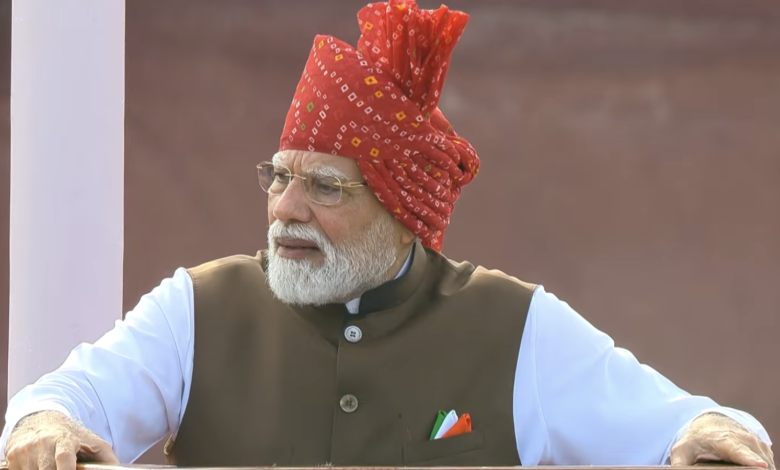
Prime Minister Narendra Modi, in his Independence Day address from the ramparts of the Red Fort, unveiled a seven-point development vision aimed at giving fresh momentum to India’s journey towards becoming a Viksit Bharat by 2047. Calling the framework ‘Shakti Ki Saptdhara’, the Prime Minister identified seven strategic areas that he said would form the foundation for the next generation of reforms.
The seven pillars are manufacturing; agriculture and food processing; technology and innovation; Gati Shakti; Raksha Shakti; the green and blue economy; and India’s soft power.
Modi said the seven streams of development could help India achieve in the next five to seven years what had remained difficult to accomplish over several decades. Drawing on the historical reference to ‘Sapta Sindhu’, or the seven rivers, he described the seven pillars as a new current of development that could provide the country with greater momentum and capabilities.
“Today, from the ramparts of the Red Fort, I invoke the ‘Saptdhara’ of strength before the nation,” Modi said, underlining the importance of the seven areas in shaping India’s next phase of growth.
Manufacturing to drive global competitiveness
The first pillar of the Prime Minister’s vision is manufacturing. Modi called for Indian products to become globally competitive in terms of cost, quality and scale.
He stressed that India must not merely manufacture for its domestic market but should aim to become a major global production hub. The focus, therefore, would be on improving competitiveness, expanding manufacturing capabilities and ensuring that Indian products meet international standards.
Agriculture and food processing
The second stream focuses on agriculture and food processing. Modi said India needs to move beyond producing agricultural commodities and work towards creating internationally recognised Indian brands.
He emphasised greater value addition, food processing and access to global markets. The objective is to enable farmers and producers to benefit from growing international demand while strengthening India’s position as a major food and agricultural products exporter.
Technology and innovation
The third pillar is technology and innovation, which the Prime Minister described as critical for the next phase of India’s economic growth.
He highlighted digital and communication technologies and called for stronger capabilities in emerging areas. India’s ability to develop and adopt advanced technologies, he said, would be crucial to strengthening economic competitiveness and creating new opportunities for young Indians.
The emphasis comes against the backdrop of India’s growing ambitions in areas such as artificial intelligence, semiconductors, digital infrastructure and advanced manufacturing.
Gati Shakti: Faster connectivity
The fourth pillar is Gati Shakti, covering mobility, connectivity and infrastructure.
Modi said India needs faster and more seamless movement of people and goods, with high-speed transportation and modern infrastructure playing a central role.
The vision includes strengthening connectivity across different modes of transport and improving logistics efficiency. Modern highways, railways, ports, airports and urban transport networks are expected to contribute to faster economic activity and improved movement of goods across the country.
India’s expanding modern railway network, including Vande Bharat trains, is part of this broader push towards faster and more advanced passenger connectivity.
Raksha Shakti and defence self-reliance
The fifth pillar, Raksha Shakti, focuses on strengthening India’s defence capabilities and reducing dependence on imports.
Modi called for greater self-reliance in defence technology and highlighted the need to develop next-generation capabilities, including drones and supersonic technologies.
The objective is to strengthen domestic defence manufacturing while developing advanced technologies that can meet the requirements of India’s armed forces and potentially create opportunities for defence exports.
Green and blue economy
The sixth stream combines the green and blue economy, reflecting the Prime Minister’s emphasis on sustainable development and the economic potential of India’s natural resources.
The green economy encompasses areas such as clean energy and environmentally sustainable growth, while the blue economy focuses on India’s vast maritime resources and opportunities linked to oceans and coastal development.
Modi said India’s natural resources could become a major source of future growth if they were utilised sustainably and responsibly.
Soft power and India’s global influence
The seventh pillar is India’s soft power. Modi highlighted India’s global strengths in Yoga, Ayurveda, holistic health, creative industries and tourism.
He said India’s cultural and civilisational heritage could play an important role in expanding the country’s global influence while generating economic opportunities.
Tourism, creative industries and traditional knowledge systems, according to the vision, can become important contributors to employment, entrepreneurship and international engagement.
From ‘Panch Pran’ to ‘Saptdhara’
The seven-point framework builds on Modi’s ‘Panch Pran’ announced from the Red Fort in 2022, when India marked 75 years of Independence. Those five pledges focused on making India a developed nation, shedding the colonial mindset, taking pride in India’s heritage, strengthening unity and fulfilling citizens’ duties.
Four years later, the Prime Minister has expanded the development narrative through ‘Shakti Ki Saptdhara’, presenting it as a framework for the next generation of reforms.
Modi said the potential of India’s youth would be fully harnessed and integrated into nation-building. He argued that the country’s young population, combined with technological capabilities, manufacturing strength, infrastructure and cultural influence, could provide the momentum required to achieve the Viksit Bharat goal.
Calling the seven streams the “power of seven”, the Prime Minister said their combined strength could provide India with new heights, new momentum and the capability to achieve goals that had remained out of reach for decades.
The ‘Shakti Ki Saptdhara’ vision thus places economic competitiveness, modern infrastructure, technological innovation, defence self-reliance, sustainable development and cultural influence at the centre of India’s roadmap towards 2047.