
Government Begins Targeted Release of Onion Buffer Stocks as Seasonal Demand Rises

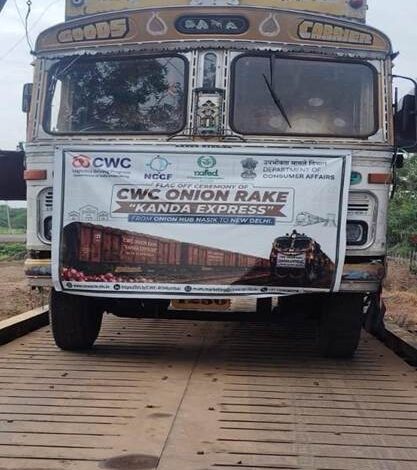
Kanda Express carrying onions departs Nashik for Delhi; buffer onions to be sold at ₹35 per kg through NCCF, NAFED, Kendriya Bhandar and other outlets
The Government has begun a calibrated and targeted release of onion buffer stocks to ensure adequate domestic availability and moderate seasonal price pressures during the coming months. The intervention comes ahead of the festive and wedding season, when demand for onions generally rises and supply-chain pressures can contribute to higher retail prices.
The Department of Consumer Affairs is implementing the intervention through a hybrid transportation strategy involving railway rakes and road transport. Onion stocks are being moved from major producing regions to important consumption centres according to prevailing market conditions, arrivals, demand and price trends.
The first Kanda Express carrying onions from Nashik to New Delhi has already departed. At the same time, road-based supplies are being dispatched to several other major consumption centres, including Chennai, Kolkata, Ernakulam, Guwahati, Varanasi, Lucknow, Patna, Chandigarh, Jammu and Amritsar.
Comfortable Production and Buffer Availability
The Government said domestic onion availability remains comfortable and is expected to meet demand in the coming months. Estimated onion production during 2025-26 stands at 307.37 lakh metric tonnes (LMT), broadly comparable with the previous year’s production of 307.67 LMT.
The combination of robust production, buffer stocks and timely market interventions is expected to support stable supplies and contain seasonal price pressures.
In view of the favourable production outlook, the Government has set a procurement target of 2.00 LMT of Rabi onion for the Price Stabilization Fund (PSF) buffer for 2026-27. Procurement began on May 15, 2026, through the National Agricultural Cooperative Marketing Federation of India (NAFED) and the National Cooperative Consumers’ Federation of India (NCCF).
So far, approximately 1.21 LMT of onions have been procured for the buffer.
For the first time during 2026-27, the Central Warehousing Corporation (CWC) has been engaged as the storage agency for the PSF onion buffer. The move is aimed at strengthening storage management and improving operational efficiency in handling the strategic stock.
Buffer Releases Ahead of Festive Season
Onion prices generally face seasonal pressure during periods of increased consumption. The upcoming festive calendar includes Onam, Ganesh Chaturthi, Durga Puja, Dussehra and Diwali, followed by the wedding season.
Against this backdrop, the Government has decided to release buffer stocks in a calibrated manner rather than flooding markets with supplies. The quantity, geographical coverage and distribution channels will be expanded depending on market conditions.
The objective is to ensure that sufficient onions reach consumption centres while preventing unnecessary price volatility.
Onion to Be Sold at ₹35 Per Kg
As part of the retail intervention, buffer onions will be made available to consumers at ₹35 per kg through mobile vans and retail outlets operated by NCCF and NAFED, besides outlets of Safal and Kendriya Bhandar.
The initial retail distribution network includes:
| Agency | Retail Outlets | Mobile Vans |
|---|---|---|
| NCCF | 9 | 40 |
| NAFED | 13 | 50 |
| Kendriya Bhandar | About 100 | — |
The targeted retail programme is intended to provide consumers with access to onions at an affordable price, particularly in areas where retail prices show signs of sustained upward movement.
Kanda Express Expands Onion Logistics
The Kanda Express initiative has become an important logistics mechanism for transporting buffer onions from producing regions to major consumption centres.
The scale of railway transportation has expanded significantly in recent years. During 2024-25, onion buffer stocks were transported through 14 railway rakes, carrying nearly 12,000 MT of onions to five cities.
The operation expanded considerably during 2025-26, when 86 railway rakes transported around 88,000 MT of onions to 16 cities across the country.
The latest Nashik-Delhi Kanda Express marks the beginning of railway-based transportation of onion consignments during the current financial year. The railway route is being supplemented by road transportation to ensure that stocks can be moved quickly to locations where market intervention is required.
The hybrid model provides the Government with greater flexibility in responding to regional price movements and supply requirements.
Major Consumption Centres Covered
Under the current intervention, onion supplies are being directed towards several major consumption centres through railway and road networks.
| Mode | Major Movement / Destinations |
|---|---|
| Railway | Nashik to New Delhi |
| Road | Chennai, Kolkata, Ernakulam, Guwahati |
| Road | Varanasi, Lucknow, Patna, Chandigarh |
| Road | Jammu and Amritsar |
The Government said the network and quantity of releases can be expanded depending on prevailing market conditions.
Onion Exports Remain Strong
Despite the focus on domestic availability, onion exports have continued to remain robust. During April-June 2026, onion exports were approximately 3.82 LMT.
Major export destinations included Malaysia, Sri Lanka, the United Arab Emirates and Nepal.
The continued export activity, alongside comfortable domestic production and buffer availability, is being cited as an indication of adequate overall supply conditions.
Government Monitoring Prices Across 579 Centres
The Department of Consumer Affairs maintains close surveillance of essential commodity prices across the country. Retail prices of 41 essential commodities, including onion, are monitored daily across 579 centres.
The data generated through this monitoring system, along with information on market arrivals, demand and regional availability, is used to determine where buffer stocks should be released and in what quantities.
The Government is closely tracking onion prices and market arrivals across states and has indicated that additional intervention will be undertaken wherever necessary.
Prices of Key Essential Commodities Remain Range-Bound
According to the latest all-India average retail price data for August 26, 2026, prices of several key food commodities remain stable and range-bound.
| Commodity | All-India Average Retail Price |
|---|---|
| Tomato | ₹38.33/kg |
| Potato | ₹22.63/kg |
| Chana Dal | ₹86.71/kg |
| Atta | ₹40.48/kg |
| Tur Dal | ₹123.30/kg |
| Milk | ₹60.82/litre |
| Onion | ₹37.87/kg |
The Government noted that Tomato, Potato and Chana Dal prices are lower than their levels a year ago.
The average retail price of onion stood at ₹37.87 per kg on August 26, making the planned sale of buffer onions at ₹35 per kg a targeted measure to provide consumers with access to relatively lower-priced supplies in selected markets.
Balancing Consumer and Farmer Interests
The Government’s onion price stabilisation strategy seeks to balance two objectives: protecting consumers from sharp and unwarranted price increases while ensuring that farmers receive remunerative returns for their produce.
Instead of relying on a uniform nationwide release, the Government is adopting an evidence-based approach in which the scale and destination of buffer releases are adjusted according to market conditions.
The availability of more than one transportation option is also expected to improve the speed and flexibility of intervention. Railway rakes can move large quantities over long distances, while road transportation allows stocks to be distributed to specific markets requiring immediate supplies.
With the festive season approaching, the Government will continue monitoring onion prices, arrivals and availability across states. Further releases from the buffer stock can be undertaken if market conditions warrant.
The combination of domestic production, strategic buffer stocks, expanded logistics through Kanda Express and targeted retail sales is expected to help maintain adequate onion supplies and moderate seasonal price pressures in the months ahead.
The Government has reiterated that market interventions will remain calibrated to prevailing conditions, with the broader objective of safeguarding consumer interests while maintaining a balanced and sustainable agricultural market for farmers.