
India Targets 10% of Global 6G Patents and Standards, Says Telecom Minister

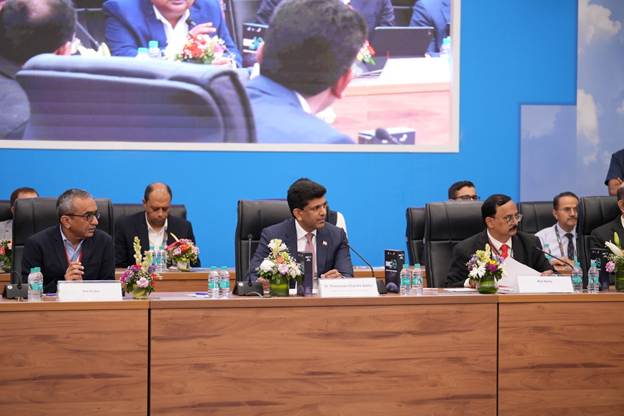
India is aiming to secure at least 10% of global patents and standards related to 6G technology, while developing indigenous alternatives to critical telecom technologies currently dependent on imports, Union Minister of State for Communications and Rural Development Dr Chandra Sekhar Pemmasani said on Thursday.
Addressing the telecom industry during the session titled “Shaping the Intelligent Infrastructure for 6G: A Technology Leadership Dialogue, CTO Round Table” on the sidelines of India Mobile Congress (IMC) 2026, Dr Pemmasani outlined India’s telecom achievements over the past five years and identified key technology priorities for the next phase of the country’s digital development.
The minister said India has made significant progress in expanding digital connectivity, with more than one billion people connected and 5G connectivity extended to every district through nearly 5.6 lakh Base Transceiver Stations (BTS). He also highlighted the expansion of 4G connectivity to villages and the development of an indigenous 4G technology stack.
Dr Pemmasani credited telecom operators, equipment manufacturers, technology companies, researchers and other industry stakeholders for contributing to these achievements.
Focus on Indigenous Telecom Technologies
A major priority outlined by the minister was reducing India’s dependence on imported telecom technologies. He called for the identification of 10 to 20 critical network technologies that are currently imported and urged the industry and government to develop Indian alternatives.
The focus, he said, should extend across the telecom technology value chain, including components, chipsets, radios, routers and advanced optical systems.
The initiative is intended not only to strengthen India’s technological self-reliance but also to position the country as a technology developer and exporter in the next generation of telecommunications.
The minister’s emphasis comes at a time when 6G development is increasingly moving beyond research laboratories and into discussions around standards, intellectual property, network architecture, security and commercial deployment.
India Sets 10% Target for Global 6G Patents
Dr Pemmasani reiterated India’s ambition to become a significant contributor to the global 6G ecosystem. He said the country should target at least 10% of global 6G patents and standards.
For achieving this objective, he called for measurable contributions from major telecom operators and other stakeholders. These contributions should include standards development, Standard Essential Patents (SEPs), university research and industry-academia collaboration.
The minister suggested that telecom companies should establish annual and quarterly targets for their participation in global standards and research activities.
The emphasis on patents and standards reflects the strategic importance of intellectual property in next-generation telecommunications. Countries and companies that contribute to technical standards and develop essential technologies can play a greater role in shaping the architecture of future global networks.
Nearly ₹500 Crore for Telecom R&D
The government has also stepped up support for research and development in emerging telecom technologies.
According to Dr Pemmasani, nearly 136 research and development projects worth around ₹500 crore have been funded under the Telecom Technology Development Fund (TTDF).
These projects cover a broad range of technologies, including 5G and 6G networks, quantum communications, non-terrestrial networks, advanced optical systems, indigenous telecom cores and telecom security.
The government has also established 5G testbeds in academic institutions, enabling students, researchers and startups to experiment with next-generation telecom technologies and develop new applications and solutions.
Such testbeds are expected to help bridge the gap between academic research and commercial technology development while providing startups with access to infrastructure for testing innovative solutions.
Quantum Communication Moves Towards Field Trials
Quantum communications emerged as another important area in the minister’s roadmap for India’s future telecom infrastructure.
Dr Pemmasani called on the Centre for Development of Telematics (C-DOT) to move quantum communication technologies towards actual operator trials.
He specifically highlighted the need to test quantum-safe encryption on critical communication links and deploy Quantum Key Distribution (QKD) where it is economically justified.
The minister’s call indicates a shift from treating quantum communication primarily as a research subject to evaluating its practical applications in operational telecom networks.
Quantum-safe technologies could become increasingly important as telecommunications networks handle sensitive government, financial and critical infrastructure data.
From AI-Assisted to AI-Native Networks
Another major priority identified by Dr Pemmasani was the transformation of telecom networks through artificial intelligence.
He called for the industry to move beyond AI-assisted networks towards AI-native networks, where artificial intelligence is integrated into network architecture and operations from the outset.
AI-native networks could potentially support more autonomous network management, predictive maintenance, intelligent resource allocation and faster responses to changing traffic patterns.
However, the minister also stressed that technological advancement must be accompanied by stronger safeguards.
Telecom Security and Supply Chains
Dr Pemmasani placed particular emphasis on national security, equipment security and supply-chain security.
He called for greater attention to fraud prevention and the protection of critical telecom infrastructure as networks become increasingly important to the country’s economy and essential services.
The growing dependence on connected infrastructure also increases the potential impact of equipment vulnerabilities, compromised supply chains and cyber threats. The minister therefore stressed the need to integrate security considerations into the development and deployment of emerging telecom technologies.
Telecommunications Act and Connectivity Expansion
Dr Pemmasani also highlighted regulatory developments during the session. He said that most of the rules under the Telecommunications Act, 2023 have now been notified.
According to him, the objective is to establish a regulatory framework that is simpler, technology-neutral and aligned with the requirements of a rapidly evolving technology environment.
The government is simultaneously pursuing connectivity programmes such as BharatNet and 4G saturation projects, aimed at extending high-speed fibre connectivity and mobile services to villages and households across the country.
Together, these initiatives are intended to strengthen India’s digital infrastructure while preparing the foundation for future technologies such as 5G Advanced, 6G, quantum communication and AI-driven networks.
Government-Industry Collaboration Key to 6G Leadership
The minister called for closer cooperation among the government, telecom operators, equipment manufacturers and technology companies.
He also invited industry stakeholders to submit their recommendations and identify areas where policy and regulatory simplification could accelerate technological development.
India’s 6G strategy, therefore, is being positioned not merely as an effort to deploy a new generation of mobile networks but as a broader technology-development programme involving intellectual property, standards, domestic manufacturing, research, cybersecurity and global collaboration.
Concluding his address, Dr Chandra Sekhar Pemmasani summed up the government’s broader vision with the statement: “The last decade was Digital India. Our goal is to make the next decade an Intelligent India.”
The 6G target of 10% of global patents and standards, coupled with the push for indigenous alternatives to critical imported technologies, reflects India’s ambition to move from being primarily a large telecom market to becoming a global contributor and technology leader in next-generation communications.