
India Achieves 1,000-km Quantum Communication Milestone, Expands Deep-Tech Push

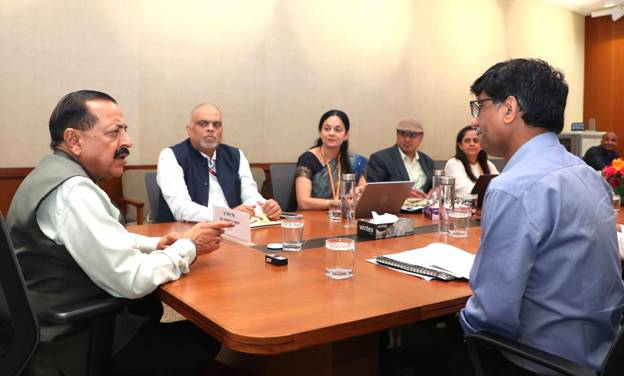
India’s ambitious National Quantum Mission has recorded a major breakthrough, achieving a 1,000-kilometre secure quantum communication network in less than three years since its launch, Union Minister for Science and Technology Jitendra Singh announced following a high-level review of the Department of Science and Technology (DST).
The milestone places India among global leaders in quantum communication, as the demonstrated network is one of the longest quantum key distribution (QKD) deployments in the world. Notably, the achievement comes well ahead of the mission’s long-term goal of building a 2,000-km quantum communication network over an eight-year period.
The breakthrough has been enabled using indigenous technology developed by QNu Labs, a startup supported under the National Quantum Mission. The company specializes in quantum-safe cybersecurity solutions, a critical requirement in an era of rising cyber threats and data vulnerabilities.
Reviewing the progress, DST Secretary Abhay Karandikar described the achievement as a “landmark advancement in secure quantum communication,” highlighting that the mission is progressing ahead of schedule. The development is expected to significantly enhance secure communication capabilities across key sectors such as defence, financial systems, and critical infrastructure.
Officials noted that the quantum communication technology developed under the mission is designed to function across challenging terrains, including underwater and underground environments. This expands its potential applications beyond strategic sectors to civilian infrastructure, strengthening India’s broader digital security ecosystem.
In parallel with this technological milestone, the government has stepped up efforts to strengthen the country’s quantum innovation ecosystem. Support under the National Quantum Mission has now been extended to nine additional startups, taking the total number of supported ventures to 17.
The newly backed startups are working across cutting-edge domains such as quantum computing, communication, sensing, and advanced materials. These include ventures like Sense-XT, ORVISSEMI, QuBeats, Quantum AI Global, bloq, GDQ Labs, Quantum Biosciences, Bumble Bee Instruments Pvt. Ltd., and SAS Qute Electronics Pvt. Ltd. Their research spans diverse applications including quantum biosensors for disease detection, photon sensing technologies, quantum positioning systems, atomic memory, and precision electronics.
The review meeting also assessed progress under the Research, Development and Innovation (RDI) funding framework, which aims to accelerate deep-tech innovation through structured financial support. Under this framework, key agencies such as the Technology Development Board and the Biotechnology Industry Research Assistance Council are acting as second-level fund managers.
The Technology Development Board (TDB) has received over 100 proposals within just two months of issuing its call for applications, indicating strong industry interest in government-backed R&D funding. Of these, six companies have already been recommended by the investment committee for further support, while additional proposals are currently under evaluation.
Similarly, the biotechnology segment is witnessing significant traction. The Biotechnology Industry Research Assistance Council (BIRAC) has received nearly 200 applications under recent calls, covering critical areas such as cancer research, gene therapy, and bio-manufacturing. This surge in applications reflects growing confidence among innovators and researchers in India’s evolving deep-tech funding ecosystem.
Officials also emphasized the introduction of innovative financial instruments such as optionally convertible debt (OCD). These instruments are designed to support startups without immediate equity dilution, while also attracting private investment alongside public funding. The approach aims to strike a balance between fostering innovation and ensuring scalability across emerging sectors.
During the review, Dr. Jitendra Singh stressed the importance of transparency, structured evaluation mechanisms, and wider outreach to improve participation in government-backed R&D initiatives. He also called for a coordinated communication strategy to better showcase India’s scientific achievements, including the recent quantum milestone, on the global stage.
Senior officials present at the meeting included DST Secretary Dr. Abhay Karandikar, TDB Secretary Rajesh Kumar Pathak, and BIRAC Managing Director Dr. Jitendra Kumar.
The latest developments come amid a broader policy push by the government to strengthen India’s capabilities in deep technology sectors through mission-mode programmes, blended financing models, and startup support frameworks. With rapid progress in quantum technologies, alongside advancements in biotechnology, space, and advanced communications such as 6G, India is positioning itself as a key player in the global innovation landscape.