
Amaravati Declared Sole and Permanent Capital of Andhra Pradesh as Centre Notifies Amendment Act in Gazette

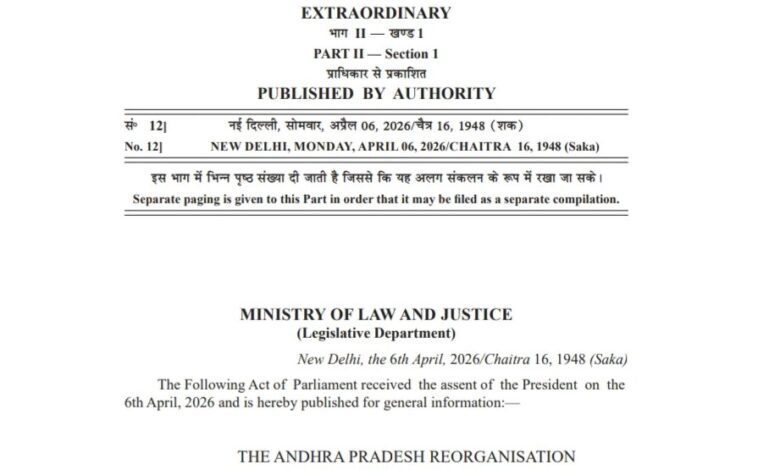
In a landmark development that resolves years of political uncertainty over the state’s administrative headquarters, the Union Government on Monday published the Andhra Pradesh Reorganisation (Amendment) Act, 2026 in The Gazette of India (Extraordinary, Part II, Section 1). The notification, issued by the Ministry of Law and Justice, formally designates Amaravati as the sole and permanent capital of Andhra Pradesh, granting it statutory recognition with retrospective effect from June 2, 2024.
The Act (No. 7 of 2026) received the assent of President Droupadi Murmu on April 6, 2026, following its swift passage in Parliament. The Lok Sabha cleared the bill on April 1 by voice vote, and the Rajya Sabha approved it on April 2. This legislative move amends Section 5 of the Andhra Pradesh Reorganisation Act, 2014, which had originally provided for Hyderabad as the common capital for both Andhra Pradesh and Telangana for a period not exceeding ten years, after which the successor state of Andhra Pradesh was to have “a new capital” without specifying its name or location.
Key Provisions of the Amendment
Under the new law:
- In sub-section (2) of Section 5, the phrase “and there shall be a new capital” has been substituted with “and Amaravati shall be the new capital.”
- A new Explanation 2 has been inserted, clarifying that the expression “Amaravati” includes the capital city areas notified under the provisions of the Andhra Pradesh Capital Region Development Authority (APCRDA) Act, 2014.
The Act is deemed to have come into force on June 2, 2024 — the day the ten-year common capital arrangement with Hyderabad officially ended. This retrospective effect provides legal certainty and prevents future disputes over the capital’s status.
The move stems from a resolution passed by the Andhra Pradesh Legislative Assembly on March 28, 2026, requesting the Centre to incorporate “Amaravati” explicitly into the 2014 Act for statutory clarity. The Statement of Objects and Reasons in the bill highlighted that the state government had already identified and notified Amaravati as the new capital after due planning and consultation following the 2014 bifurcation.
Political and Historical Context
The capital debate in Andhra Pradesh has been contentious since the state’s bifurcation in 2014. The previous YSR Congress Party (YSRCP) government, led by Y.S. Jagan Mohan Reddy, had proposed a “three-capitals” model — with Amaravati as the legislative capital, Visakhapatnam as the executive capital, and Kurnool as the judicial capital — citing decentralisation. This faced strong opposition from farmers in the Amaravati region, who had given up fertile lands for the greenfield capital project, as well as from the Telugu Desam Party (TDP) and other stakeholders who viewed it as diluting Amaravati’s status.
The return of the TDP-led NDA alliance to power in 2024, with N. Chandrababu Naidu as Chief Minister, revived the focus on developing Amaravati as the unified capital. Naidu’s government argued that a single, well-planned capital was essential for administrative efficiency, investment attraction, and fulfilling the aspirations of landowners who had contributed to the project.
Reactions from Leaders
Chief Minister N. Chandrababu Naidu welcomed the notification enthusiastically. In a post on X (formerly Twitter), he stated: “On behalf of the people of Andhra Pradesh, I convey my heartfelt gratitude to President Droupadi Murmu for giving her assent to the Andhra Pradesh Reorganisation (Amendment) Act, 2026, thereby realizing the long-cherished dream of our capital.” He also thanked Prime Minister Narendra Modi and the Union Government for their support.
Andhra Pradesh BJP president P.V.N. Madhav described the development as a “historic victory” that grants permanent recognition to Amaravati. Leaders from the Jana Sena Party and other alliance partners echoed similar sentiments, calling it a fulfilment of the people’s mandate.
Opposition parties, including YSRCP, staged a walkout during the Rajya Sabha proceedings, expressing reservations. Critics had earlier raised concerns about the lack of detailed provisions on farmer compensation and development timelines in the bill itself, though the state government has maintained that infrastructure work in Amaravati is progressing.
Significance and Way Forward
This amendment provides legal insulation to Amaravati against future political reversals, offering stability for large-scale investments in infrastructure, governance institutions, and urban development. Amaravati, envisioned as a world-class greenfield capital on the banks of the Krishna River, was originally designed with modern architecture, sustainable planning, and integrated townships.
With statutory backing now in place, the state government is expected to accelerate development activities, including the construction of the Assembly, Secretariat, and other key facilities. The clarification that “Amaravati” encompasses areas notified under the APCRDA Act ensures that the entire capital region remains covered under the legal definition.
The notification marks the end of a prolonged chapter of uncertainty that began with the 2014 bifurcation and had significant political, economic, and emotional ramifications for the people of Andhra Pradesh. It is seen as a major boost for the state’s growth trajectory under the current dispensation.
As the government moves ahead with implementation, focus will likely shift to ensuring inclusive development, addressing any pending issues related to land and rehabilitation, and positioning Amaravati as a vibrant administrative and economic hub for the state.