
Western Disturbances to Trigger Widespread Rain, Hailstorms Across India Till April 8; Temperatures to Stay Below Normal

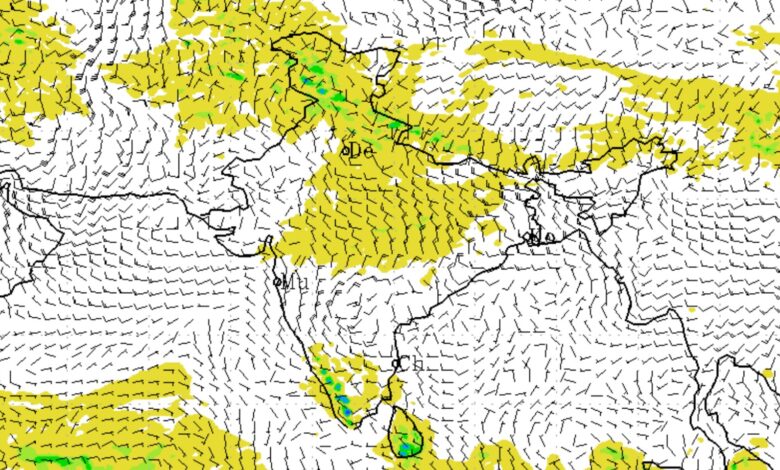
The India Meteorological Department (IMD) has forecast an extended spell of rain, thunderstorms, and hailstorms across large parts of the country under the influence of active western disturbances, with significant weather activity expected to continue till April 8.
According to IMD, a strong western disturbance is currently affecting northwest India, bringing widespread rainfall and hailstorm activity on April 4. Another fresh western disturbance is expected to impact the region from April 7, with peak intensity likely on April 7 and 8. Isolated heavy rainfall is also predicted over the Kashmir Valley on April 4.
Rainfall & Weather Activity Forecast (Till April 8)
| Region | Key Forecast |
|---|---|
| Northwest India | Rain, thunderstorms, gusty winds, hailstorms; peak activity on April 7–8 |
| Central India | Thunderstorms, lightning, isolated hailstorms (April 4) |
| East India | Rain with thunderstorms; hailstorms in Bihar, West Bengal, Jharkhand (April 5–8) |
| Peninsular India | Rain, lightning, gusty winds till April 8 |
| Northeast India | Rain and thunderstorms; heavy rainfall in Arunachal Pradesh, Assam & Meghalaya |
Hailstorm activity is likely over parts of Maharashtra, Madhya Pradesh, Chhattisgarh on April 4, and over Bihar, West Bengal, Sikkim, and Jharkhand between April 5 and April 8.
Recent Weather: Heavy Rain, Strong Winds Recorded
Over the past 24 hours ending April 4 morning, several regions witnessed intense weather activity:
- Heavy rainfall (7–11 cm) was recorded in parts of Interior Karnataka
- Hailstorms were reported in Rajasthan, Himachal Pradesh, Haryana, West Uttar Pradesh, Madhya Pradesh, and Gujarat
- Thunderstorms with gusty winds reaching 50–80 kmph affected multiple states including Jammu & Kashmir, Punjab, Delhi, Bihar, Odisha, and Tamil Nadu
The highest wind speeds were recorded at 67 kmph in Jharkhand and West Uttar Pradesh, indicating strong squall conditions.
Temperature Trends Across India
| Parameter | Observation |
|---|---|
| Maximum Temperature | Mostly between 34°C–40°C |
| Highest Temperature | 41.6°C at Jharsuguda (Odisha) |
| Minimum Temperature | 12°C–25°C across plains |
| Lowest Minimum | 14.6°C at Bathinda (Punjab) |
IMD stated that day temperatures will remain normal to below normal across most parts of the country for the next seven days, providing relief from extreme heat conditions.
Weather Systems Behind the Activity
Meteorologists attribute the ongoing weather to multiple systems:
- A western disturbance over Pakistan and adjoining regions
- Cyclonic circulations over Punjab, Chhattisgarh, and coastal Andhra Pradesh
- An incoming western disturbance expected from April 7
These systems are driving widespread instability, leading to rain, thunderstorms, and hailstorms across regions.
Delhi-NCR Weather Forecast (April 4–7)
| Date | Forecast |
|---|---|
| April 4 | Cloudy skies, light rain, thunderstorms, winds up to 40 kmph |
| April 5 | Partly cloudy, possible thunderstorm activity |
| April 6 | Partly cloudy, mild conditions |
| April 7 | Rain, thunderstorms, strong winds up to 50 kmph |
Temperatures in Delhi are expected to remain below normal, with maximum temperatures ranging between 29°C and 32°C.
Warnings & Possible Impact
IMD has issued alerts for thunderstorms, hailstorms, and gusty winds, warning of:
- Damage to standing crops and horticulture
- Uprooting of trees and disruption of power lines
- Localised waterlogging and traffic disruptions
- Risk of injury to people and livestock due to hail
Advisory for Public & Farmers
Authorities have advised people to:
- Stay indoors during thunderstorms and avoid shelter under trees
- Secure loose objects and unplug electrical appliances
- Avoid travel during severe weather conditions
Farmers have been advised to:
- Harvest mature crops and store them safely
- Use protective measures like hail nets
- Ensure proper drainage in fields to prevent waterlogging
Fishermen Warning
Fishermen have been advised to avoid venturing into parts of the Arabian Sea, including the Gulf of Oman and Gulf of Khambhat, between April 6 and April 8 due to rough weather conditions.