PM Modi to Flag Off India’s First Hydrogen Train on July 17; World’s Longest High-Capacity Hydrogen Train Marks Green Mobility Milestone

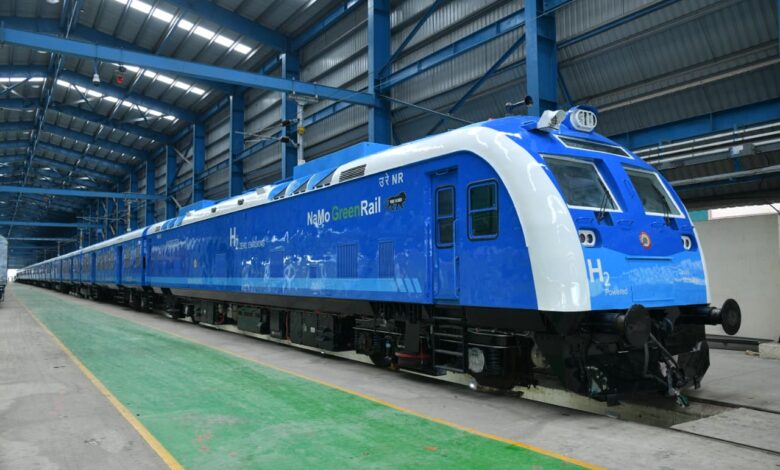
Prime Minister Narendra Modi will flag off India’s first Hydrogen Fuel Cell Powered Train between Jind and Sonipat in Haryana on July 17, marking a historic milestone in the country’s journey towards sustainable and zero-emission rail transportation. The hydrogen-powered train, developed entirely with indigenous technology, is among the world’s longest and most powerful hydrogen passenger trains and represents a significant leap in India’s clean energy ambitions.
The inauguration of the hydrogen train will be one of the highlights of the Prime Minister’s visit to Haryana, Chandigarh and Punjab, during which he will launch and dedicate development projects worth nearly ₹25,000 crore. In Jind alone, projects worth around ₹14,700 crore will be inaugurated or have their foundation stones laid.
The hydrogen train is expected to redefine rail mobility in India by replacing conventional fossil fuel-based propulsion with hydrogen fuel cell technology. Unlike diesel locomotives that burn fuel to generate mechanical power, the new train produces electricity onboard through a chemical reaction between hydrogen and oxygen inside Proton Exchange Membrane (PEM) fuel cells. The electricity generated powers the traction motors, while the only by-product released into the atmosphere is water vapour, resulting in zero carbon emissions during operation.
Officials said the train has been designed, engineered and integrated in India using indigenous technology, demonstrating the country’s growing capability in advanced railway engineering. With the introduction of this train, India joins a select group of nations operating hydrogen-powered passenger trains, alongside countries such as Germany, France, Italy and Japan.
One of the biggest achievements of the project is its scale. While hydrogen trains operating in several countries generally consist of only two to four coaches, the Indian Railways hydrogen train features a 10-coach configuration capable of carrying around 2,600 passengers. Powered by a robust 3,200-horsepower propulsion system, it is among the world’s most powerful hydrogen-powered passenger trainsets.
The train will initially operate between Jind and Sonipat in Haryana, serving as a demonstration project for hydrogen-powered rail transportation under regular operating conditions. The project is expected to provide valuable operational experience for future expansion of hydrogen technology across the Indian Railways network.
Hydrogen fuel cell technology offers several environmental advantages over conventional diesel-powered trains. Since electricity is generated onboard, the train does not require continuous overhead electrification infrastructure like traditional electric trains. At the same time, it eliminates harmful exhaust emissions, significantly reduces dependence on imported fossil fuels and operates with much lower noise levels. The use of green hydrogen also supports India’s efforts to reduce reliance on electricity generated from coal-based thermal power plants, contributing to the country’s broader climate goals.
The launch of the hydrogen train aligns with the Government of India’s National Green Hydrogen Mission, which aims to position the country as a global leader in green hydrogen production and utilisation. Indian Railways has already electrified more than 99 percent of its Broad Gauge network, and hydrogen technology is expected to complement electrification by providing a clean alternative for routes where conventional electrification may not be practical or economical.
Beyond the hydrogen train, Prime Minister Modi will dedicate several major infrastructure projects in Haryana. These include National Highway projects worth over ₹12,470 crore, aimed at strengthening road connectivity and boosting economic development across the state.
Among the key highway projects is the inauguration of the 157.92-kilometre fully access-controlled Delhi-Amritsar-Katra Expressway (Packages 1 to 5), built at a cost of approximately ₹9,680 crore. The expressway is expected to reduce travel time between Delhi and Katra from around 14 hours to nearly six hours, while cutting the Delhi-Amritsar journey from about eight hours to four hours. It will also ease congestion on NH-44 and improve connectivity for pilgrims travelling to Shri Mata Vaishno Devi.
The Prime Minister will also dedicate the Ambala-Kala Amb Highway and the Jind-Gohana Greenfield Highway, both of which are expected to improve regional connectivity, facilitate industrial growth and reduce logistics costs. Additionally, the foundation stone will be laid for the Hansi-Barwala Highway project, while the elevated railway track at Kurukshetra will also be dedicated to the nation to eliminate traffic congestion at railway crossings and improve both road and rail movement.
Healthcare and education will also receive a major boost during the visit. Prime Minister Modi will dedicate Pandit Neki Ram Sharma Government Medical College in Bhiwani and Maharishi Chyawan Medical College along with Rao Tula Ram Hospital in Narnaul. These institutions are expected to strengthen medical education, increase MBBS seats and improve access to quality healthcare services in Haryana.
A significant cultural initiative will also be launched with the foundation stone of the Sikh Museum at Kurukshetra. The museum will showcase the history, teachings, courage and sacrifices of the Sikh Gurus while highlighting the invaluable contribution of the Sikh community to India’s civilisation and cultural heritage through modern exhibition technology.
Later in the day, the Prime Minister will travel to Chandigarh to inaugurate and lay the foundation stone of projects worth over ₹4,700 crore covering healthcare, education and road infrastructure. Among the major projects are the Advanced Mother and Child Centre and the Advanced Neurosciences Centre at PGIMER, Chandigarh, along with the foundation stone for a 150-bed Critical Care Block under the Pradhan Mantri Ayushman Bharat Health Infrastructure Mission. Several educational infrastructure projects and major highway developments around Chandigarh will also be launched.
The final leg of the Prime Minister’s visit will be in Jalandhar, Punjab, where rail and road infrastructure projects worth over ₹5,470 crore will be inaugurated or have their foundation stones laid. A major highlight will be the inauguration of 75 redeveloped railway stations across 20 states under the Amrit Bharat Station Scheme, including Jalandhar Cantt station. Developed at a cost of about ₹1,570 crore, these stations have been transformed into modern, passenger-friendly facilities while preserving local culture and architectural heritage.
Prime Minister Modi will also inaugurate the Daulatpur Chowk-Kartoli new railway line, flag off the Kartoli-Ambala train service and launch the Amritsar (Chheharta)-Varanasi train service, further strengthening rail connectivity across Punjab, Haryana and Himachal Pradesh. In addition, National Highway projects worth over ₹3,070 crore, including the final package of the Delhi-Amritsar-Katra Expressway and the Southern Ludhiana Bypass, will also be launched to improve connectivity and support regional economic growth.
The flagging off of India’s first Hydrogen Fuel Cell Powered Train is expected to become one of the defining milestones in the country’s transport sector, signalling the beginning of a new era of clean, sustainable and technologically advanced railway operations. By combining indigenous innovation with green energy, Indian Railways aims to set new benchmarks in environmentally responsible transportation while supporting India’s long-term vision of achieving net-zero emissions.