Indian Railways Announces Eight Major Structural Reforms to Transform Freight, Logistics and Project Execution

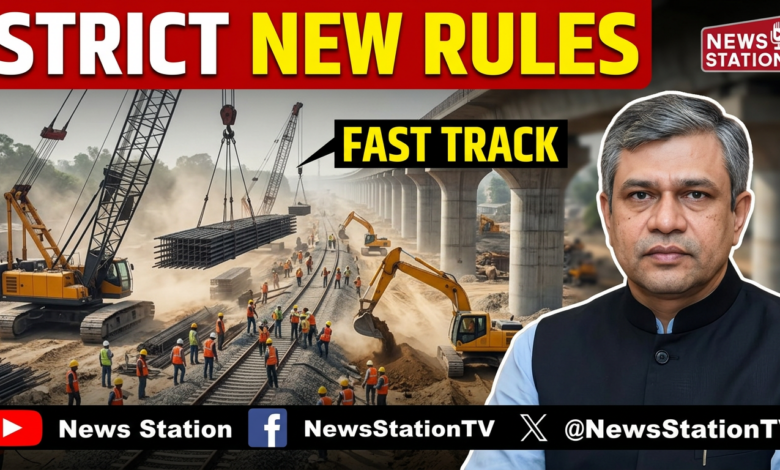
Union Railway Minister Ashwini Vaishnaw on Monday unveiled eight new structural reforms under the Indian Railways’ ambitious “Reform Express” initiative, taking the total number of reforms implemented so far to 17. The latest measures are aimed at modernising freight transportation, reducing logistics costs, improving project execution, promoting private sector participation, encouraging innovation, and supporting environmentally sustainable transport.
Addressing a press conference at Rail Bhawan, Vaishnaw said the reforms form part of the Ministry’s larger roadmap of implementing 52 reforms in 52 weeks to build a future-ready railway system. He noted that the reforms introduced earlier under the initiative have already begun delivering positive results and that the new policy measures would significantly strengthen India’s freight ecosystem and railway infrastructure.
One of the major announcements was a new policy for the containerised transportation of fly ash. India generates nearly 340 million tonnes of fly ash annually, but only a small portion is currently transported by rail. Traditionally, fly ash has been moved in open wagons, leading to severe dust pollution during loading, transit and unloading.
Under the new policy, Indian Railways will use specially designed ISO-standard closed containers that can be loaded directly at thermal power plants and unloaded through side-discharge or pneumatic systems without causing dust pollution. The Minister said the new system will improve environmental sustainability, allow safer storage at cement plants, reduce dependence on road transport and enhance logistics efficiency by enabling seamless end-to-end movement using reach stackers.
Another significant reform relates to the container train operator licensing framework. Indian Railways has abolished the earlier four-category licensing system and replaced it with a single unified Pan-India Container Train Operator licence. Under the new framework, operators will be able to run container trains across the national railway network without route-based restrictions.
The registration process has also been simplified through a uniform non-refundable registration fee of ₹25 crore. Licences will remain valid for twenty years and can subsequently be extended without any renewal fee, subject to satisfactory operations. According to Vaishnaw, the simplified framework will improve ease of doing business, attract greater private investment, encourage containerisation and help shift more non-bulk cargo to rail transport.
Indian Railways has also introduced a major reform in fertilizer transportation, an area where the railways currently handle nearly 85 per cent of the country’s freight movement. The complex freight charging system consisting of nearly fifty different slabs has now been replaced with a simplified per tonne per kilometre tariff structure.
The policy also allows fertilizers to be transported in containers. Instead of waiting for an entire rake to be unloaded at a single destination, individual containers can now be unloaded and distributed according to local demand. This is expected to improve wagon turnaround, reduce detention of rakes, protect fertilizers from weather damage and provide greater flexibility in supply chain management.
Recognising the importance of skilled manpower in railway infrastructure projects, the Ministry has introduced a comprehensive artisan skilling policy. Workers engaged in safety-critical activities such as welding, fitting, masonry and specialised construction will undergo structured assessments and certification.
Successful candidates will receive QR code-enabled skill certificates linked to a live verification database. The policy will initially be implemented in complex infrastructure projects, including bridges and tunnels, before being expanded across all Zonal Railways and Production Units over the next two years. The initiative aims to improve workmanship, standardise skill assessment and strengthen quality assurance across railway projects.
Vaishnaw also announced another set of construction reforms designed to improve project execution and minimise disputes. Under the revised framework, contractors will now be required to deposit 10 per cent Performance Security at the beginning of the contract instead of through deductions from running bills.
The Ministry has also tightened eligibility norms by disqualifying contractors whose pending litigation exceeds 50 per cent of their net worth. In addition, Contractor’s All Risk Insurance and Professional Indemnity Insurance have been made mandatory to improve risk management during project execution.
A key feature of the reforms is the launch of the Rail Bhoomi digital platform, developed by CRIS for end-to-end management of railway land acquisition. The portal integrates multiple railway applications, including IRPSM, IPAS and HRMS, enabling online processing, workflow management, real-time monitoring and better coordination between land acquisition and project implementation. The system is expected to speed up land acquisition, reduce disputes and facilitate timely completion of railway infrastructure projects.
To promote innovation in freight transportation, Indian Railways has introduced a new wagon design approval policy. Previously, wagon designs were largely developed by the Research Designs and Standards Organisation (RDSO), limiting industry participation.
Under the revised policy, private manufacturers and designers will be able to develop specialised wagon designs suited to specific commodities. After prototype development, testing and safety certification, approved designs can be inducted into service. The Minister said the reform would encourage innovation and support specialised transportation for sectors including steel, petroleum, chemicals, plastics and milk.
The Ministry has also liberalised the petroleum products transportation sector by allowing oil companies to procure or lease specialised tank wagons instead of relying exclusively on railway-owned wagons. This is expected to improve logistics planning, reduce transportation costs and minimise risks associated with road transportation, including product losses and adulteration.
Similarly, Indian Railways has simplified freight charges for the transportation of foodgrains, flour and pulses by introducing a per tonne per kilometre tariff structure and promoting containerised movement. Containers can now be stored at the premises of sellers or buyers and unloaded according to operational requirements without detaining an entire rake. Since the containers remain sealed throughout transportation, the reform is expected to reduce contamination while improving supply chain efficiency.
Highlighting the broader vision behind the initiative, Vaishnaw said the reforms are intended to shift a larger share of freight traffic from road to rail, significantly lowering logistics costs while delivering major environmental benefits. He noted that rail transport generates nearly 90 per cent lower carbon emissions than road transport and said gradual containerisation of more commodities would diversify Indian Railways’ freight portfolio beyond traditional bulk cargo and strengthen its long-term freight business.