Government Raises Financial Powers for CGHS Medical Reimbursement Claims; Major Reform to Speed Up Settlements

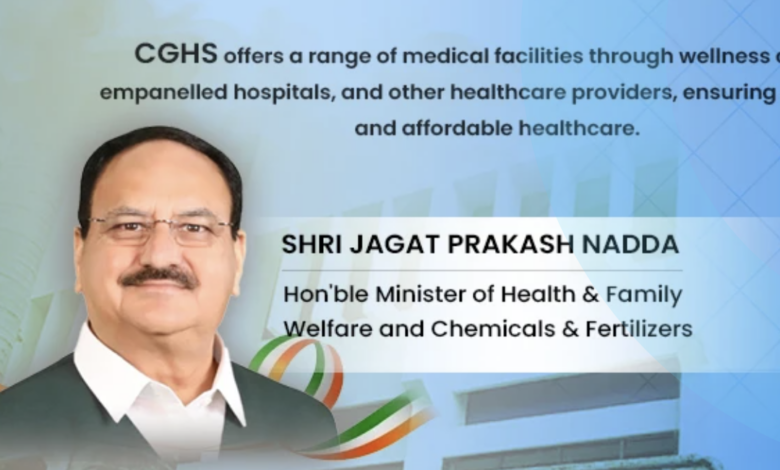
In a significant move aimed at improving healthcare services for Central Government Health Scheme (CGHS) beneficiaries, the Ministry of Health and Family Welfare (MoHFW) has substantially enhanced the financial powers of senior CGHS officials for the settlement of medical reimbursement claims and grant of approvals for treatments and investigations. The decision marks the first major revision in the delegation of financial powers in nearly a decade and is expected to considerably reduce delays in processing reimbursement cases.
The revised powers have been notified through an Office Memorandum issued by the Ministry of Health and Family Welfare on June 25, 2026.
The reform comes as part of the government’s broader initiative to modernize the CGHS ecosystem, streamline procedures, and provide faster, more efficient services to pensioners, serving employees, and other eligible beneficiaries.
Major Increase in Financial Powers
Under the revised delegation, the financial limits for approving medical reimbursement claims and hospital bills at approved rates have been substantially increased.
| Competent Authority | Existing Power | Revised Power |
|---|---|---|
| Additional Director, CGHS City/Zone | ₹7 lakh | ₹15 lakh |
| Director, CGHS | ₹15 lakh | ₹25 lakh |
| Additional Secretary & Director General, CGHS | ₹25 lakh | ₹50 lakh |
Cases involving reimbursement claims exceeding ₹50 lakh will continue to be referred to the Ministry of Health and Family Welfare for approval, with the concurrence of the Integrated Finance Division (IFD).
Officials believe that increasing the approval limits will significantly reduce the number of cases requiring referral to higher authorities, thereby shortening processing times and enabling quicker reimbursement to beneficiaries.
Relief for Patients Undergoing Specialized Treatments
The Ministry has also enhanced the financial powers related to unlisted investigations, procedures, and implants where CGHS package rates or ceiling rates are not available.
The revised limits are as follows:
| Competent Authority | Existing Power | Revised Power |
|---|---|---|
| Additional Director, CGHS City/Zone | Up to ₹1 lakh | Up to ₹2 lakh |
| Director, CGHS | Up to ₹3 lakh | Up to ₹5 lakh |
| Additional Secretary & DG, CGHS | Up to ₹5 lakh | Up to ₹10 lakh |
Cases exceeding ₹10 lakh in such categories will continue to require approval from the Ministry along with the concurrence of the Integrated Finance Division.
The decision is expected to provide major relief to patients undergoing complex treatments, advanced diagnostic procedures, or requiring high-cost implants that are not covered under standard CGHS package rates.
Faster Approvals for Non-Empanelled Hospitals
The Ministry has also revised provisions regarding permissions and ex-post facto approvals for treatments and investigations conducted in non-empanelled hospitals and diagnostic centres.
Under the new guidelines, requests for permission or post-facto approval for elective treatment or investigations in non-empanelled hospitals concerning pensioners, former Members of Parliament, freedom fighters, serving CGHS employees and other beneficiaries will be considered by the Additional Director of the concerned CGHS city or zone.
However, reimbursement in such cases will remain restricted to either:
- CGHS package rates, or
- Actual expenditure incurred,
whichever is lower.
Relaxation in Procedural Requirements
The revised guidelines also address cases involving procedural lapses.
The Additional Director of the concerned CGHS city or zone has been empowered to consider requests for approval of elective treatments or investigations in empanelled hospitals or diagnostic centres even in situations where:
- There is no recommendation from a Government Specialist or Chief Medical Officer (CMO); or
- Prior permission was not obtained.
Again, reimbursement will be restricted to the lower of CGHS package rates or actual expenditure.
This provision is expected to provide relief to numerous beneficiaries whose reimbursement claims often get delayed or rejected due to procedural deficiencies despite the treatment being medically necessary.
Need for Reform
The Ministry stated that the matter had been reviewed in view of the need to enhance and rationalize financial delegations for the expeditious settlement of claims and related approvals under CGHS.
According to the Office Memorandum, the revision aims to:
- Streamline procedures;
- Reduce avoidable references to higher authorities;
- Facilitate timely disposal of cases;
- Improve efficiency in claim settlement;
- Strengthen service delivery mechanisms.
Over the years, CGHS beneficiaries have frequently expressed concerns regarding delays in reimbursement, particularly in cases involving high-value treatments and unlisted procedures.
Since the previous delegation of powers was issued in October 2016, the cost of healthcare and medical procedures has increased substantially. Consequently, many cases that could earlier be handled at lower administrative levels had to be escalated to higher authorities, causing delays and increasing administrative burden.
The revised financial powers are expected to address these challenges.
Conditions Governing the Revised Delegations
The Ministry has specified several conditions for exercising the revised powers.
No Relaxation of Rules
The revised delegations will not apply to cases involving relaxation of CGHS rules, irrespective of the amount involved.
Referral of High-Value Cases
Cases exceeding the prescribed monetary limits must continue to be referred to the Ministry of Health and Family Welfare with the concurrence of the Integrated Finance Division.
Restriction on Reimbursement
Reimbursement shall remain limited to:
- CGHS package rates,
- CGHS ceiling rates, where applicable, or
- Actual expenditure,
whichever is lower.
Cases Without CGHS Package Rates
Where no CGHS package rate or ceiling rate exists, reimbursement may be considered on actual expenditure, subject to:
- Admissibility under CGHS rules;
- Reasonableness of charges;
- Availability of supporting documents;
- Financial limits prescribed.
Requirement of Medical Records
All approvals will remain subject to:
- Availability of supporting medical records;
- Bills and invoices;
- Admissibility under CGHS rules;
- Reasonableness of charges;
- Budgetary provisions;
- Audit requirements.
No Precedent for Future Cases
The powers delegated under the revised guidelines are to be exercised on a case-to-case basis and shall not create any general entitlement or precedent.
Superseding Earlier Instructions
The revised delegations supersede earlier instructions on the subject to the extent of the new financial powers being conveyed.
Significance for CGHS Beneficiaries
The decision is expected to benefit lakhs of CGHS beneficiaries across the country, including:
- Central Government employees;
- Pensioners;
- Former Members of Parliament;
- Freedom fighters;
- Serving CGHS employees;
- Other eligible beneficiaries.
One of the major challenges faced by beneficiaries has been the long wait for reimbursement approvals, especially in cases involving expensive treatments, cancer therapies, organ transplants, cardiac procedures, and advanced medical interventions.
The enhanced financial powers will allow more cases to be settled at the city and zonal level itself, reducing dependence on the Ministry for approvals.
Officials say the measure will also reduce administrative bottlenecks and improve overall efficiency within the CGHS system.
Part of Larger CGHS Modernization Drive
The latest reform comes soon after the successful implementation of the CGHS Token Display System, which was introduced to streamline beneficiary services and improve patient management at wellness centres.
The Token Display System has significantly improved the experience of beneficiaries by:
- Reducing waiting time;
- Enhancing transparency;
- Streamlining patient flow;
- Improving service delivery.
The enhancement of financial powers is being viewed as another major step in the government’s broader effort to modernize the CGHS ecosystem through administrative reforms and technology-driven initiatives.
Experts believe that the combination of digital reforms and administrative decentralization could significantly transform the functioning of CGHS in the coming years.
Positive Response from Employee Associations
The Central Secretariat Service (CSS) Forum has welcomed the decision and described it as a landmark reform in the healthcare administration framework for Central Government employees and pensioners.
According to the Forum, the revision of financial powers will:
- Accelerate claim settlement;
- Reduce procedural delays;
- Improve beneficiary satisfaction;
- Strengthen service delivery.
The CSS Forum also expressed gratitude to Shri Manashvi Kumar, Joint Secretary (CGHS), for his leadership and sustained efforts toward modernizing and strengthening the CGHS ecosystem.
In a statement, the Forum said that the latest reforms demonstrate the government’s commitment to making healthcare administration more responsive, efficient, and beneficiary-centric.
A Long-Awaited Decision
Healthcare costs have risen significantly over the past decade, making the earlier financial ceilings increasingly inadequate. Stakeholders had repeatedly urged the government to revise the powers delegated to CGHS authorities so that reimbursement claims could be settled more quickly.
The new delegation of powers addresses this long-standing demand and is expected to have a substantial impact on reducing pendency and improving efficiency.
For thousands of pensioners and employees who often depend on timely reimbursement of high medical expenses, the decision could prove to be a major relief.
With the enhancement of approval powers and continued modernization initiatives, the CGHS appears to be moving towards a more decentralized, efficient, and beneficiary-friendly healthcare administration system.