60% Recycled Road Material Demonstrated on NH-716 in Major Push for Sustainable Highway Construction

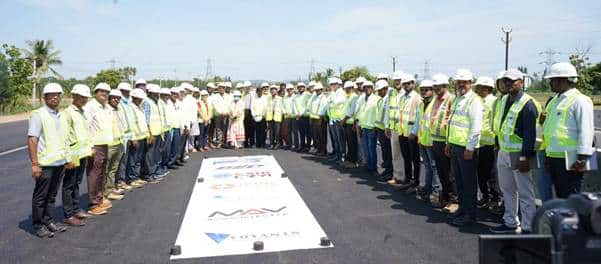
A major step towards making India’s highway construction more sustainable and resource-efficient has been achieved with the successful field-scale demonstration of 60% Reclaimed Asphalt Pavement (RAP) in the Dense Bituminous Macadam (DBM) layer of National Highway-716, part of the Chennai–Tirupati Package-I.
The demonstration was jointly carried out by the CSIR-Central Road Research Institute (CSIR-CRRI), Oriental Structural Engineers Private Limited (OSEPL), and Ooms Polymer Modified Bitumen Pvt. Ltd. (Ooms India). The trial is being seen as an important milestone in the development and practical application of high-RAP recycling technology under actual highway construction conditions.
Senior officials from the National Highways Authority of India (NHAI) and the Government of Tamil Nadu, along with representatives of highway infrastructure companies, researchers, technical experts and other industry stakeholders, attended the demonstration.
The field exercise was designed to showcase the complete process involved in converting material recovered from an existing road into a component of a new pavement. This included RAP recovery and processing, material characterisation, evaluation and rejuvenation of aged bitumen, mix design, hot-mix plant production, transportation, laying and field compaction.
Participants also visited the hot-mix plant to observe how the high-RAP mixture was produced. An Experience Centre was also established to demonstrate the complete journey of reclaimed asphalt, from recovery and processing to its incorporation into new pavement construction.
Existing Roads as a Resource Bank
Reclaimed Asphalt Pavement is generated when old asphalt pavement is removed or milled during road maintenance, rehabilitation or reconstruction. Rather than treating this material as construction waste, RAP can be processed and reused because it contains valuable aggregates and aged bitumen.
The 60% RAP demonstration seeks to show how a substantial proportion of material required for a new asphalt mix can come from an existing pavement.
Higher utilisation of RAP can potentially reduce the consumption of virgin aggregates and bitumen, both of which are important resources in conventional road construction. It can also help reduce the amount of old pavement material sent for disposal.
The concept effectively treats existing highways as a “resource bank”, where materials already embedded in the road network can be recovered and reused for future infrastructure.
Such an approach could become increasingly important as India continues to expand and upgrade its highway network while simultaneously seeking ways to reduce construction waste, conserve natural resources and improve the environmental performance of infrastructure projects.
Indigenous REJUBIT Technology
One of the key technological components of the NH-716 demonstration was REJUBIT, an indigenous RAP rejuvenator jointly developed by CSIR-CRRI and Ooms India.
Bitumen in old asphalt undergoes ageing over time, which changes its properties and can affect the performance of recycled asphalt if high quantities of RAP are used without appropriate treatment.
REJUBIT is designed to help restore important properties of aged bitumen contained in RAP, enabling a higher proportion of reclaimed pavement material to be incorporated into new asphalt mixes.
The successful use of the technology at NH-716 represents an important transition from laboratory-level research and evaluation towards field-scale application under real highway construction conditions.
CSIR-CRRI Highlights Importance of Recycling
Dr. Chalumuri Ravi Sekhar, Director, CSIR-CRRI, described the demonstration as an important development in sustainable and circular road construction.
He emphasised that RAP should not simply be regarded as waste because it contains valuable aggregates and bitumen that can be recovered, scientifically characterised, rejuvenated and reused.
According to CSIR-CRRI, the NH-716 trial is particularly significant because it brings together the entire recycling chain in one field application. The process begins with RAP recovery and characterisation and continues through aged-binder evaluation, rejuvenation, scientific mix design, hot-mix plant production and finally pavement laying and compaction.
The institute said such field demonstrations can help generate practical construction knowledge, build confidence among stakeholders and establish a stronger scientific basis for increasing the use of reclaimed materials in Indian road projects.
RAP Described as ‘Black Gold’
Dr. Ambika Behl, Senior Principal Scientist at CSIR-CRRI and project leader of the 60% RAP field demonstration, highlighted the resource value of reclaimed asphalt.
She described RAP as “black gold for the road sector”, pointing out that it contains two valuable non-renewable resources—aggregate and bitumen—that are already available within the existing road network.
The successful use of higher RAP content, she noted, depends on several technical factors, including proper characterisation of reclaimed material, assessment of aged binder properties, scientific mix design, suitable rejuvenation and strict quality control.
The NH-716 demonstration therefore goes beyond simply increasing recycled content. It provides an opportunity to evaluate how high-RAP mixes can be designed and produced while maintaining the necessary engineering and construction controls.
Industry Collaboration
The field trial was the result of collaboration between a government research institution, a highway construction company and a specialised bitumen technology provider.
Nagaraj, Senior CPM and Project Head at OSEPL, said the real test of an innovative pavement technology is whether it can successfully move beyond laboratory development into plant production and actual highway construction.
The 60% RAP trial provides an opportunity to evaluate high-RAP pavement construction at field scale while maintaining appropriate quality-control procedures, according to OSEPL.
Palash Kathal, Director of Ooms India, said greater RAP utilisation could help extract more value from aggregates and bitumen already contained in existing pavements while reducing dependence on virgin materials.
He also highlighted the importance of taking the technology through the entire chain—from laboratory assessment and mix design to hot-mix plant production and live highway laying.
Tamil Nadu Sees Potential for Wider Adoption
The demonstration was also welcomed by Tamil Nadu’s highway authorities.
Er. A. Venkatachalam, Director, Highway Research Station, Chennai, who was the chief guest, congratulated the organisations involved in the project and described the demonstration as an important milestone for sustainable and resource-efficient road construction in Tamil Nadu.
Tamil Nadu has an extensive road network, providing considerable potential for recovering and recycling materials from existing pavements. Greater reuse of such materials could help reduce demand for virgin aggregates and bitumen while also addressing construction waste.
The Highway Research Station expressed confidence that the field experience generated through the NH-716 trial could contribute to wider adoption of high-RAP recycling technology in suitable highway projects across the state.
Testing High-RAP Technology in Real Conditions
The 60% RAP trial section was executed under the technical guidance of CSIR-CRRI. Dr. Ambika Behl, Scientist F at CSIR-CRRI, led the project, while Dr. Rajiv Kumar, Scientist E1, was involved in the design and construction of the trial section alongside teams from Ooms India and OSEPL.
The objective is not only to demonstrate that high RAP content can be incorporated into asphalt mixes, but also to build a technical and field-level evidence base for its responsible expansion.
As India continues to invest heavily in highways, expressways and road upgrades, technologies that enable existing construction materials to be reused could become increasingly important.
The NH-716 demonstration therefore represents more than a single road trial. It highlights a potential shift in highway construction—from a predominantly linear model of extracting virgin resources, building roads and disposing of old pavement towards a circular model in which existing roads become sources of material for future infrastructure.
The successful field-scale demonstration of 60% RAP, supported by indigenous rejuvenation technology and collaboration between research and industry, could provide an important foundation for greener and more resource-efficient highway construction in India.