Railways Plans 3rd and 4th Line on Ghaziabad–Sitapur Corridor to Boost Capacity and Connectivity

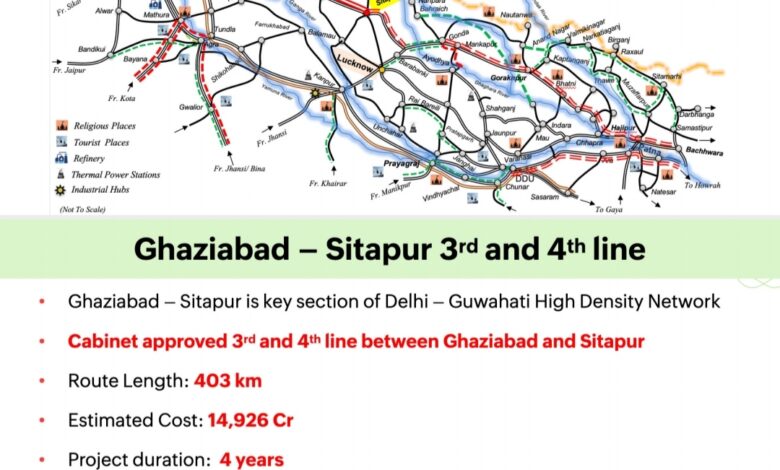
In a major step toward strengthening rail infrastructure and easing congestion on one of North India’s busiest corridors, Indian Railways has proposed the construction of third and fourth railway lines on the Ghaziabad–Sitapur section, spanning approximately 403 kilometres. The project is part of the Delhi–Guwahati High Density Network (HDN-4) and is aimed at significantly enhancing connectivity between northern and eastern regions of the country.
The Ghaziabad–Sitapur route is currently a double-line section and plays a critical role in passenger and freight movement. However, with line capacity utilization already reaching up to 168 per cent, the corridor is operating well beyond its optimal limits. Officials estimate that without expansion, capacity utilization could rise further to 207 per cent in the coming years, leading to severe congestion and delays.
The proposed multi-tracking project is expected to address these challenges by increasing line capacity, improving operational efficiency, and enabling smoother movement of both passenger and freight trains. The route traverses several key districts of Uttar Pradesh, including Ghaziabad, Hapur, Amroha, Moradabad, Rampur, Bareilly, Shahjahanpur, Lakhimpur Kheri, and Sitapur.
Apart from improving passenger connectivity, the corridor is vital for industrial freight movement. The alignment passes through several prominent industrial hubs such as Ghaziabad, known for machinery, electronics, and pharmaceutical industries; Moradabad, famous for its brassware and handicrafts; Bareilly, a centre for furniture, textiles, and engineering goods; Shahjahanpur, which hosts carpet and cement-related industries; and Roza, home to a major thermal power plant. The enhanced rail capacity is expected to provide a significant boost to industrial logistics and regional economic growth.
To ensure seamless train operations and reduce bottlenecks, the project includes plans to bypass some of the most congested stations along the route, including Hapur, Simbhaoli, Moradabad, Rampur, Bareilly, Shahjahanpur, and Sitapur. As part of these bypass arrangements, six new railway stations are proposed to be constructed, facilitating better traffic management and improved passenger convenience.
The project is also expected to support tourism and religious travel, as the route connects or passes near several important destinations. These include Dudheshwarnath Temple, Garhmukteshwar Ganga Ghat, Dargah Shah Wilayat Jama Masjid, and Naimisharanya, among others. Improved rail connectivity is likely to increase tourist footfall and facilitate easier access for pilgrims.
From a freight perspective, the upgraded corridor is projected to handle an additional 35.72 million tonnes per annum (MTPA) of goods traffic. Key commodities expected to be transported include coal, foodgrains, chemical fertilisers, finished steel, and other essential materials. This increased freight capacity will play a crucial role in supporting industrial supply chains and ensuring efficient distribution of goods across regions.
The total estimated cost of the project stands at approximately ₹14,926 crore. In addition to infrastructure development, the project is expected to generate significant employment, with an estimated 274 lakh human-days of work during its execution phase.
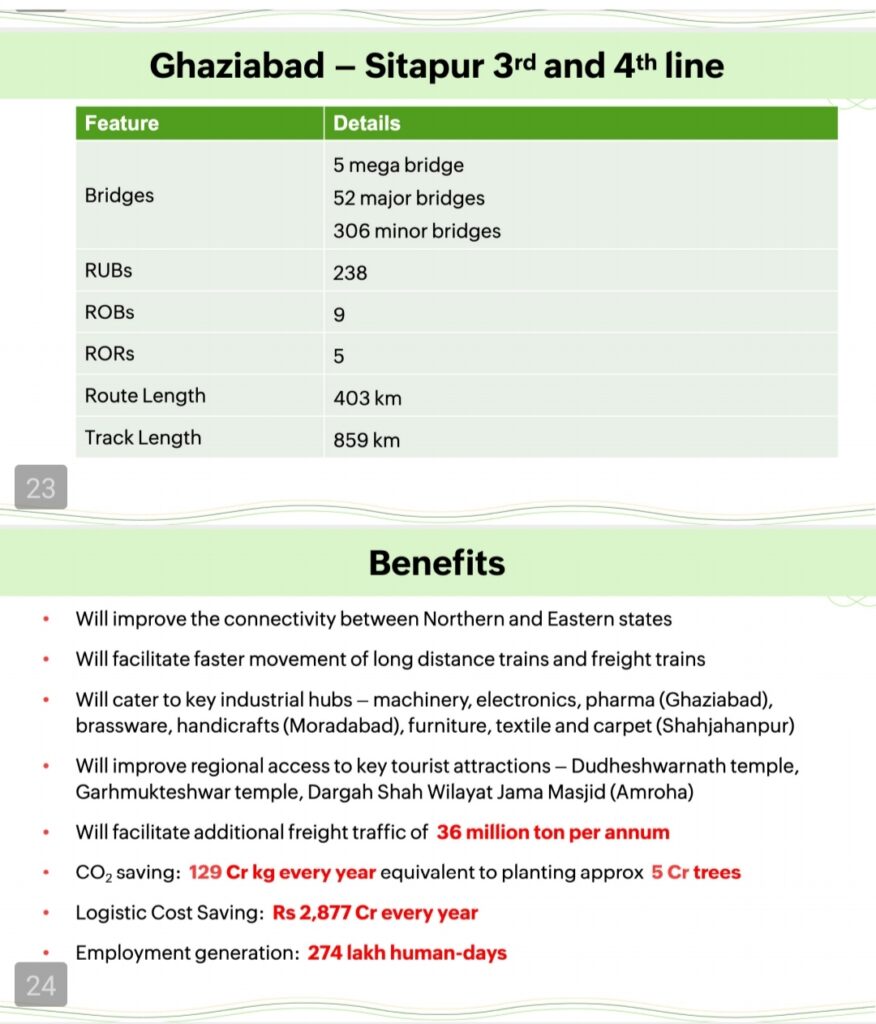
Environmental benefits also form a key component of the project’s impact. By shifting a substantial portion of freight traffic from road to rail, the initiative is expected to reduce carbon emissions by around 128.77 crore kilograms of CO2. This reduction is equivalent to the environmental benefit of planting approximately 5.15 crore trees, making the project an important contributor to sustainable transportation.
Moreover, the enhanced rail network is projected to yield substantial savings in logistics costs. Estimates suggest that the project could save nearly ₹2,877.46 crore annually compared to road-based transportation, thereby improving overall economic efficiency.
With its focus on capacity expansion, economic growth, environmental sustainability, and improved connectivity, the Ghaziabad–Sitapur third and fourth line project is poised to become a key milestone in India’s railway modernization efforts.