PM Modi Revisits ‘Fragile Five’ Era, Highlights India’s Economic Transformation

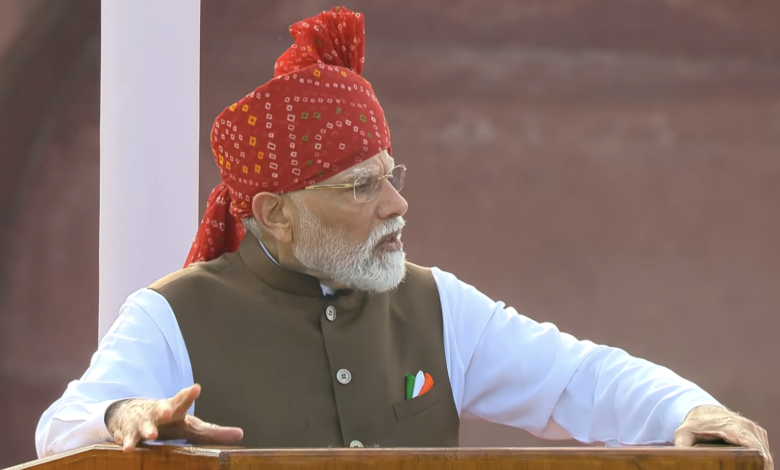
New Delhi: Prime Minister Narendra Modi, in his 80th Independence Day address from the Red Fort on August 15, 2026, revisited the widely cited “Fragile Five” label to highlight India’s economic transformation over the past decade.
The “Fragile Five” term was coined by Morgan Stanley in 2013 to describe five emerging-market economies considered particularly vulnerable to external financial shocks — Brazil, India, Indonesia, South Africa and Turkey. India’s inclusion came at a time when the economy was facing significant macroeconomic pressures, including high inflation, a weakening rupee, a large current account deficit and dependence on foreign capital.
The backdrop was the US Federal Reserve’s decision to signal a gradual withdrawal, or tapering, of its massive bond-buying programme. The prospect of tighter global liquidity triggered capital outflows from several emerging markets, placing additional pressure on currencies and financial markets.
India was particularly vulnerable because of its sizeable current account deficit, which had reached around 5 per cent of GDP during the 2012–13 period. The deficit reflected the country’s heavy import bill, particularly for crude oil and gold, compared with its export earnings. At the same time, elevated inflation, slowing economic growth and pressure on the rupee added to concerns over the country’s external position.
The combination of fiscal and current account pressures, often referred to as the “twin deficits”, along with dependence on foreign portfolio capital, made India susceptible to sudden changes in global investor sentiment. As international investors moved money towards safer assets and the US dollar, the rupee came under severe pressure and concerns over India’s foreign-exchange position intensified.
The “Fragile Five” label subsequently became a powerful reference point in India’s economic and political discourse. Prime Minister Modi has repeatedly referred to the term as a symbol of the economic vulnerabilities that existed before 2014. In his latest Independence Day address, he contrasted that period with India’s subsequent economic progress and said the efforts of the past 12 years had helped the country acquire new momentum.
India’s economic position began changing after the 2013 episode. The country took several measures to contain external vulnerabilities, including steps to moderate gold imports. A subsequent decline in global crude oil prices also helped reduce the import burden. At the same time, strong services exports and remittance inflows provided support to the external account.
India’s foreign-exchange reserves also increased substantially over the following years, providing a larger buffer against external shocks. The current account deficit narrowed considerably from the elevated levels seen during the 2012–13 period, although it has continued to fluctuate depending on global commodity prices, domestic demand and international economic conditions.
Alongside these changes, India undertook a series of structural reforms aimed at improving the functioning and competitiveness of the economy. The introduction of the Goods and Services Tax (GST) sought to create a more unified domestic market, while the Insolvency and Bankruptcy Code was aimed at addressing stressed assets and improving the resolution of corporate insolvencies.
The government also accelerated digitisation, infrastructure development and efforts to strengthen domestic manufacturing. Digital payments expanded rapidly, while programmes focused on manufacturing and domestic production sought to increase India’s role in global supply chains.
The transformation was not limited to macroeconomic indicators. India increasingly positioned itself as a major destination for investment, technology and manufacturing. The expansion of digital infrastructure, growth in services and increased investment in physical infrastructure contributed to the country’s changing economic profile.
By the mid-2020s, India was being widely described as one of the fastest-growing major economies in the world. Official and international projections also placed India among the world’s largest economies by nominal GDP. However, the precise ranking has remained subject to exchange-rate movements, revisions to national accounts and differences between estimates and actual outcomes.
The evolution from the “Fragile Five” period to India’s current position illustrates how external vulnerability can change significantly over time. The label used in 2013 was based on the economic circumstances of that period and was not intended to be a permanent assessment of India’s long-term prospects.
The experience also demonstrated the importance of foreign-exchange reserves, a sustainable external balance and reduced dependence on volatile capital flows. India’s subsequent efforts to strengthen its macroeconomic buffers helped reduce some of the vulnerabilities that had been exposed during the 2013 market turmoil.
For Prime Minister Modi, however, the “Fragile Five” episode represents more than an economic statistic. It has become a political and economic marker used to contrast the challenges of the pre-2014 period with the government’s development narrative of the subsequent 12 years.
In his Independence Day address, Modi presented the shift as evidence of the determination and capability of India’s 140 crore citizens. He argued that the country had moved from a period when its economic vulnerabilities attracted global concern to one in which India is increasingly being viewed as a major engine of global growth.
The journey, however, remains subject to global risks. Crude oil prices, geopolitical tensions, capital flows, exchange-rate movements and changes in global interest rates continue to influence India’s external position. The experience of 2013 remains a reminder that even large emerging economies can face sudden financial pressure when global liquidity conditions change.
The “Fragile Five” story, therefore, is best understood as a snapshot of India’s vulnerabilities at a particular point in time rather than a permanent description of the economy. Over the following decade, improvements in external buffers, reforms, infrastructure, digitalisation, manufacturing and domestic demand helped reshape India’s economic trajectory.
As India looks towards 2047 and the goal of becoming a developed nation, the transformation from the “Fragile Five” era has become an important part of the country’s economic narrative — illustrating both how far India has travelled and the scale of the ambitions that lie ahead.