Inquiry Panel Holds Justice Yashwant Varma Guilty of Misbehaviour Over Unexplained Cash Found in Official Residence Fire

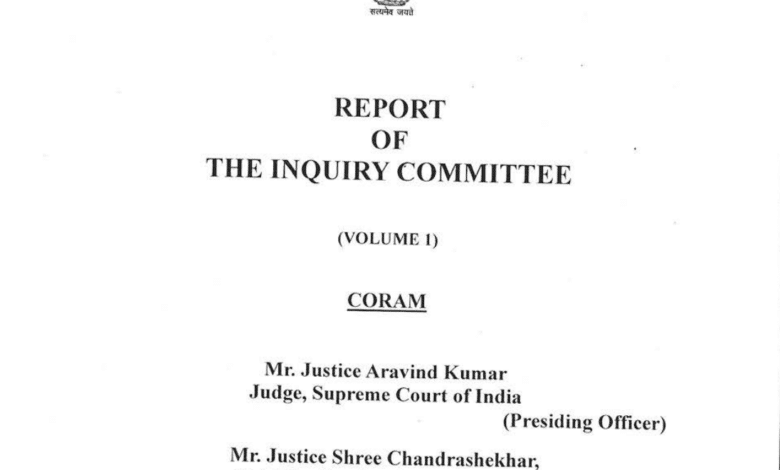
A statutory Inquiry Committee constituted under the Judges (Inquiry) Act, 1968, has submitted its detailed report to the Speaker of the Lok Sabha, recording findings of proved misbehaviour against Justice Yashwant Varma of the Allahabad High Court. The three-member panel, presided over by Supreme Court Judge Justice Aravind Kumar, with Bombay High Court Chief Justice Shree Chandrashekhar and senior advocate B.V. Acharya as members, examined three articles of charge stemming from the discovery of large quantities of burnt and partially burnt Indian currency notes during a fire at the judge’s official residence in New Delhi on the night of 14-15 March 2025.
The Committee concluded that the charges of possession of unexplained currency within official premises, failure to preserve material evidence, and furnishing of evasive and misleading explanations stood proved on the basis of consistent testimony from fire and police personnel, contemporaneous photographs and videos, and the overall evidentiary record. Justice Varma withdrew from the proceedings after the presenting side closed its evidence, without leading any defence witnesses or entering the witness box himself.
Background of the Incident
On the intervening night of 14 and 15 March 2025, a fire was reported at 30, Tughlaq Crescent, New Delhi, then the official residence allotted to Justice Yashwant Varma while he was a Judge of the Delhi High Court. A Police Control Room call triggered the dispatch of fire tenders from the Safdarjung Fire Station of the Delhi Fire Services. Police personnel from the jurisdictional station and PCR vans also reached the spot. The blaze was confined to a storeroom located at one corner of the premises, near the portion housing security personnel and servants.
While firefighters were extinguishing the fire and conducting cooling operations, they noticed material that appeared to be Indian currency notes in burnt, half-burnt and wet condition scattered on the floor and on ledges inside the storeroom. Officials took still photographs and videos of the scene and forwarded them to superior officers. The visual material soon circulated widely in the media. Justice Varma was not present at the residence that night; he and his wife were outside Delhi, while his daughter and aged mother were at home. The fire service was alerted by his daughter and Private Secretary.
In his written response dated 22 March 2025, the judge stated that the storeroom was used for storing unused furniture, bottles, crockery, mattresses, old carpets, speakers, garden implements and CPWD material. He described it as unlocked, accessible from both the front and back gates of the staff quarters, disconnected from the main residence, and not a room in his house. He asserted that no cash had been placed there by him or his family and that no currency was seen by household members after the fire was doused. He also expressed an apprehension of conspiracy.
Institutional Response and In-House Inquiry
The matter was first examined under the Supreme Court’s 1999 In-House Procedure. On 22 March 2025, then Chief Justice of India Sanjiv Khanna constituted a three-member In-House Committee. Mobile phones of Delhi Police and Fire Service personnel present that night were taken into custody, sealed and forwarded to the Supreme Court Registry. On 28 March 2025, the Supreme Court announced that no judicial work would be assigned to Justice Varma. The In-House Committee submitted its report on 4 May 2025. After considering the material, the Chief Justice of India advised the judge to resign or seek voluntary retirement. When that course was not availed, the report was forwarded to the President and the Prime Minister.
Justice Varma challenged the In-House report and its forwarding in Writ Petition (Civil) No. 699 of 2025. The Supreme Court dismissed the petition on 7 August 2025. Notices of motion for his removal were submitted by Members of Parliament on 21 July 2025 during the Monsoon Session. The Speaker of the Lok Sabha admitted the notice on 12 August 2025 and, under Section 3(2) of the Judges (Inquiry) Act, 1968, constituted a three-member Committee.
Composition and Framework of the Statutory Committee
The original Committee comprised Justice Aravind Kumar as Presiding Officer, Justice Maninder Mohan Shrivastava (then Chief Justice of the Madras High Court) and senior advocate B.V. Acharya. Following Justice Shrivastava’s retirement on 5 March 2026, the Committee was reconstituted with effect from 6 March 2026, with Justice Shree Chandrashekhar, Chief Justice of the Bombay High Court, joining as Member. Continuity was maintained by placing the complete record before the newly inducted Member.
| Role | Name | Designation |
|---|---|---|
| Presiding Officer | Justice Aravind Kumar | Judge, Supreme Court of India |
| Member | Justice Shree Chandrashekhar | Chief Justice, Bombay High Court |
| Member | Mr. B.V. Acharya | Senior Advocate, Karnataka High Court |
Smt. Aishwarya Bhati, Additional Solicitor General, and senior advocate Raja Thakare were appointed to conduct the case against the judge under Section 3(9) of the Act. The statutory framework under the Judges (Inquiry) Act, 1968, and the Rules of 1969 is sui generis. It is neither a criminal trial nor a purely adversarial civil proceeding. The Committee frames definite charges, affords the judge reasonable opportunity to cross-examine witnesses, adduce evidence and be heard, and ultimately submits findings on each charge with reasons to the Speaker.
Course of Proceedings
The Committee held multiple meetings beginning 17 September 2025. Charges were framed on 23 November 2025 and served on the judge in Form I on 27 November 2025, along with the statement of grounds, list of documents and list of witnesses. The judge was granted time until 12 January 2026 to file his statement of defence. He also challenged the constitution of the Committee in the Supreme Court; that petition was dismissed on 16 January 2026.
The Committee formulated a procedure for in-camera hearings, affidavits in lieu of examination-in-chief, cross-examination and submissions. Nine witnesses were examined on behalf of the presenting side and subjected to detailed cross-examination by senior counsel appearing for the judge. Documents and electronic material were marked as exhibits C-1 to C-5 and P-1 to P-128. Official records from Delhi Police, CRPF, Police Station Tughlaq Road and Delhi Fire Services were produced and inspected.
Evidence of the presenting side closed on 17 March 2026. The judge was directed to furnish a list of defence witnesses and affidavits by 6 April 2026. No such list was filed. Instead, on 10 April 2026 the Committee received a communication dated 9 April 2026 from the judge stating that he was withdrawing from the proceedings. Parallel communications were addressed to the President of India and the Chief Justice of India. On 21 April 2026, the advocates appearing for the judge sought and were granted discharge on instructions. The Committee held that a statutory inquiry cannot be brought to a halt by unilateral withdrawal after substantial participation, including cross-examination of witnesses and marking of exhibits. The Speaker subsequently directed the Committee to complete its investigation and submit the report under Section 4(2) of the Act.
Appreciation of Evidence
The Committee approached the evidence issue-wise rather than witness-wise, focusing on the physical setting, the fire response, the presence of currency, electronic corroboration, non-preservation of the scene, the judge’s successive explanations, and the later non-availability of the notes.
The storeroom, though used for storage and situated near staff quarters, formed part of the official residential premises under the judge’s effective control. Shared access by staff or maintenance personnel did not sever that control. Site photographs and a site map (Exhibit P-2A) confirmed the layout.
Key first-responder witnesses included:
| Witness | Designation | Key Observation |
|---|---|---|
| PW-2 | Ankit Sehwag, Fire Operator | Bundles of ₹500 notes spread over 7-8 feet; identified videos and stills showing heaps of money |
| PW-3 | Manoj Kumar Mehlawat, Station Officer | Voice in video saying “Mahatma Gandhi Mein Aag Lag Rahi Hai Bhai”; saw singed and wet notes |
| PW-4 | Bhanwar Singh, Fire Operator-cum-Driver | Large pile of ₹500 notes near entrance, height about 2.5 feet; scattered throughout room |
| PW-5 | Pravindra Malik, Fire Operator | Currency notes splashed all over the storeroom from door to end; never seen so much money |
| PW-6 | Sunil Kumar, Head Constable, PCR | Heaps of ₹500 notes, partly burnt, fully burnt and unburnt |
| PW-7 | Roop Chand, Head Constable | Notes from door to back of storeroom; amount “much more than five lakhs” and “unimaginable” |
| PW-8 | Umesh Malik, SHO, Tughlaq Road | Heaps of burnt and half-burnt notes on floor and ledge; directed photography |
Videos recorded on mobile phones (Exhibits P-83 to P-85, P-89 to P-91) and still images corroborated the oral testimony. Suggestions put in cross-examination that fire personnel themselves removed the money were treated as reinforcing the presence of currency rather than undermining it.
The Committee noted the complete absence of formal seizure, panchnama, inventory or physical verification. The currency later became unavailable. Successive explanations offered by the judge were found inconsistent. Theories of planting, conspiracy or arson remained unsubstantiated. The judge’s decision not to enter the witness box or summon any defence witnesses left his pleas unproved.
Findings on the Articles of Charge
The Committee recorded separate findings on each charge.
Article I – Discovery and Possession of Unexplained Indian Currency within Official Premises: Proved. The storeroom was within the official premises under the judge’s effective control. Multiple independent official witnesses and contemporaneous electronic material established the presence of substantial quantities of ₹500 notes in various states of burning and wetness.
Article II – Failure to Preserve and Causing Interference with Material Evidence: Proved. No steps were taken to secure, inventory or preserve the currency or the scene in a manner consistent with the gravity of the discovery. The subsequent non-availability of the material was significant.
Article III – Evasive and Misleading Explanations/Statements: Proved. The explanations furnished by the judge regarding the nature of the room, the absence of any knowledge of currency, and alternative theories of conspiracy or planting did not satisfactorily account for the established facts and contained inconsistencies.
In its consolidated finding, the Committee held that the proved conduct constituted misbehaviour within the meaning of the constitutional and statutory scheme. The report, spanning two volumes with extensive annexures, rests solely on the material taken on record during the inquiry.
Way Forward
Under Articles 124(4) and 218 of the Constitution, removal of a High Court Judge requires an address by each House of Parliament supported by a special majority, following investigation under the law made by Parliament. The Committee’s report, stating findings on each charge with detailed reasons, has been submitted to the Speaker of the Lok Sabha for further consideration in accordance with the constitutional process. The episode highlights both the institutional mechanisms available to examine allegations against judges of constitutional courts and the exacting standards of conduct expected of them.