
CBSE Makes Three Languages Mandatory for Class IX from 2026, No Board Exam for Third Language


Central Board of Secondary Education (CBSE) has announced a major change in the language curriculum for secondary classes by making the study of three languages compulsory for students of Class IX from the academic session 2026-27 onwards, in line with the recommendations of the National Education Policy (NEP) 2020 and the National Curriculum Framework for School Education (NCF-SE) 2023.
In a circular issued on May 15, 2026, the Board clarified that while students will be required to study three languages — referred to as R1, R2 and R3 — there will be no Board examination for the third language (R3) in Class X. The decision will come into effect from July 1, 2026.
According to the circular, at least two of the three languages studied by students must be native Indian languages. Foreign languages may be chosen as the third language only if the other two languages are Indian languages. Alternatively, students may opt for a foreign language as an additional fourth language.
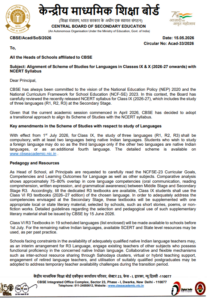
CBSE stated that the revised language scheme has been introduced after carefully reviewing the recently released NCERT syllabus for Classes IX and X, which incorporates the study of three languages at the secondary stage.
The Board said the changes are aimed at strengthening multilingual learning while aligning school education with the broader vision of NEP 2020, which promotes linguistic diversity, cultural understanding and foundational language proficiency.
The circular emphasised that the transition to the new language policy will be implemented gradually and in a student-friendly manner to ensure that no learner faces academic disadvantage during the transition period.
Under the revised framework, the study of languages will focus on improving communication skills, comprehension, reading proficiency, writing ability and grammatical awareness among students. CBSE highlighted that the new curriculum places nearly 75-80 percent emphasis on core language competencies across Middle Stage and Secondary Stage education.
To support the transition, NCERT textbooks for Class IX in scheduled languages are expected to be made available to schools before July 1, 2026. For other native Indian languages where textbooks may not yet be available, schools will be allowed to use SCERT and state-level teaching resources.
The Board also acknowledged that several schools may face challenges in arranging qualified teachers for regional or native Indian languages. In such cases, schools have been permitted to adopt temporary and flexible arrangements.
According to the circular, institutions may engage existing teachers from other subjects who possess functional proficiency in the concerned Indian language. Schools may also collaborate through Sahodaya clusters for resource sharing, use hybrid or virtual teaching support, involve retired language teachers or hire qualified postgraduate educators to manage teaching requirements during the transition period.
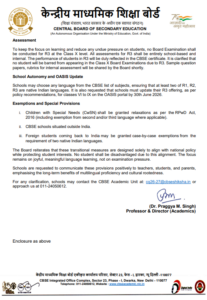
One of the most significant aspects of the new policy is CBSE’s decision not to conduct a Board examination for the third language in Class X. The Board said all assessments for R3 will remain entirely school-based and internal.
The circular clarified that while students’ performance in R3 will be reflected in the CBSE certificate, no student will be barred from appearing in the Class X Board examination on the basis of third-language performance.
CBSE stated that the move is intended to reduce academic pressure on students while preserving the focus on language learning and multilingual competency.
“To keep the focus on learning and reduce undue pressure on students, no Board Examination shall be conducted for R3 at the Class X level,” the Board said in the circular.
Sample question papers, rubrics and assessment guidelines for internal evaluation of the third language will be shared separately by the Board.
The circular also introduced updates related to school autonomy and the Online Affiliated School Information System (OASIS). Schools will have the flexibility to choose any language from the CBSE-approved list of subjects, provided that at least two of the three languages are Indian languages.
Schools have been instructed to update their R3 language offering for Classes VI to IX on the OASIS portal by June 30, 2026.
CBSE further outlined special provisions for certain categories of students. Children With Special Needs (CWSN) will continue to receive relaxations as per the Rights of Persons with Disabilities (RPwD) Act, 2016, including exemptions from the second or third language wherever applicable.
The Board also clarified that CBSE schools located outside India will be exempt from the requirement of teaching two native Indian languages.
Additionally, foreign students returning to India may be granted case-by-case exemptions from the requirement of studying two Indian languages.
The Board stressed that the revised language policy has been designed solely to align school education with national educational reforms while protecting the interests of students.
“No student shall be disadvantaged due to this alignment. The focus remains on joyful, meaningful language learning, not on examination pressure,” the circular noted.
Education experts believe the move represents one of the most significant language policy changes introduced by CBSE in recent years. The implementation of the three-language formula at the secondary level is expected to strengthen regional language learning while also encouraging students to develop multilingual capabilities in an increasingly interconnected world.
The revised framework also reflects the broader objectives of NEP 2020, which advocates greater integration of Indian languages in education and promotes the preservation of India’s linguistic diversity.
School administrators and teachers across the country are now expected to begin preparations for curriculum adjustments, teacher deployment and resource planning ahead of the July 2026 implementation deadline.
CBSE has asked schools to communicate the new provisions positively to parents, students and teachers while highlighting the long-term educational and cultural benefits of multilingual learning.