
Government Pushes AI Integration in Governance, Emphasises Data Security
DoPT Secretary Rachna Shah highlights use of AI in recruitment, grievance redressal and training; calls for safeguards and capacity building

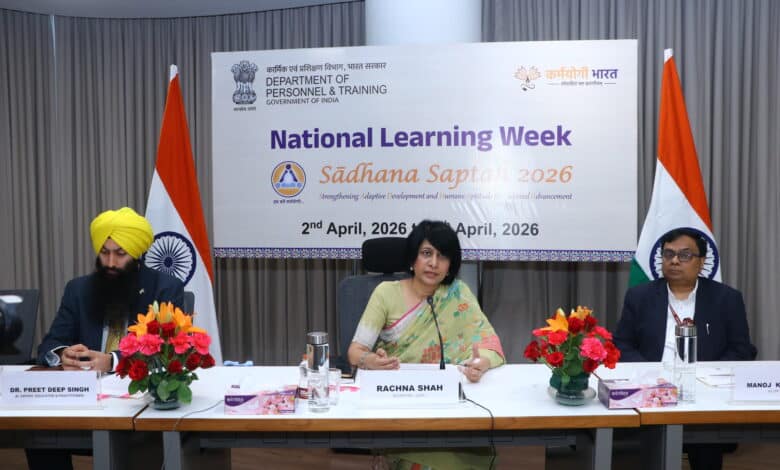
The Government of India has signalled a strong push towards integrating Artificial Intelligence (AI) into core governance processes, with Secretary, Department of Personnel and Training (DoPT), Rachna Shah, highlighting the transformative potential of emerging technologies while stressing the need for robust safeguards around data privacy and security.
Addressing a “Samuhik Charcha” on AI in Public Governance आयोजित under SADHANA Saptah 2026, part of Mission Karmayogi, Shah outlined a clear policy direction to embed AI across administrative workflows. She said the government is actively exploring AI-driven applications in areas such as recruitment rule generation, grievance redressal, employee service delivery, and financial processes.
The Secretary pointed to several emerging use cases, including automated salary processing, anomaly detection in reimbursements, chatbot-based grievance handling, and real-time note generation. Tools such as AI Medha, Bhashini, and AI Coach are already being explored within government systems to streamline operations and enhance efficiency.
“AI adoption is being driven to improve accuracy, transparency, uniformity, and cost efficiency in governance,” Shah said. However, she cautioned that given the sensitive nature of government data, it is critical to build safeguards around privacy, ethical usage, and cybersecurity into all AI-enabled systems. She also emphasised the importance of capacity building, noting that AI-focused training modules on the iGOT platform would play a key role in ensuring responsible and effective use of these technologies by government officials.
Providing an expert perspective, AI practitioner Preet Deep Singh highlighted both the opportunities and risks associated with deploying AI in governance. Demonstrating real-world applications across administrative workflows, he underscored the importance of handling confidential data carefully, particularly when using external platforms. Singh warned of potential data exposure risks and stressed the need for secure, controlled environments for government AI usage.
Joint Secretary (Training), Chhavi Bhardwaj, elaborated on DoPT’s structured approach to AI adoption, focusing on three key areas: capacity building, data-driven decision support, and workforce management. She noted that AI has already significantly reduced the time and cost required to develop training content on the iGOT platform—from several months to about a week, and at a fraction of earlier costs.
Bhardwaj added that future initiatives would focus on hyper-personalised learning pathways and competency-based assessments for government employees. She also highlighted AI’s potential in analysing performance appraisal data, improving cadre management, and enabling intelligent decision-support systems. At the same time, she reiterated that all deployments must prioritise data confidentiality, preferably through on-premise infrastructure or secure government cloud solutions.
Concluding the session, Additional Secretary Manoj Kumar Dwivedi stressed the need to move beyond fragmented, individual use of AI tools towards institutionalised and system-wide integration. He identified training, policy formulation, and data-driven human resource management as three priority areas where AI could deliver tangible benefits.
Dwivedi pointed to opportunities such as intelligent query systems, advanced analytics, and enhanced decision-support frameworks within platforms like e-HRMS. He cautioned that unless AI tools are embedded into routine workflows, their adoption would remain limited. He also flagged data confidentiality as a critical concern, calling for dedicated protocols and training to address associated risks.
Highlighting the urgency of technological adaptation, Dwivedi warned that failure to keep pace with advancements in AI could widen the efficiency gap between government systems and the private sector. He called for leveraging government platforms and systems developed by agencies like NIC to ensure seamless and secure AI integration.
The session witnessed active participation from all officers and staff of DoPT, both physically and through virtual platforms, reflecting a department-wide commitment to aligning administrative processes with emerging AI-driven governance frameworks.