Government Approves 29 New Proposals Under ECMS to Boost Electronics Manufacturing

The Government of India has approved 29 additional proposals under the Electronics Component Manufacturing Scheme (ECMS), further strengthening the country’s push to become a global electronics manufacturing hub. The latest approvals, announced by the Ministry of Electronics and Information Technology (MeitY), are expected to attract an investment of ₹7,104 crore, generate production worth ₹84,515 crore, and create 14,246 direct jobs.
These approvals come in addition to the 46 proposals worth ₹54,567 crore cleared earlier, taking the total number of approved applications under the scheme to 75. The cumulative expected investment now stands at ₹61,671 crore, with projected employment generation of over 65,000 jobs.
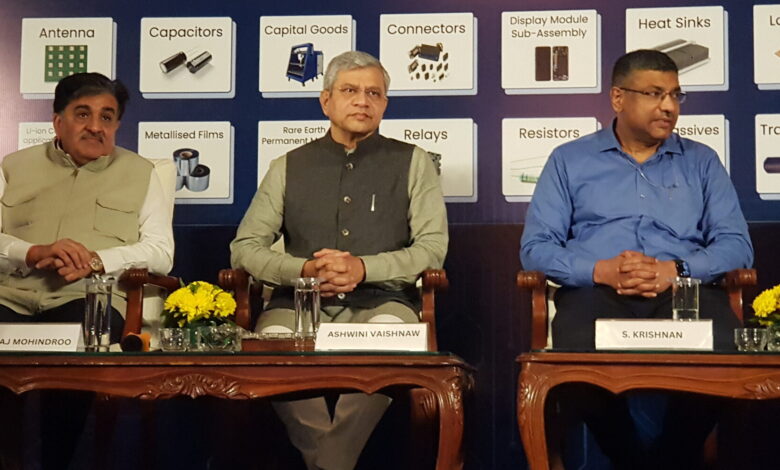
Union Minister for Electronics and IT, Ashwini Vaishnaw, highlighted the importance of strengthening India’s domestic electronics ecosystem. He stressed the need for robust in-house design capabilities, urging companies to invest in research and collaborate with academic institutions and industry partners. According to him, deeper value addition within the country is essential for long-term competitiveness.
The newly approved projects span 16 product categories with applications across sectors such as mobile manufacturing, telecom, consumer electronics, automotive, IT hardware, and strategic electronics. These include sub-assemblies like display modules, a range of bare components such as capacitors, connectors, resistors, inductors, antennas, and lithium-ion cells, as well as critical supply chain inputs like laminates, metallised films, and rare earth permanent magnets.
A notable highlight of the approvals is the establishment of several first-of-their-kind manufacturing facilities in India. These include the country’s first SMD passive plant for tantalum-based capacitors, the first flexible printed circuit board (PCB) plant, and the first rare earth permanent magnet manufacturing facility. These projects are expected to significantly reduce India’s dependence on imports of critical electronic components and materials.
In the sub-assembly segment, approvals have been granted to companies such as Dixon Display Technologies Pvt. Ltd. and Wangda Technologies Pvt. Ltd. for manufacturing display modules. In the components category, major approvals include projects by VVDN Technologies Pvt. Ltd. for antennas and heat sinks, and Molex (India) Pvt. Ltd. along with other firms for connectors.
Global and domestic players alike are part of this expansion. Vishay Components India Pvt. Ltd. will manufacture capacitors, while TDK India Pvt. Ltd. will produce inductors. Syrma Strategic Electronics Pvt. Ltd. has been approved for flexible PCBs, marking a key step in developing advanced electronics manufacturing capabilities in the country.
The government has also placed strong emphasis on strengthening the upstream supply chain. Approvals for manufacturing copper-clad laminates, a crucial raw material for PCB production, have been given to Syrma Components Pvt. Ltd. and Ratnaveer Precision Engineering Ltd. Meanwhile, Lohum Cleantech Pvt. Ltd. will set up India’s first rare earth permanent magnet facility, a move seen as strategically important for sectors like electric vehicles and renewable energy.
Additionally, six companies, including Titan Engineering & Automation Ltd., NeST Advanced Technology Development Centre Pvt. Ltd., and Bharat FIH Ltd., have been approved for manufacturing capital goods and equipment. This is expected to support the development of indigenous manufacturing machinery and reduce reliance on imported equipment.
Secretary, MeitY, S. Krishnan, noted that the ECMS has witnessed strong industry interest since its launch, with swift approvals by the government. He emphasized that the focus must now shift to rapid implementation, especially in light of global geopolitical challenges that underscore the importance of resilient and diversified supply chains.
Industry stakeholders have also welcomed the move. Pankaj Mahindroo, Chairman of the India Cellular and Electronics Association, said the enhanced outlay of ₹40,000 crore for ECMS in the Union Budget, combined with the success of the Production Linked Incentive (PLI) scheme, will accelerate growth in the electronics manufacturing sector.
Experts believe that the latest approvals will significantly enhance domestic value addition, create a strong supplier base, and position India as a competitive player in the global electronics supply chain. By focusing on both components and capital equipment, the government aims to build a comprehensive ecosystem that supports end-to-end manufacturing within the country.
The ECMS initiative aligns with the broader vision of transforming India into a global electronics manufacturing hub, reducing import dependence, and creating large-scale employment opportunities. With sustained policy support and increasing industry participation, the scheme is expected to play a pivotal role in shaping the future of India’s electronics sector.