Sacred Relics of Lord Buddha Arrive at Arunachal’s Golden Pagoda; Public Darshan Till November 20
Governor Kaiwalya Trivikram Parnaik inaugurates final phase of Sacred Relics exposition at Namsai; over 66,000 devotees have paid homage at Tawang and Bomdila, with two special exhibitions showcasing India’s rich Buddhist heritage

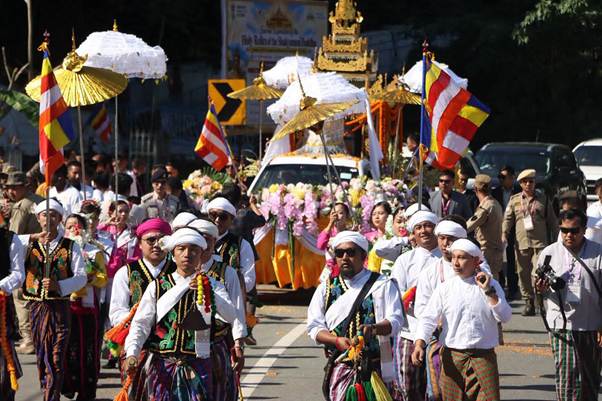
The Governor of Arunachal Pradesh, Lt Gen Kaiwalya Trivikram Parnaik (Retd.), formally received the Sacred Relics at Nalung Helipad in Namsai. Deputy Chief Minister Chowna Mein, state ministers, public representatives, Buddhist monks and religious leaders were present during the ceremonial reception.
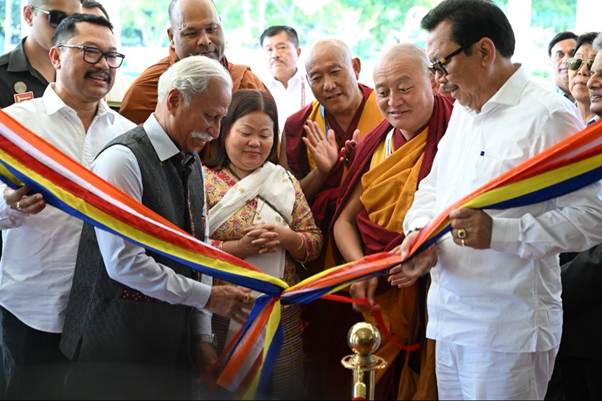
A large number of devotees and local residents gathered along the route leading to the Golden Pagoda to welcome the Sacred Relics. Following the ceremonial reception, the relics were taken to the Golden Pagoda, one of the most prominent centres of Buddhist faith and heritage in eastern Arunachal Pradesh, where they were ceremonially enshrined.
The Governor subsequently inaugurated the exposition at the Golden Pagoda in the presence of Deputy Chief Minister Chowna Mein, Raghav Prasad Bhatnagar, Director General of the International Buddhist Confederation (IBC), members of the Buddhist Sangha and other distinguished guests.
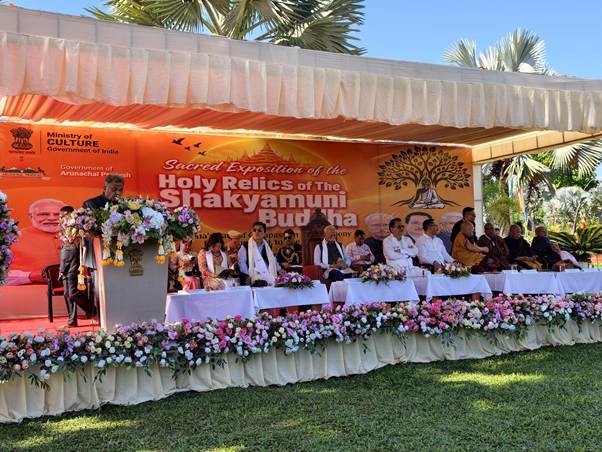
Governor Highlights Relevance of Buddha’s Teachings
Addressing the gathering, Governor Kaiwalya Trivikram Parnaik described the exposition as an occasion of immense spiritual, cultural and historical significance. He observed that the Sacred Relics represent the life, enlightenment and timeless teachings of Lord Buddha, whose philosophy continues to guide humanity towards peace and harmony.
The Governor emphasised that the teachings of Lord Buddha have particular relevance in the contemporary world, which is facing numerous challenges arising from conflicts, intolerance, violence and social divisions.
He highlighted the importance of peace, compassion, wisdom and non-violence, stating that these values can contribute towards building a more harmonious and inclusive society. He encouraged people to incorporate the principles of Buddha’s teachings into their everyday lives and promote mutual respect, understanding and human dignity.
The Governor also appreciated the collective efforts of the Ministry of Culture, Government of India, the Arunachal Pradesh Government, the National Museum, New Delhi, and the International Buddhist Confederation in organising the exposition.
He acknowledged the contribution of all institutions and individuals involved in bringing the Sacred Relics closer to Buddhist communities and devotees across Arunachal Pradesh.
Deputy Chief Minister Chowna Mein highlighted the state’s rich and diverse Buddhist heritage. He noted that Arunachal Pradesh has historically been an important centre for different Buddhist traditions, including Mahayana, Vajrayana and Theravada Buddhism.
According to him, the arrival of the Sacred Relics at Namsai provides a rare and cherished opportunity for devotees to offer prayers, seek blessings and reconnect with the spiritual teachings of Lord Buddha.
Two Special Exhibitions on Buddhist Heritage Inaugurated
Apart from the ceremonial exposition of the Sacred Relics, two special exhibitions showcasing India’s Buddhist heritage were inaugurated at the Meditation Centre of the Golden Pagoda.
The exhibitions have been jointly organised by the International Buddhist Confederation and the National Museum, New Delhi. They aim to provide visitors with a deeper understanding of the historical, archaeological, artistic and cultural significance of Buddhism in India.
The first exhibition, titled “Unearthing the Sacred Piprahwa: The Story of the Holy Buddha Relics and Their Discovery,” has been organised by the International Buddhist Confederation.
It showcases the historical and archaeological significance of the Piprahwa Relics and traces the discoveries made at Piprahwa in Uttar Pradesh. The exhibition explains the importance of Buddhist relics in religious traditions and highlights the long-standing practice of preserving and venerating objects associated with Lord Buddha.
A major highlight is the story of the Piprahwa jewel collection and its return to India in 2025 after more than a century. The exhibition seeks to familiarise visitors with the importance of protecting India’s Buddhist archaeological treasures and preserving their cultural and spiritual legacy.
The second exhibition, titled “Crossroads of Dhamma: Classical Legacies, Living Art, and Anthropological Perspectives,” has been curated by the National Museum, New Delhi.
It presents the artistic, historical and cultural evolution of Buddhism through different periods. The exhibition highlights how Buddhist philosophy and traditions have influenced India’s art, architecture, culture and society.
Together, the two exhibitions complement the spiritual experience of the Sacred Relics exposition. They are expected to attract not only devotees but also students, researchers, scholars and visitors interested in India’s Buddhist history and cultural heritage.
Over 35,000 Devotees Visit Bomdila Exposition
The arrival of the Sacred Relics at Namsai follows the successful conclusion of the six-day exposition at Thubchog Gatsel Ling (TGL) Monastery, popularly known as Lower Gompa, in Bomdila, West Kameng district.
The exposition was organised from November 8 to 13, 2026, and witnessed an overwhelming response from Buddhist devotees. More than 35,000 people visited the monastery during the six-day period to offer prayers and pay homage to the Sacred Relics.
Buddhist monks, senior citizens, persons with disabilities and devotees from different parts of West Kameng district and neighbouring areas participated in the public darshan.
To ensure smooth arrangements and facilitate participation from different parts of the district, the local administration organised constituency-wise visits. The arrangements helped maintain an orderly flow of devotees and provided people from different areas an opportunity to have darshan of the Sacred Relics.
The significant turnout reflected the deep spiritual connection of local communities with Buddhism and the importance attached to the exposition.
After the conclusion of public darshan on November 13, the Sacred Relics were accorded a ceremonial farewell on the morning of November 14 for their onward journey to Namsai.
More Than 66,000 Devotees at Tawang and Bomdila
The exposition of the Sacred Relics in Arunachal Pradesh began at the historic Gaden Namgyal Lhatse, popularly known as Tawang Monastery, on October 31, 2026.
The inaugural ceremony was attended by Union Minister of Culture and Tourism Gajendra Singh Shekhawat, Arunachal Pradesh Chief Minister Pema Khandu, senior Buddhist monks and other dignitaries.
The exposition continued at Tawang Monastery until November 7 and attracted more than 31,000 devotees.
The subsequent six-day exposition at Bomdila witnessed participation by over 35,000 devotees.
Sacred Relics Exposition: Devotee Footfall
31,000+
Tawang Monastery
35,000+
Bomdila Monastery
66,000+
Combined devotees at Tawang and Bomdila
Namsai is the third and final venue of the exposition in Arunachal Pradesh.
The cumulative footfall at Tawang and Bomdila has crossed 66,000, underlining the widespread enthusiasm and religious significance of the exposition among Buddhist communities in the state.
Sacred Relics Return to Arunachal Pradesh After 13 Years
The return of the Sacred Relics to Arunachal Pradesh after a gap of 13 years has been a significant occasion for Buddhist communities across the state.
The exposition has provided devotees belonging to different Buddhist traditions and cultural backgrounds with an opportunity to come together and pay homage to Shakyamuni Buddha.
Arunachal Pradesh has a longstanding association with Buddhism, with different traditions flourishing across its regions. While Tawang and adjoining areas have strong associations with Mahayana and Vajrayana traditions, Theravada Buddhism has a significant presence in eastern Arunachal Pradesh, particularly in Namsai.
The three-venue exposition has therefore brought together diverse Buddhist communities and highlighted the shared spiritual and cultural heritage connecting different regions of the state.
The event has also strengthened the connection between Arunachal Pradesh’s Buddhist traditions and India’s wider Buddhist heritage.
Public Darshan at Golden Pagoda Till November 20
The Sacred Relics will remain enshrined at the Golden Pagoda (Kongmu Kham) in Namsai until November 20, 2026.
The Golden Pagoda is an important centre of Theravada Buddhist faith and practice in Arunachal Pradesh. Its location makes the final phase of the exposition particularly significant for devotees from eastern Arunachal Pradesh and neighbouring regions.
The public darshan period from November 14 to 20 is expected to provide an opportunity for a large number of devotees to offer prayers and seek blessings.
Following the conclusion of the exposition at Namsai, the Sacred Relics are scheduled to return to the National Museum, New Delhi, on November 21, 2026.
Ministry of Culture Leads Nationwide Buddhist Heritage Initiative
The exposition is being organised by the Ministry of Culture, Government of India, in collaboration with the Government of Arunachal Pradesh, the National Museum, New Delhi, and the International Buddhist Confederation (IBC), New Delhi.
The initiative reflects the government’s efforts to preserve, protect and promote India’s Buddhist heritage and make its important cultural and spiritual treasures accessible to people across the country.
By taking the Sacred Relics to Tawang, Bomdila and Namsai, the exposition has brought an important part of India’s Buddhist legacy closer to devotees, while also promoting awareness about the country’s archaeological and cultural heritage.
The three-phase programme in Arunachal Pradesh has highlighted the diversity of Buddhist traditions and their continuing influence on the state’s cultural identity.
As the exposition enters its final phase at the Golden Pagoda, Namsai, its central message remains the universal philosophy of Lord Buddha — peace, compassion, wisdom, non-violence and harmony.