Himalaya Is Not More Dangerous, Human Vulnerability Is Increasing, Says Scientist
Is the Himalaya Becoming More Vulnerable? Dr. Vineet Gahalaut Explains the Growing Risks

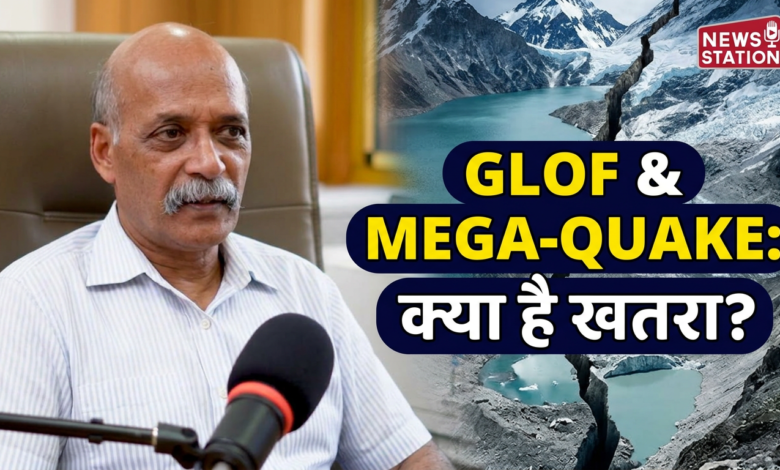
Is the Himalaya becoming increasingly dangerous, or are human activities making communities more vulnerable to natural events that have always been part of the mountain system?
This question formed the central theme of an exclusive News Station podcast featuring Dr. Vineet K. Gahalaut, Director, Wadia Institute of Himalayan Geology, in conversation with Siddharatha, Editor, The News Station Network.
The discussion covered some of the most critical geological and disaster-related challenges facing the Himalayan region, including earthquakes, landslides, floods, glacial lake outburst floods (GLOFs), climate change, unplanned construction, infrastructure development and building safety.
Dr. Gahalaut made an important distinction at the beginning of the conversation: the Himalaya itself has not suddenly become dangerous; rather, human vulnerability to natural Himalayan processes has increased.
According to him, earthquakes, landslides and floods are natural components of the geological system that created and continues to shape the Himalaya. The growing problem is that population and infrastructure are increasingly occupying areas exposed to these hazards.
The Himalaya Has Always Been a Dynamic Mountain System
Explaining the formation of the Himalaya, Dr. Gahalaut said the mountain system developed through the collision of the Indian and Eurasian tectonic plates.
Millions of years ago, the region between the two plates was occupied by the Tethys Sea. As the Indian Plate moved towards the Eurasian Plate, the distance between the two plates gradually decreased. Rocks beneath the former sea were pushed upwards, eventually contributing to the formation of the Himalayan mountain chain.
Dr. Gahalaut explained that the Himalayan system did not simply stop evolving once the mountains emerged above the Earth’s surface.
Tectonic processes continue beneath the region, while surface processes such as rainfall, erosion, landslides and floods constantly modify the terrain.
In other words, the same geological forces responsible for creating the Himalaya are still active.
Human Activity Is Increasing Vulnerability
According to Dr. Gahalaut, the major change is not necessarily the existence of natural hazards but the extent to which humans are exposed to them.
Population growth has resulted in settlements expanding into areas that were previously sparsely inhabited. Roads, buildings, hotels and other infrastructure are increasingly being constructed in mountainous terrain.
In some locations, slopes are cut to make way for roads or buildings. If such interventions are not appropriately engineered, they can increase instability.
Dr. Gahalaut stressed that there is an important difference between a natural event and a disaster.
A landslide in an uninhabited location may cause little damage. The same landslide occurring beside a densely populated settlement, road or hotel can result in deaths, injuries and substantial economic losses.
This means that vulnerability — rather than the natural event alone — plays a critical role in determining the scale of a disaster.
Climate Change Adds Another Layer of Risk
The podcast also examined the relationship between climate change and Himalayan hazards.
Dr. Gahalaut explained that natural systems operate under a complex combination of conditions. Changes in temperature, humidity, rainfall and other environmental parameters can affect how these systems behave.
He described natural systems as operating around critical conditions, meaning relatively small changes in certain parameters can potentially produce disproportionately large changes in outcomes.
This complexity becomes particularly important in the Himalaya because several hazards can interact.
Changes in glaciers and glacial lakes, intense rainfall, landslides, floods and earthquakes cannot always be viewed independently.
Growing Concern Over Glacial Lakes
One of the major subjects discussed during the interview was the increasing attention being given to glacial lakes and the possibility of Glacial Lake Outburst Floods, or GLOFs.
Dr. Gahalaut said several agencies have been working to identify and categorise glacial lakes across the Himalayan region.
Inventories have been prepared by different scientific and disaster-management organisations, including work involving the National Remote Sensing Centre and other agencies.
The objective is not simply to count the lakes but to identify which ones are potentially vulnerable and determine where monitoring and mitigation measures may be necessary.
According to Dr. Gahalaut, significant numbers of glacial lakes are found in areas including Ladakh and Arunachal Pradesh, while Sikkim has a particularly important concentration of potentially vulnerable lakes.
2023 Sikkim GLOF Highlighted the Scale of the Threat
The 2023 South Lhonak Lake event in Sikkim was discussed as a major lesson in understanding GLOF risks.
The event demonstrated how a glacial-lake-related hazard can have consequences far beyond the immediate lake area, particularly when downstream infrastructure and settlements are exposed.
Dr. Gahalaut said the incident increased attention towards assessing glacial-lake vulnerability, monitoring potential hazards and developing early-warning systems.
He also discussed ongoing efforts in Uttarakhand.
According to his explanation, several glacial lakes in the state have been identified for closer attention, with five lakes considered potentially hazardous, including four in Pithoragarh and lakes including Kedartal and Vasundhara Tal in Chamoli.
He said studies are being undertaken to understand their characteristics and possible triggering mechanisms, while monitoring and instrumentation are also being considered.
Cascading Disasters Could Multiply the Impact
One of the most significant concepts discussed in the podcast was cascading disasters.
Traditionally, hazards such as earthquakes, landslides, floods and GLOFs have often been studied separately. But Dr. Gahalaut explained that one event can potentially trigger another.
An earthquake, for example, can destabilise slopes. A landslide can alter a river system or affect a glacial lake. A subsequent flood can then travel downstream and interact with infrastructure.
Such interconnected events can potentially create impacts much larger than those produced by an individual hazard.
The concept is particularly important in the Himalaya because of the region’s steep terrain, active tectonics, glaciers, rivers and growing infrastructure.
Himalayan Earthquake Risk Remains a Major Concern
The interview then turned to the question of earthquakes.
Dr. Gahalaut explained that tectonic strain is accumulating across the Himalayan region, although the rate varies geographically.
He referred to higher rates of strain accumulation in parts of the eastern Himalaya and lower rates towards Kashmir.
The major scientific challenge is that accumulated strain cannot be converted into an exact prediction of when an earthquake will occur.
Historical earthquake records are also incomplete. Older accounts may indicate that an earthquake occurred but often do not provide the detailed information required to determine its exact magnitude, location and impacts.
Scientists therefore combine historical records with geological investigations and other techniques to understand past seismic activity.
Could a Magnitude 8.5–8.6 Earthquake Occur?
During the podcast, Dr. Gahalaut discussed the possibility of a very large Himalayan earthquake, referring to magnitudes around 8.5 to 8.6 in the context of accumulated tectonic strain.
However, he stressed that the consequences of an earthquake cannot be assessed by magnitude alone.
Population density, building quality, public awareness, preparedness and the location of the earthquake all influence the number of casualties and the extent of damage.
Historical earthquakes illustrate this difference.
The discussion referred to major earthquakes including the 1905 Kangra earthquake, the 1934 Bihar-Nepal earthquake, the 1950 Assam earthquake, the 2005 Kashmir earthquake and the 2015 Nepal earthquake.
The key lesson, according to Dr. Gahalaut, is that the same magnitude does not automatically produce the same human consequences.
Unsafe Buildings Can Turn Earthquakes Into Disasters
A major part of the conversation focused on construction standards.
Dr. Gahalaut argued that reducing earthquake risk requires reducing the number of unsafe and poorly engineered buildings.
Building regulations and earthquake-resistant construction guidelines exist, but the effectiveness of these measures ultimately depends on implementation and enforcement.
He raised concerns about structures constructed without adequate engineering oversight, particularly in densely populated areas.
The challenge, therefore, is not only preparing for an earthquake but ensuring that buildings are capable of withstanding one.
Enforcement Is Critical
Dr. Gahalaut repeatedly returned to the issue of enforcement.
He argued that early-warning systems alone cannot solve the problem if people and infrastructure continue to occupy high-risk locations.
For example, an early warning lasting only a few seconds may not be sufficient to protect a hotel, market or other structure built directly in a vulnerable flood zone.
Similarly, simply issuing construction guidelines is not enough if compliance is not verified.
He suggested that authorities need mechanisms to check buildings after construction and ensure that approved designs are actually implemented.
Development Must Respect Natural Systems
The discussion also highlighted the tension between infrastructure development and the natural environment.
Dr. Gahalaut did not argue against development. Instead, he stressed that development needs to account for geological and environmental conditions.
River floodplains, unstable slopes and other naturally hazardous locations have physical characteristics that cannot simply be eliminated through administrative decisions.
The interview also drew attention to the need to respect the natural space required by rivers.
When development occupies flood-prone areas, the consequences of extreme rainfall or flooding can become much more severe.
Reducing Vulnerability Is the Central Solution
For Dr. Gahalaut, the central strategy is straightforward: reduce human vulnerability.
That means improving building safety, enforcing construction regulations, restricting unsafe development, monitoring glacial lakes, establishing early-warning systems and increasing public awareness.
He also emphasised that disaster management cannot be the responsibility of scientists alone.
Government agencies, local administrations, engineers, developers and citizens all have roles to play.
The public needs to understand the risks associated with particular locations, while authorities need to ensure that regulations are implemented effectively.
Lessons Must Move From Reports to the Ground
A recurring concern in the conversation was the gap between lessons identified after disasters and their implementation on the ground.
Dr. Gahalaut questioned whether sufficient changes have actually taken place after previous earthquakes, floods and other disasters.
He argued that simply documenting lessons is not enough.
The real test is whether those lessons change building practices, land-use decisions, infrastructure planning and emergency preparedness.
The Himalaya Cannot Be Stopped — But Vulnerability Can Be Reduced
The central message of the News Station podcast is that the Himalaya is a naturally dynamic geological system.
Earthquakes, landslides, floods and glacial processes are intrinsic to its evolution. Human beings cannot stop these geological processes.
What can be changed is the degree to which people and infrastructure are exposed to them.
As population increases and infrastructure expands into vulnerable areas, the potential consequences of natural hazards also increase.
Climate change introduces additional complexity, particularly in relation to glaciers, rainfall and glacial lakes.
Dr. Gahalaut’s message is therefore not that the Himalaya itself has suddenly become dangerous. Rather, the challenge is to understand the mountain system, respect its geological characteristics and reduce human vulnerability through better planning, safer construction, stronger enforcement, scientific monitoring and public awareness.
The question facing Himalayan states is ultimately not whether natural hazards will disappear. It is whether society can become better prepared for the hazards that are an inherent part of the region.