Ashwini Vaishnaw Flags Off New Kanpur Express Between Kanpur Central and Anand Vihar Terminal
Daily train service to cover 428 km with 22 LHB coaches, connecting major industrial and educational centres of Uttar Pradesh with Delhi-NCR; 16-km elevated rail corridor between Anwar Ganj and Mandhana to provide permanent relief from railway crossing congestion

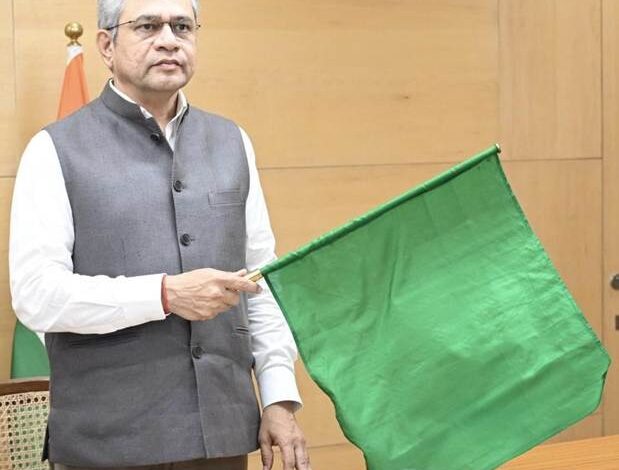
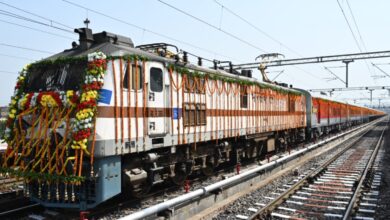
Union Railway Minister Ashwini Vaishnaw and Kanpur Member of Parliament Ramesh Awasthi on Monday flagged off the new Kanpur Express between Kanpur Central and Anand Vihar Terminal in Delhi, strengthening rail connectivity between Uttar Pradesh’s major industrial hub and the National Capital Region (NCR).
The introduction of the daily train service will provide passengers with an additional travel option between Kanpur and Delhi while improving connectivity for several important industrial, commercial, agricultural and educational centres along the route.
The flag-off ceremony was attended by Kanpur Mayor Pramila Pandey, Akbarpur MP Devendra Singh Bhole, senior railway officials and other dignitaries.
The new train will cover a distance of approximately 428 km and comprise 22 modern Linke-Hofmann-Busch (LHB) coaches. It is expected to benefit business travellers, students, working professionals, traders and other passengers travelling between Kanpur and Delhi.
Kanpur Express to Connect Major Industrial and Commercial Centres
The new Kanpur Express will provide improved railway connectivity to several economically important towns across Uttar Pradesh, linking industrial clusters, agricultural markets and educational institutions with the national capital.
One of the key beneficiaries will be passengers travelling from Phaphund, which provides access to the industrial areas of Auraiya district, including NTPC Auraiya and GAIL’s Pata facility. The train will also improve connectivity for Etawah, an important agricultural centre, and the Firozabad region, which is nationally recognised for its glass industry, through Tundla.
The service will further strengthen connectivity for Hathras, known for its hing processing industry, brass products and agriculture-based businesses. The town is an important commercial centre for several traditional industries.
Aligarh, internationally recognised for its lock and hardware manufacturing industry, will also benefit from improved rail connectivity. The city is additionally home to Aligarh Muslim University, one of India’s prominent educational institutions.
The train will also serve the Khurja region, known for its ceramics and pottery industry, providing improved connectivity for traders, workers and other passengers.
Further along the route, the service will connect Dadri, an important logistics and industrial centre, before passing through Ghaziabad, one of the major industrial and urban centres of the NCR, and terminating at Anand Vihar Terminal.
The new service is expected to strengthen economic linkages between these cities and provide more convenient access to Delhi’s wider transport network.
Direct Connectivity to Delhi’s Multimodal Transport Hub
Anand Vihar Terminal is an important railway and multimodal transportation hub in eastern Delhi, offering connectivity to different parts of the National Capital Region.
The direct rail connection between Kanpur Central and Anand Vihar Terminal will particularly benefit passengers travelling for business, education, employment and other purposes.
Kanpur is one of Uttar Pradesh’s most important industrial centres, with a strong presence in the leather, textile, manufacturing and engineering sectors. The city is also an important educational and commercial hub.
The new service is expected to facilitate smoother movement of people between Kanpur and Delhi, while supporting trade, business activities and regional economic development.
Congratulating the people of Kanpur on the launch of the new train, Railway Minister Ashwini Vaishnaw said that Uttar Pradesh Chief Minister Yogi Adityanath had also conveyed his best wishes to the residents of the city on the occasion.
16-km Elevated Railway Corridor to Resolve Kanpur’s Traffic Congestion
Highlighting upcoming railway infrastructure projects in Kanpur, the Railway Minister announced that construction of a 16-km elevated railway track between Anwar Ganj and Mandhana would provide a permanent solution to the city’s decades-old traffic congestion problem at railway level crossings.
The project is particularly significant for Kanpur, where railway crossings have historically caused traffic bottlenecks, affecting daily commuters and road transportation.
Vaishnaw said the Detailed Project Report (DPR) for the elevated corridor had been prepared and the necessary approvals had also been obtained. Construction work is expected to begin soon.
The proposed elevated alignment will help separate railway operations from road traffic at several congested locations, reducing waiting time for road users and improving mobility across the city.
The project is expected to bring substantial relief to residents, particularly those who regularly encounter traffic congestion due to the movement of trains through densely populated urban areas.
Proposed Bullet Train Corridor to Bring Delhi Closer to Kanpur
The Railway Minister also highlighted the proposed North High-Speed Rail Corridor, which is expected to open new opportunities for Kanpur and other major cities across northern and eastern India.
According to Vaishnaw, the proposed bullet train corridor will connect Delhi, Agra, Kanpur, Varanasi, Lucknow and Ayodhya, with further connectivity extending towards Patna, Siliguri and Guwahati.
The high-speed rail project is expected to significantly reduce travel time between major urban and economic centres.
As per the travel-time estimates shared by the Railway Minister:
| Proposed High-Speed Rail Route | Estimated Travel Time |
|---|---|
| Delhi–Kanpur | 1 hour 45 minutes |
| Lucknow–Kanpur | 27 minutes |
| Kanpur–Prayagraj | 1 hour 15 minutes |
The proposed connectivity is expected to strengthen regional mobility, facilitate business and tourism, and support economic development across the connected cities.
Vaishnaw said the introduction of high-speed rail connectivity would add a new chapter to Kanpur’s development and strengthen its links with major economic and educational centres.
Kanpur Central Station Redevelopment Progressing
The Railway Minister also reviewed the ongoing redevelopment of Kanpur Central railway station and said that work was progressing rapidly.
The redevelopment project is part of Indian Railways’ broader initiative to modernise railway stations and improve passenger amenities, infrastructure and the overall travel experience.
He indicated that several additional railway infrastructure development projects would be taken up in Kanpur in the coming years.
The modernisation of Kanpur Central, combined with the new train service, elevated railway corridor and proposed high-speed rail connectivity, is expected to transform the city’s railway infrastructure.
MP Ramesh Awasthi Welcomes Railway Development Projects
Addressing the programme, Kanpur MP Ramesh Awasthi said the resolve to restore Kanpur’s lost industrial and economic glory was now beginning to translate into concrete development initiatives.
He expressed happiness over the announcement of a bullet train stoppage in Kanpur, stating that the development had generated considerable enthusiasm among residents.
Awasthi also highlighted the long-pending demand for an elevated railway corridor between Anwar Ganj and Mandhana, which had been raised by the people of Kanpur since 2017-18. He welcomed the approval of the project, describing it as an important step towards resolving the city’s persistent traffic congestion problem.
He also appreciated the ongoing redevelopment of Kanpur Central railway station and the introduction of the new Kanpur Express, stating that these initiatives would improve railway connectivity and strengthen the city’s development prospects.
Indian Railways Focuses on Connectivity and Modernisation
The launch of the Kanpur Express marks another step towards strengthening rail connectivity between Uttar Pradesh and the National Capital Region.
With 22 LHB coaches, the new daily service will provide an additional passenger connection between Kanpur and Delhi while linking several industrial and commercial centres along the route.
Meanwhile, the proposed Anwar Ganj-Mandhana elevated corridor, Kanpur Central station redevelopment and the planned high-speed rail corridor reflect the broader infrastructure development roadmap for the city.
Together, these projects are expected to improve passenger mobility, reduce urban congestion, strengthen industrial connectivity and support Kanpur’s emergence as a major economic and transportation hub in northern India.