
Poster of ‘Jamlok’, World’s First AI Horror Film, Unveiled in Delhi
Waveband Production, producer of ‘Mastiii 4’, partners with Y Combinator-backed Koyal AI; film aims to blend real performances with generative AI

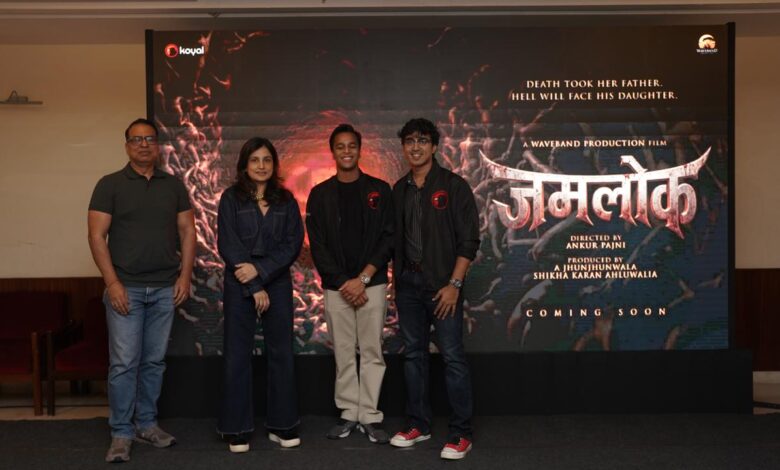
Waveband Production, which has produced Mastiii 4, is collaborating with Koyal AI, a filmmaking technology company backed by Y Combinator. According to the announcement, the project is expected to be completed within three months. The makers are also in discussions with prominent actors from Bollywood and the Telugu film industry, popularly known as Tollywood.
The project is expected to adopt a hybrid filmmaking model, combining performances by real actors with generative artificial intelligence for various production elements. The announcement signals growing interest in applying AI tools to feature-film production in India, particularly in areas that traditionally require substantial budgets, manpower and production time.
Hybrid Filmmaking to Combine Actors and AI
Koyal AI co-founder and CEO Mehul Agarwal described Jamlok as the world’s first AI horror film. Explaining the proposed production approach, he said the film would retain the emotional performances of real actors while using AI to create backgrounds, sets, extras, visual assets and costumes.
According to the announcement, AI will also play a role in incorporating the actors’ likenesses into the production process. The approach is intended to combine human performances with digitally generated environments and characters, potentially offering filmmakers greater flexibility in creating atmospheric horror sequences.
Amar Jhunjhunwala and Shikha Karan Ahluwalia, co-founder of Waveband Production, were also present at the poster unveiling.
The planned three-month production timeline highlights the potential efficiency of AI-assisted filmmaking. However, the project’s final production schedule, cast, release date and distribution arrangements have not been announced in the information provided.
Uncanny India Brings AI Filmmakers Together
The poster unveiling took place at Uncanny India, the first Indian edition of Koyal’s Uncanny Valley Fest. The event brought together filmmakers, content creators, students and technology professionals to explore the creative possibilities of artificial intelligence in filmmaking.
Participants were challenged to create AI-powered films within a single day. Entries were invited across three categories: advertising films, music videos and short films. Nine selected films from the different categories were screened at the festival.
The Uncanny Valley Fest has previously been organised at Y Combinator in San Francisco, at the South by Southwest (SXSW) festival in Austin, Texas, and at Carnegie Mellon University in Pittsburgh.
The Indian edition sought to bring together creative professionals and technology enthusiasts at a time when generative AI tools are opening new possibilities for visual storytelling, music production, advertising and independent filmmaking.
Industry Experts Evaluate AI-Generated Films
The festival featured separate juries for advertising films, music videos and short films.
The advertising category was judged by Sameer Datar of Crayons Advertising and Rajarajan Ramakrishnan of Astra Studios. The music video jury comprised Jaideep Singh of Offbeet Media Group and Anupam Siddhant of Bombay Locale.
The short-film category was evaluated by CV Rao, chief technology officer of Annapurna Studios; Aman Srivastava, CEO of Amar Chitra Katha; and Shikha Karan Ahluwalia of Waveband Production.
The participation of professionals from advertising, entertainment, technology and publishing reflected the festival’s wider focus on the intersection of artificial intelligence and creative industries.
Panel Discussions Examine the Future of Storytelling
Two panel discussions explored how AI could influence Indian storytelling, cultural representation and the filmmaking process.
The first session, titled The India Narrative: AI, Culture and Influence, featured Ganesh Prasad of Think School, Sameer Datar of Crayons Advertising, Kabir Kochhar of Audacity Venture Capital, Jaideep Singh of Offbeet Media Group and Prashant Tandon of Tata 1mg.
The discussion examined the relationship between AI, Indian cultural narratives and influence, including the opportunities emerging as technology becomes increasingly accessible to content creators.
The second session, titled Production Rewritten: Bending the Rules of Filmmaking, focused on AI’s impact on film production. Participants included Shikha Karan Ahluwalia of Waveband Production, Harshit Bansal of Humans of Cinema, Anupam Siddhant of Bombay Locale and Rajarajan Ramakrishnan of Astra Studios.
The programme also included a conversation with content creator Gaurav Chaudhary, widely known as Technical Guruji. CV Rao and Aman Srivastava shared their perspectives on the evolving relationship between technology and filmmaking.
Harikishore S., joint secretary in the Ministry of Tourism, Government of India, addressed the awards ceremony alongside Chaudhary and other guests.
Koyal 3.0 Showcases AI Filmmaking Capabilities
Koyal also presented Koyal 3.0, the latest version of its AI filmmaking platform. The company said the platform can transform a script or voice recording into a film, with particular emphasis on maintaining consistency in characters and locations.
Founded by siblings Mehul Agarwal and Gauri Agarwal, Koyal is backed by Y Combinator. According to the announcement, the company has worked with music and entertainment businesses including Universal Music, T-Series and Maddock, and has created music videos featuring artists such as A.R. Rahman, Shankar Mahadevan and Ricky Kej.
The development of Jamlok comes as filmmakers increasingly explore how generative AI can reduce production constraints and expand visual possibilities. Its hybrid model will test how far AI-generated environments and assets can be integrated with human performances in a feature-length horror narrative.
If completed as planned, the film could offer an early example of how AI filmmaking tools are being applied to mainstream Indian cinema. Its eventual impact will depend on the finished film, the quality of its storytelling and performances, and how audiences respond to the use of AI in the production process.