ISRO Successfully Launches EOS-05 on GSLV-F17, Marks Major Earth Observation Milestone

The Indian Space Research Organisation (ISRO) has successfully launched and precisely placed the advanced Earth Observation Satellite EOS-05 into its intended Sub-Geosynchronous Transfer Orbit (Sub-GTO), marking a significant milestone in India’s space and Earth observation capabilities.
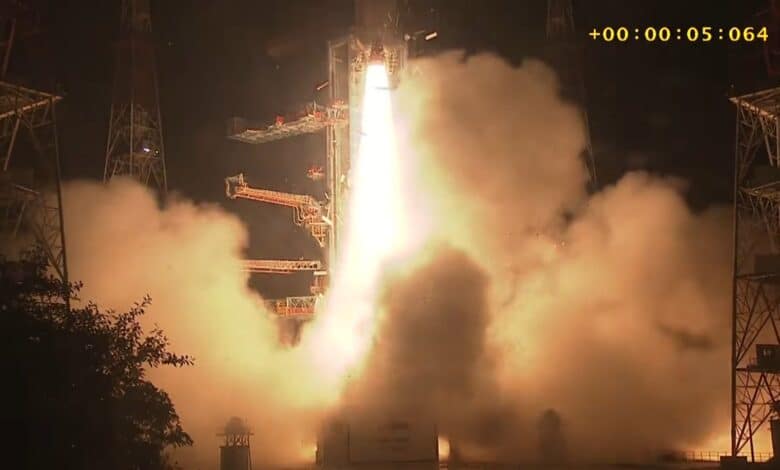
The satellite was launched aboard the GSLV-F17 rocket from the Second Launch Pad at the Satish Dhawan Space Centre in Sriharikota early Friday. Following the successful mission, ISRO Chairman V. Narayanan announced that the launch vehicle had accurately injected EOS-05 into the required orbit.
“I am very happy to announce that the GSLV-F17 vehicle has successfully and precisely injected the Advanced Earth Observation Satellite 05, the geo-imaging star satellite, in the intended and required orbit,” Narayanan said.
He highlighted the strategic importance of the mission, saying that once EOS-05 is operationalised, it will become India’s first dedicated imaging satellite operating from a geosynchronous orbit, providing important strategic data for the country.
India’s First Imaging Satellite from Geosynchronous Orbit
EOS-05 is described as a state-of-the-art Earth observation spacecraft and represents a major advancement in India’s satellite imaging capabilities.
Unlike conventional Earth observation satellites operating from lower orbits, EOS-05 is designed to operate from a geosynchronous orbit, at an altitude of nearly 36,000 km above Earth. Its position is expected to enable frequent and near-real-time monitoring of large geographical areas.
The satellite will strengthen India’s ability to observe the Indian subcontinent and surrounding regions, with applications spanning both civilian and strategic requirements.
The availability of high-frequency Earth observation data could support several important areas, including disaster management, agriculture, weather monitoring and environmental observation.
GSLV-F17 Mission
The mission was carried out using the Geosynchronous Satellite Launch Vehicle (GSLV-F17), marking the 19th flight of India’s GSLV.
The launch was conducted from the Second Launch Pad (SLP) at the Satish Dhawan Space Centre, Sriharikota. The GSLV-F17 configuration featured a 4-metre-diameter ogive composite payload fairing, designed to protect the spacecraft during the initial stages of flight.
The successful placement of EOS-05 into Sub-GTO demonstrates the GSLV’s capability to deliver sophisticated and relatively heavy spacecraft into higher-energy orbits required for geosynchronous missions.
Strategic and Civilian Applications
The EOS-05 mission is expected to expand India’s ability to continuously monitor large areas from space. Such observations can be particularly valuable during natural disasters, when timely satellite imagery can assist authorities in assessing affected regions and planning relief and rescue operations.
In agriculture, Earth observation data can help monitor crops, land use and changing environmental conditions. Satellite-based observations can also contribute to weather and climate-related studies and improve monitoring of environmental changes.
The satellite’s geosynchronous vantage point is particularly significant because it can provide repeated observations of large areas, potentially improving the availability of timely information for decision-making.
Another Milestone for India’s Space Programme
The successful GSLV-F17 mission adds another achievement to India’s growing space capabilities. With EOS-05, ISRO is seeking to combine advanced imaging technology with the advantages of geosynchronous observation.
ISRO has identified EOS-05 as an Earth Observation satellite, with its primary application focused on Earth observation. Once the spacecraft is fully operationalised, it is expected to provide valuable imagery and data for a wide range of national applications.
The successful launch also reinforces the importance of the GSLV platform in deploying advanced satellites into higher orbits. With the precise injection of EOS-05 into Sub-GTO, ISRO has once again demonstrated its ability to execute complex satellite launch missions and expand India’s space-based observation capabilities.