India’s First Hydrogen-Powered Train: Technology, Safety, Cost and the Road Ahead

Indian Railways is exploring alternative fuels as part of its efforts to reduce dependence on conventional fossil fuels and move towards cleaner transportation. Among its most ambitious initiatives is the development of a hydrogen-powered train, a project that has brought new engineering challenges, advanced fuel-cell technology and questions about commercial viability into focus.
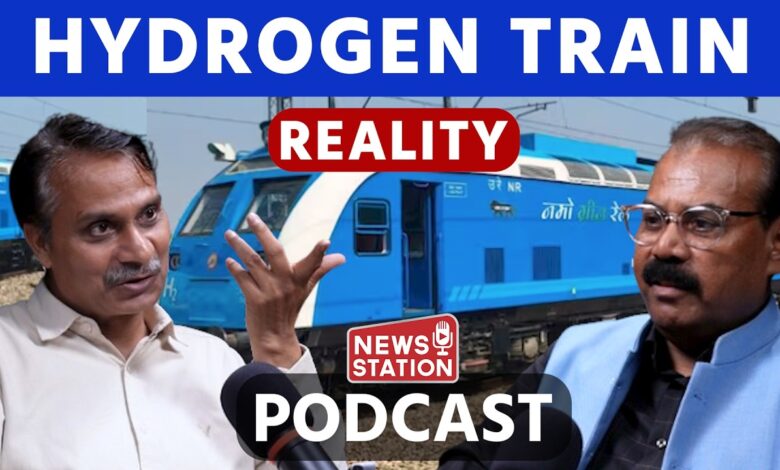
In an exclusive podcast hosted by Siddharatha, Editor, The News Station Network, A.K. Chandra, former Principal Chief Mechanical Engineer (PCME), Northern Railway, discussed the development of India’s first hydrogen-powered train, its operating technology, safety arrangements, costs and the proposed expansion of hydrogen-powered services to heritage railway routes.
Chandra, who served Indian Railways for approximately 36 years, explained that the project was initiated in 2020–21 under the Indian Railways Organization for Alternate Fuels (IROAF). Although the organisation was subsequently closed in September 2021, the approved project continued through the Railway Board and zonal railway system.
How Indian Railways developed the hydrogen train
According to Chandra, the hydrogen train project was initially approved when IROAF was responsible for promoting alternative fuels within Indian Railways. Following the organisation’s closure, its projects were redistributed among the Railway Board and zonal railways.
The hydrogen initiative was assigned to the relevant Railway Board directorate, while Northern Railway was selected to coordinate implementation. The Principal Chief Mechanical Engineer of Northern Railway was made the nodal officer, while the Research Designs and Standards Organisation (RDSO) handled design approvals.
Medha Servo Drives was eventually awarded the work after a tender process involving three participating companies. The project required the conversion of existing diesel-powered DEMU trainsets to hydrogen fuel-cell propulsion without changing their existing traction motors.
“The biggest thing about this is that there were no changes made to our existing drives,” Chandra explained during the podcast.
The project involved several organisations and stages of work. The train’s shell was to be built at Integral Coach Factory (ICF), followed by integration and refurbishment activities. The hydrogen supply arrangement and the need to coordinate different manufacturing and maintenance facilities added to the complexity.
Although the project exceeded its original completion schedule, Chandra described it as a successful experiment that gave Indian Railways practical experience in hydrogen-powered railway technology.
He also highlighted the role of senior railway officials and the Railway Ministry in accelerating the project and ensuring that the experimental train progressed towards operation.
What technology powers India’s hydrogen train?
Unlike conventional diesel trains, which use an internal combustion engine to generate traction power, the hydrogen train uses fuel cells to generate electricity.
Hydrogen is supplied to proton exchange membrane (PEM) fuel cells, which generate electrical energy. This electricity powers the train’s traction system, while batteries provide additional support when higher power is required, particularly during acceleration.
Chandra explained that each power car has four fuel-cell units rated at 120 kilowatts each. The train also uses lithium iron phosphate (LFP) batteries, which support the hybrid propulsion arrangement.
The train has two driving power cars, one at each end. The overall arrangement combines fuel-cell power, battery support and existing traction equipment.
One of the project’s key engineering achievements was adapting internationally available fuel-cell technology to India’s broad-gauge railway system without replacing the existing traction motors.
Chandra said that fuel cells generate electricity at a lower voltage than the approximately 700 volts required by the traction system. A boost converter helps raise the voltage to the required level.
This integration of fuel cells, batteries, power electronics and existing railway equipment was among the technical challenges addressed during development.
He argued that the experience gained by Indian engineers and the manufacturing partner would help India develop further hydrogen-powered railway applications instead of relying entirely on imported trainsets.
How safe is hydrogen as a railway fuel?
Hydrogen safety was one of the major subjects discussed during the interview. Hydrogen is highly flammable, colourless and odourless, which makes leak detection and effective ventilation essential.
Chandra said that the project incorporated safety measures at locations where hydrogen leakage could potentially occur. These include the onboard storage cylinders, fuel supply connections and hydrogen-fuelling infrastructure.
According to him, the train stores hydrogen in high-pressure cylinders operating at approximately 350 bar. Sensors are installed at potential leakage points, while ventilation and exhaust arrangements help prevent leaked hydrogen from accumulating inside enclosed spaces.
Because hydrogen is lighter than air, it generally rises when released. However, this does not eliminate the risk of fire or explosion, particularly where gas can accumulate in enclosed or poorly ventilated areas.
Chandra compared hydrogen-related risks with those associated with conventional fuels and lithium-ion batteries, emphasising that risk management depends on appropriate engineering safeguards and operating procedures.
He also said that the train underwent safety assessment involving TÜV SÜD, an international testing and certification organisation.
The interview highlighted an important principle: hydrogen-powered trains require specialised safety systems, continuous monitoring and trained personnel. The presence of sensors and ventilation reduces risks but does not make hydrogen inherently risk-free.
Hydrogen production and the Jind fuelling facility
The availability of hydrogen is central to the train’s operational viability. Unlike diesel, hydrogen is not directly extracted as a ready-to-use fuel from conventional underground reserves. It must be produced using other energy sources or chemical processes.
Chandra explained that hydrogen can be produced through different methods, including electrolysis. The Jind facility uses a proton exchange membrane electrolyser to produce hydrogen by splitting water using electricity.
According to the figures shared during the podcast, the facility has a hydrogen storage capacity of approximately 3,000 kg. This includes hydrogen stored in high-pressure cylinders, with the onboard cylinders operating at around 350 bar.
Chandra said that the train can complete two round trips on a single refuelling, depending on operating requirements. He also explained that the fuelling infrastructure could support additional trains, provided that its capacity and operational arrangements are adequate.
The environmental benefits depend significantly on how the hydrogen is produced. Hydrogen made using renewable electricity, such as solar power, can substantially reduce emissions associated with fuel production. Hydrogen produced using fossil fuels may offer a different environmental outcome.
Chandra discussed green, blue and grey hydrogen in the context of different production pathways. However, the precise classification of hydrogen depends on the production process and its associated emissions, not simply on whether electricity is used.
He said Indian Railways has renewable-energy installations at several locations and that renewable electricity could support the production of green hydrogen.
What will it cost to operate a hydrogen train?
Operating costs and commercial viability remain critical questions for the future of hydrogen-powered rail services.
Chandra said that the hydrogen train project was initially sanctioned at approximately ₹84 crore, while the final project cost reached around ₹124 crore. The latter figure, as discussed in the interview, includes the hydrogen production facility.
He emphasised that the economics of the project would improve if hydrogen infrastructure were used by multiple trains rather than a single train.
The former railway official also shared an illustrative calculation of fuel expenditure. Assuming a hydrogen price of ₹600 per kg and consumption of approximately 84 kg per train-kilometre, the fuel cost would be around ₹50,400 per train-kilometre.
At full passenger capacity of approximately 2,600 passengers, that would translate to roughly ₹19.40 per passenger-kilometre.
The calculation is important because the interview transcript contains a numerical inconsistency: the figure of 84 kg per train-kilometre, when multiplied by ₹600 per kg, gives ₹50,400—not ₹56. The reported figure of approximately 19 paise per passenger-kilometre therefore does not follow from the stated consumption and hydrogen price.
These numbers should be independently verified against actual fuel consumption, the train’s operating pattern, passenger capacity and the cost of hydrogen before being used to establish the train’s commercial economics.
Chandra also clarified that the calculation was intended to illustrate fuel expenditure and excluded infrastructure costs. The overall economics would additionally depend on capital expenditure, maintenance, electricity used to produce hydrogen, staffing and utilisation of the fuelling facility.
The key takeaway from the discussion was that hydrogen-powered trains could become more commercially attractive as production costs fall and more trains share the same infrastructure.
Why run a hydrogen train under electrified railway lines?
One criticism of the initiative is that the hydrogen train operates on a route where overhead electrification is available. Critics have questioned why Indian Railways would develop a hydrogen-powered train when it has already invested heavily in electrification.
Chandra described the project as a demonstration of an emerging technology rather than a proposal to replace electric traction across the entire railway network.
The objective is to develop the technical capability to operate hydrogen-powered trains, understand their maintenance requirements and assess their performance under Indian conditions.
He argued that the experiment should be evaluated in the context of future energy security and the need to diversify fuel sources. India imports a substantial proportion of its petroleum requirements, making alternative energy technologies strategically important.
Hydrogen traction could be particularly relevant on routes where conventional electrification is difficult or expensive, provided that hydrogen production, transportation, fuelling and maintenance can be made economically viable.
Hydrogen for Heritage: A ₹5,000-crore initiative
The interview also discussed Indian Railways’ Hydrogen for Heritage initiative, which Chandra described as a separately approved programme with a reported outlay of ₹5,000 crore.
The proposal envisages the introduction of hydrogen-powered trains on selected heritage and hill railway routes, where preserving the natural environment is particularly important.
Chandra said the successful development of the initial hydrogen train could provide valuable experience for subsequent projects. Such routes would require careful evaluation of gradients, operational demands, fuelling arrangements and safety requirements.
Hydrogen fuel-cell trains produce water as their principal direct exhaust product during operation. However, their overall environmental footprint also depends on hydrogen production, transportation and the energy used to operate supporting infrastructure.
Chandra said that the expansion of hydrogen-powered railway services could receive additional support from India’s National Green Hydrogen Mission, launched in January 2023.
He expressed optimism that the development of a domestic hydrogen ecosystem, including fuel-cell manufacturing and related technologies, could strengthen India’s position in the global clean-energy sector.
Can India’s hydrogen train run faster?
The train’s operating speed has also attracted public attention. Chandra explained that its speed had been deliberately restricted to approximately 80 kmph during the experimental phase.
According to him, the underlying train design was capable of operating at 100 kmph, while higher-speed hydrogen-powered trains could be developed in the future.
He said the speed restriction was a precaution associated with the first experimental application, with safety and operational validation taking priority.
The ability to achieve higher speeds would depend on the complete train design, traction performance, braking, infrastructure compatibility and the applicable safety approvals.
Hydrogen versus LNG: What is the difference?
The discussion also examined the distinction between hydrogen fuel-cell trains and trains powered by liquefied natural gas (LNG).
Chandra explained that LNG-powered trains use an internal combustion engine, similar in principle to diesel-powered and compressed natural gas (CNG)-powered vehicles. Hydrogen fuel-cell trains, by contrast, generate electricity through an electrochemical process.
LNG can reduce certain emissions compared with conventional diesel, depending on the engine and operating conditions. However, it remains a fossil fuel and can involve methane emissions across its supply chain.
Hydrogen fuel-cell trains avoid the direct combustion emissions associated with diesel engines, but their overall climate benefits depend on how the hydrogen is produced.
The two technologies therefore represent different approaches to alternative railway propulsion rather than identical solutions.
India’s railway energy transition: The road ahead
Looking ahead, Chandra said alternative fuels could play a larger role in transportation over the next 15–20 years. Hydrogen could potentially find applications in railways, road transport, shipping and aviation, although the pace of adoption will depend on technological progress and economics.
He described Indian Railways’ hydrogen initiative as a step towards diversifying energy sources, reducing dependence on fossil fuels and developing domestic engineering expertise.
The project’s long-term significance may extend beyond the operation of a single train. The experience gained in integrating fuel cells, batteries, power electronics, hydrogen storage and railway traction could help establish capabilities for future projects.
At the same time, commercial expansion will require reliable hydrogen supplies, lower fuel costs, efficient maintenance systems and robust safety standards.
For Indian Railways, the immediate challenge is to move from demonstration to economically sustainable deployment. If production costs fall and shared infrastructure supports multiple services, hydrogen could become a useful option for selected railway routes.
In the News Station podcast, A.K. Chandra’s central message was that the hydrogen train should be viewed as an investment in learning and technological capability. Its ultimate success will depend not only on whether the train runs, but also on whether Indian Railways can scale the technology safely, reliably and affordably.
The conversation was hosted by Siddharatha, Editor, The News Station Network, as part of News Station’s coverage of railway innovation, infrastructure development and India’s transition towards cleaner energy.