PM Modi Invites European Industries to Expand Investments in India
Prime Minister Addresses European Industry Leaders in Sweden, Highlights India-EU FTA and Strategic Economic Partnership

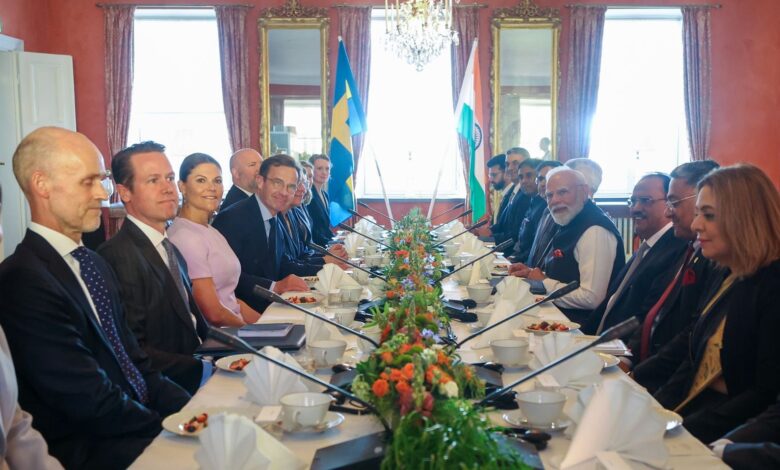
Prime Minister Narendra Modi addressed the European Round Table for Industry, or ERT, in Gothenburg, Sweden, on May 17, 2026, highlighting India’s growing economic partnership with Europe and inviting European companies to expand investments in India. The interaction was hosted by the Volvo Group and attended by Swedish Prime Minister Ulf Kristersson, European Commission President Ursula von der Leyen, senior industry leaders, and representatives of major European and Indian companies.
In his keynote address, Prime Minister Modi emphasized the increasing strategic convergence between India and Europe at a time of global uncertainty and geopolitical challenges. He stressed the importance of trusted partnerships, resilient supply chains, and stronger industrial cooperation between democratic economies.
Prime Minister Modi welcomed the growing momentum in India-European Union relations and described the recently concluded India-EU Free Trade Agreement as a landmark achievement. According to him, the agreement will open new opportunities in trade, investment, manufacturing, technology, services, and supply chain integration. He said the FTA would serve as a transformative economic partnership between India and Europe and significantly boost commercial cooperation in the coming years.
The Prime Minister also referred to the India-Middle East-Europe Economic Corridor, or IMEC, and said such connectivity projects would create new business opportunities and strengthen economic integration between India and Europe. He noted that improved connectivity and logistics networks would enhance trade efficiency and support long-term strategic cooperation.
Highlighting India’s economic progress, Prime Minister Modi described India as one of the world’s most attractive destinations for investment, innovation, and manufacturing. He pointed to India’s rapid economic growth, next-generation reforms, ease of doing business initiatives, expanding digital public infrastructure, and fast-transforming infrastructure sector.
Prime Minister Modi reiterated India’s vision of “Design for India, Make in India and Export from India,” inviting European industries to deepen their engagement with the Indian economy. He emphasized that India offers a stable, reliable, and trusted economic environment for global investors and manufacturers.
The Prime Minister underlined the need for India and Europe to work together in building resilient and diversified global supply chains. He said India is making major investments in transport, logistics, renewable energy, green hydrogen, and nuclear power as part of its long-term development and sustainability goals.
Prime Minister Modi invited European companies to collaborate with India in several high-growth sectors, including telecom and digital infrastructure, Artificial Intelligence, semiconductors, electronics, deep-tech manufacturing, clean energy, urban transformation, mobility, healthcare, and life sciences.
He also stressed the importance of talent mobility and skill partnerships between India and Europe. Highlighting India’s young and skilled workforce as a major advantage, Prime Minister Modi said stronger cooperation in education, research, innovation, and workforce development would benefit both regions in the future global economy.
During the interaction, the Prime Minister proposed holding an annual India-Europe CEOs Round Table to strengthen institutional business engagement. He also suggested the creation of an India Desk within the European Round Table for Industry to facilitate deeper coordination and business cooperation between European companies and India.
The event provided a key platform for dialogue between political leaders and industry representatives on expanding India-Europe economic and industrial collaboration. Participants discussed opportunities in sustainable growth, advanced technologies, green transition, and resilient global partnerships.
The interaction in Gothenburg is being viewed as another important step in strengthening India-Europe relations, particularly at a time when both sides are looking to enhance cooperation in trade, technology, manufacturing, and strategic infrastructure. With growing economic ties and the recently concluded India-EU FTA, India and Europe are expected to deepen collaboration across multiple sectors in the coming years.