Assembly of Massive Tunnel Boring Machines Begins at Vikhroli for India’s First Bullet Train Project

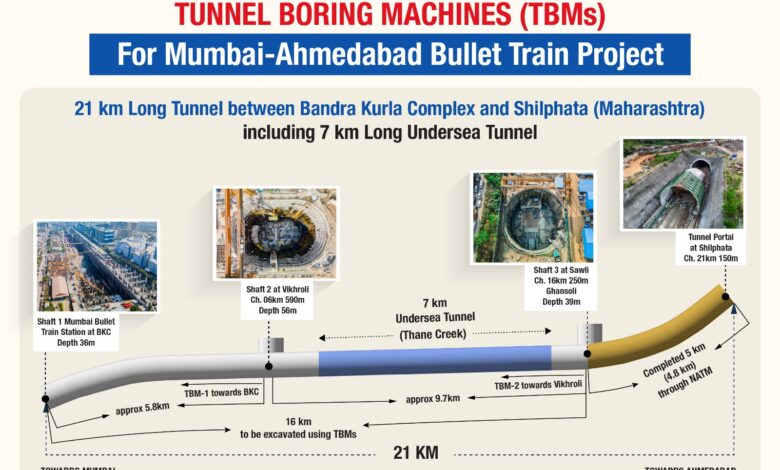
In a significant milestone for India’s ambitious Mumbai-Ahmedabad High-Speed Rail (Bullet Train) project, the lowering and assembly of advanced Tunnel Boring Machines (TBMs) has officially commenced at the Vikhroli shaft in Maharashtra. This marks the beginning of intensive underground construction for one of the most challenging sections of the 508-km corridor — a 21-km-long tunnel that includes India’s first-ever 7-km undersea tunnel beneath Thane Creek.
The development comes after the two giant TBMs, manufactured by German firm Herrenknecht and assembled via components from China, arrived at Mumbai’s Jawaharlal Nehru Port (JNPT) on March 23, 2026, following months of logistical and geopolitical delays. Their transportation to the assembly sites required over 150–219 multi-axle trailers moving in nighttime convoys to minimize disruption to Mumbai’s traffic.
Engineering Marvel Under Mumbai
The 21-km tunnel section falls under Package C2 of the project, stretching from Bandra-Kurla Complex (BKC) to Shilphata near Thane. Of this, approximately 5 km has already been completed using the New Austrian Tunnelling Method (NATM). The remaining 16 km will be excavated using two state-of-the-art Mixshield/Slurry TBMs, which are specially designed to handle complex geological conditions, including soft soil, rock, and the sensitive undersea environment.
This single-tube tunnel will have an internal diameter of about 13.1 metres to accommodate twin tracks for high-speed trains running at up to 320–350 km/h. The tunnel depth varies between 25 to 57 metres below ground level, reaching a maximum of 114 metres beneath Parsik Hill. The undersea portion beneath Thane Creek poses unique engineering challenges, requiring precise control to prevent water ingress and ensure structural integrity.
Dramatic Lowering Operation at Vikhroli
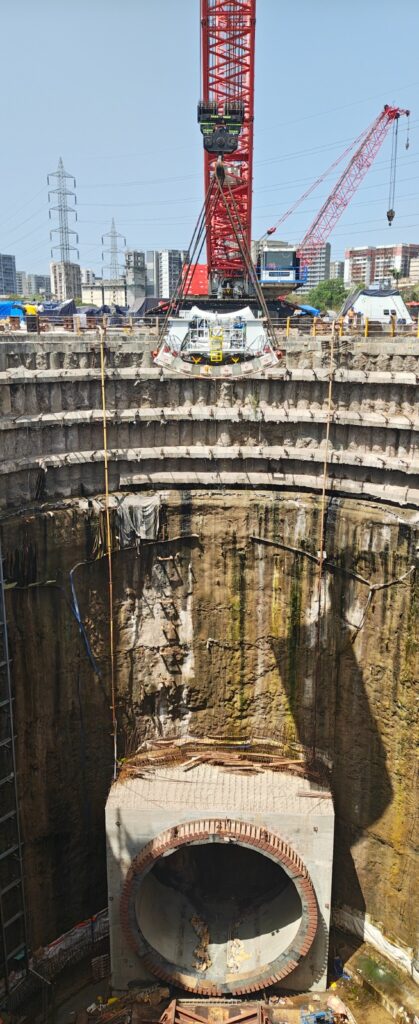
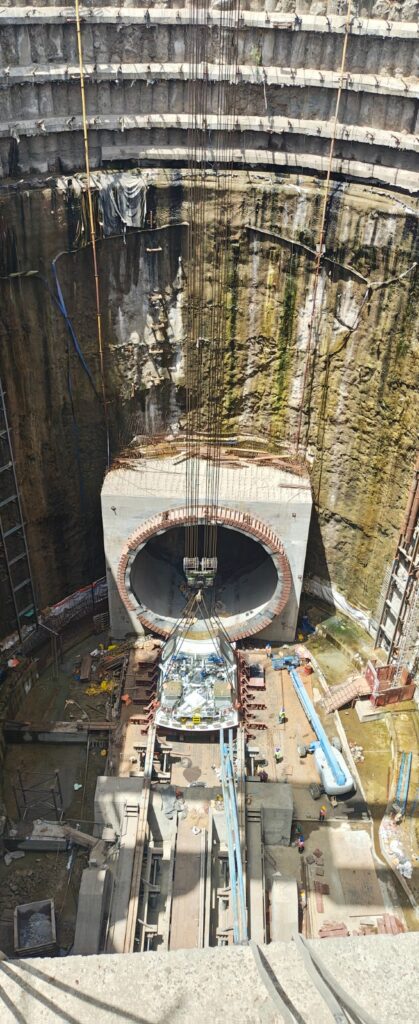
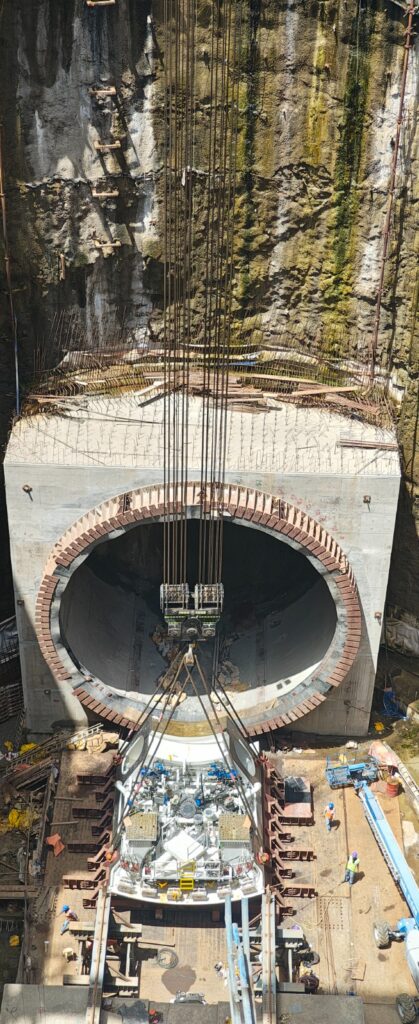
The assembly process kicked off dramatically at the Vikhroli shaft (Shaft 2), where one of the six main shield segments of the TBM — weighing approximately 170 metric tonnes, measuring 8.66 metres in length and 7 metres in width — was lowered to a depth of 56 metres below ground level. This depth is equivalent to the height of a 20-storey building.
A massive 1,700-tonne crane was deployed for the delicate operation inside a specially excavated shaft measuring roughly 56m x 56m x 40m. The site buzzed with activity as rails were laid, gantries installed, and safety protocols strictly followed with blaring sirens signalling each successful stage.
Three dedicated shafts have been constructed to facilitate the TBM operations:
- Shaft 1: Retrieval shaft at BKC (Mumbai Bullet Train station)
- Shaft 2: Launch/assembly shaft at Vikhroli
- Shaft 3: Launch shaft at Sawli (near Ghansoli in Navi Mumbai)
TBM-1 will launch from Vikhroli (Shaft 2) and bore towards BKC, while TBM-2 will start from Sawli (Shaft 3) and move towards Vikhroli. This dual-drive strategy will accelerate the excavation of the 16-km TBM-driven section.
Massive Machines with Cutting-Edge Technology
The two TBMs are among the largest and most advanced ever deployed for a railway project in India. Their key specifications include:
- Weight: TBM-1 — 3,080 tonnes; TBM-2 — 3,184 tonnes (totaling nearly 6,000 tonnes for both machines)
- Cutter head diameter: 13.6 metres
- Total length: 95.32 metres each
- Type: Mix Shield / Slurry-based technology, ideal for variable ground conditions and high water pressure
Each machine consists of critical components such as the cutter wheel, main bearing, jaw crusher, erector, main shield, tail shield, and four specialized gantries that support operations:
- Gantry 1: Transformers, operator cabin, grouting pump, STS
- Gantry 2: Segment lifter, grout tank, hose wheel
- Gantry 3: STS pipe wagon, cable box
- Gantry 4: Ventilation duct
The TBMs can operate at a maximum cutterhead speed of 4 RPM (revolutions per minute) with a peak excavation rate of 49 mm per minute. This allows for steady, controlled progress while maintaining stringent safety standards in a densely populated urban and ecologically sensitive area.
Tunnelling operations are expected to begin with an initial drive in July 2026, followed by the main drive from October 2026, after full assembly, testing, and commissioning.
Supporting Infrastructure Ready
To support the massive tunnelling effort, a dedicated casting yard spanning 11.17 hectares is already operational in Mahape, Thane district. This facility will produce 77,000 precast concrete segments to form 7,700 rings for lining the 16-km TBM tunnel.
Each ring comprises nine curved segments plus one key segment, with each segment being 2 metres wide and 500 mm (0.5 metres) thick. The yard is equipped with advanced automation, including cranes, gantries, a batching plant, casting sheds, stacking areas, and steam curing facilities to ensure high-quality, consistent production.
Safety and Monitoring at the Forefront
Given the proximity to existing infrastructure and residential areas, comprehensive monitoring systems have been installed. These include:
- Surface Settlement Points (SSP)
- Optical Displacement Sensors (ODS) or tilt meters
- BRT (By Reflect Target / 3D targets)
- Strain Gauges for measuring micro-strains
- Seismographs to monitor Peak Particle Velocity (PPV), vibrations, and seismic waves
These instruments will provide real-time data to ensure safe excavation and protect nearby structures, utilities, and the environment.
Broader Context of the Bullet Train Project
The Mumbai-Ahmedabad High-Speed Rail Corridor, India’s first bullet train project executed by the National High Speed Rail Corporation Limited (NHSRCL), aims to reduce travel time between the two cities from over 8 hours to approximately 2 hours. The project features a mix of elevated viaducts (majority of the alignment), tunnels, and bridges.
While the Maharashtra section, particularly the underground portion in Mumbai, has faced delays due to land acquisition and urban complexities, work in Gujarat has progressed faster, with several elevated sections and stations advancing rapidly. The overall project target remains December 2029–2030, though partial sections (such as Surat to Bilimora) are expected earlier.
The successful assembly of these TBMs represents a triumph of modern engineering and international collaboration. Once operational, they will not only carve out India’s first undersea rail tunnel but also set new benchmarks for infrastructure development in challenging urban environments.
As the giant machines take shape deep underground at Vikhroli, the dream of a high-speed future for Indian railways inches closer to reality — promising faster, safer, and more efficient connectivity between India’s financial capital and the vibrant city of Ahmedabad.
(Word count: approx. 998)
This development underscores India’s growing capability in executing complex mega-infrastructure projects, blending global technology with local execution excellence. The coming months will be crucial as the TBMs begin their subterranean journey, literally boring a path to India’s high-speed rail revolution.