Second Tunnel Boring Machine Begins Excavation for India’s First Undersea Bullet Train Tunnel Beneath Thane Creek

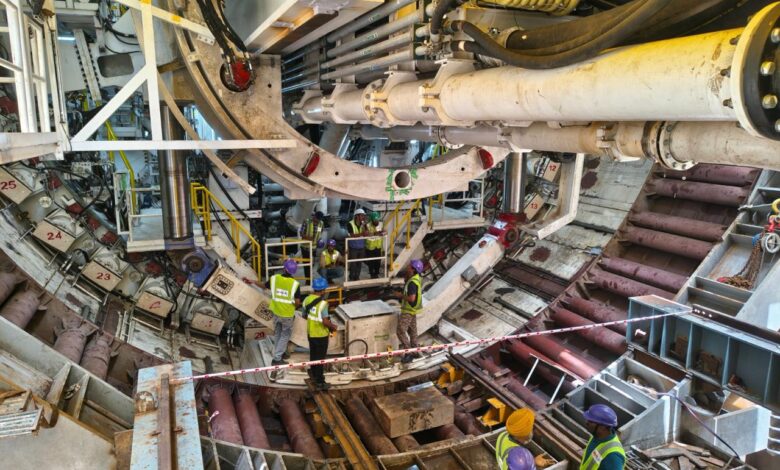
The Mumbai–Ahmedabad High-Speed Rail (MAHSR) project achieved another major engineering milestone on Friday with the launch of the second Tunnel Boring Machine (TBM) for the construction of India’s first undersea railway tunnel beneath Thane Creek in Maharashtra.
The newly commissioned TBM has started tunnelling from Sawli (Ghansoli) towards Vikhroli, where it will excavate a significant portion of the project’s underground corridor. Of the 10-kilometre stretch between Sawli and Vikhroli, nearly 7 kilometres will pass beneath the waters of Thane Creek, making it the country’s first undersea rail tunnel.
The undersea section forms part of the 21-kilometre-long underground corridor connecting Bandra Kurla Complex (BKC) in Mumbai with Sawli (Ghansoli). Of this, 16 kilometres will be excavated using Tunnel Boring Machines, while the remaining 5 kilometres have already been completed using the New Austrian Tunnelling Method (NATM).
Earlier this month, on July 5, the first TBM commenced its 6-kilometre drive from Vikhroli towards BKC. With the second machine now in operation from the opposite end, tunnelling activities have entered a new phase, accelerating progress on one of the most technically demanding sections of the country’s first high-speed rail corridor.
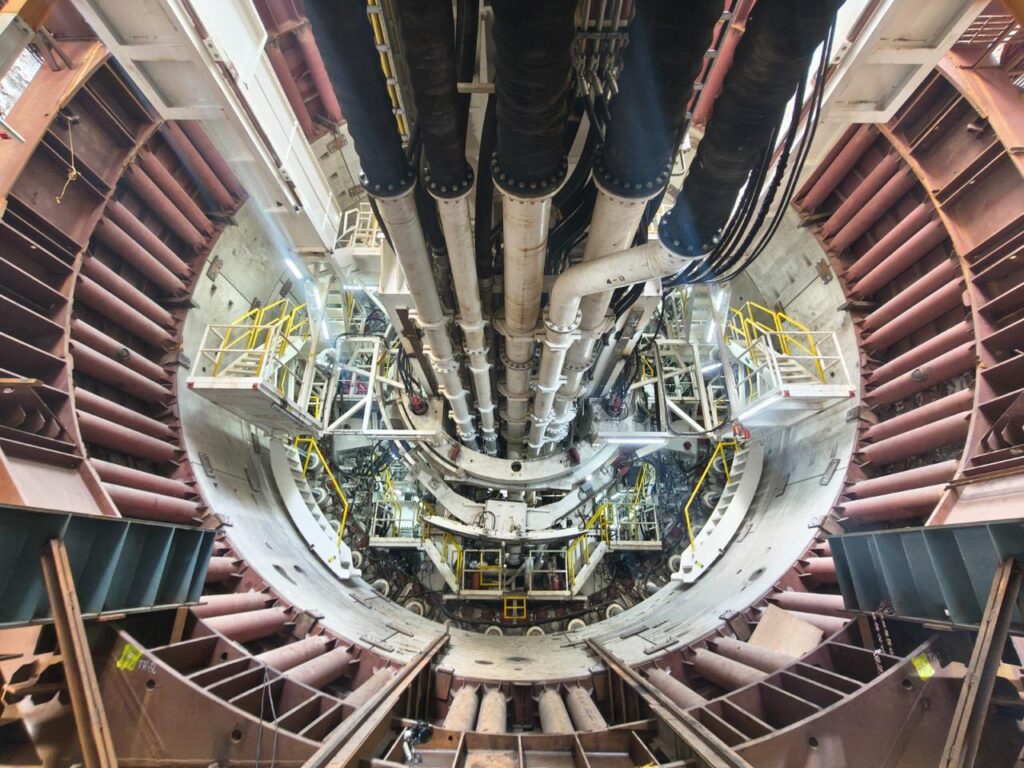
One of India’s Largest Rail Tunnel Boring Machines
The newly deployed TBM ranks among the largest machines ever used for railway tunnel construction in India. It is equipped with a cutterhead measuring 13.6 metres in diameter—roughly equivalent to the height of a four-storey building. The machine weighs approximately 3,200 tonnes, comparable to the combined weight of around 500 Asian elephants, and stretches 96 metres in length.
The TBM comprises several sophisticated components, including the cutter wheel, main bearing, jaw crusher, erector, main shield, tail shield, and four specialised gantries that support continuous tunnelling operations.
Engineers have configured the machine as a Mixshield-type, semi-automatic, slurry-based TBM, specifically designed for challenging geological conditions. The Mixshield technology employs pressurised bentonite slurry to stabilise the tunnel face during excavation, ensuring safe and controlled progress through soft soil and water-bearing strata beneath the densely populated Mumbai suburban region.
According to project officials, this technology has been selected because of its superior capability to minimise ground settlement and reduce the risk of surface disturbance in highly urbanised areas.
Faster and Safer Tunnel Construction
The TBM has also been integrated with an advanced Semi-Continuous Advance (SCA) system, enabling simultaneous tunnel excavation and installation of precast concrete lining segments. This concurrent process significantly enhances construction efficiency while maintaining high safety standards.
To launch the massive machine, engineers first constructed a 39-metre-deep vertical shaft at Sawli—equivalent to a 12-storey building below ground level.
Given the confined space available within the launch shaft, the TBM was assembled underground in multiple stages. The four double-storey gantries were lowered first and pushed into the already completed NATM tunnel before the main shield and cutterhead were carefully lowered and assembled.
Advanced Safety Systems
The trailing backup system behind the TBM consists of four double-storey gantries measuring approximately 18 to 20 metres each. These gantries house essential operational systems, including slurry pumps, hydraulic units, operator cabins, grouting equipment, power distribution systems, emergency refuge chambers, ventilation facilities, workshop areas, cable trays, and maintenance equipment.
Safety has been given top priority throughout the tunnelling operation. The TBM is equipped with a real-time multi-gas monitoring system capable of detecting methane, oxygen, carbon monoxide and carbon dioxide levels continuously during excavation.
Fire protection systems include automatic fire detection, automatic extinguishing systems installed on electrical panels and hydraulic power packs, safety water curtains, and an active sprinkler network along designated emergency escape routes.
Extensive Support Infrastructure
A comprehensive support ecosystem has been established at the Sawli shaft to facilitate uninterrupted tunnelling operations. The site includes a water treatment plant, slurry treatment facility, bentonite storage tanks, a dedicated electrical substation, backup power generators, a ready-mix concrete plant for tunnel grouting, slurry transport systems, sewage treatment facilities, and extensive logistics infrastructure.
Project engineers have also deployed an advanced real-time monitoring network to safeguard surrounding buildings and infrastructure during excavation. Monitoring instruments include Surface Settlement Points (SSP), Optical Displacement Sensors, Tilt Meters, Bi-Reflective Targets, Strain Gauges, and Seismographs to continuously track ground movement, structural behaviour and vibration levels.
Waterproof Tunnel Designed for Long-Term Durability
The tunnel section being constructed using TBMs has been designed as a fully waterproof underground structure capable of withstanding long-term groundwater pressure.
To prevent water ingress, engineers are installing double-layer Ethylene Propylene Diene Monomer (EPDM) rubber gaskets together with hydrophilic seals between tunnel lining segments. These systems are designed to provide permanent waterproofing while ensuring the structural integrity and durability of the tunnel throughout its operational life.
The commencement of the second TBM marks another significant milestone for the Mumbai–Ahmedabad Bullet Train project, bringing India closer to completing its first undersea railway tunnel and one of the country’s most ambitious transportation infrastructure projects.