
Union Environment Minister Inaugurates Centre of Excellence on Human-Wildlife Conflict in Coimbatore, Launches National Conflict Portal

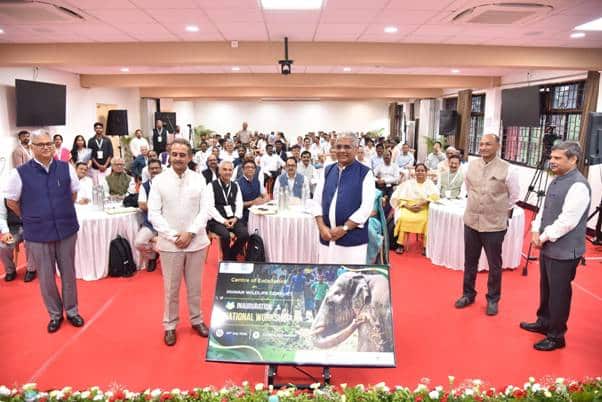
Union Minister for Environment, Forest and Climate Change Bhupender Yadav on Thursday inaugurated the Centre of Excellence (CoE) on Human-Wildlife Conflict at the Wildlife Institute of India (WII)–SACON campus in Coimbatore, Tamil Nadu. The Centre aims to strengthen scientific research, policy support, technological innovation, and capacity building to address the growing challenge of human-wildlife conflict across the country.
The inauguration was followed by a National Workshop on Human-Wildlife Conflict, which brought together senior policymakers, forest officials, scientists, conservationists, researchers, and technology experts from across India to discuss effective strategies for reducing conflicts between humans and wildlife. Union Minister of State for Environment, Forest and Climate Change Kirti Vardhan Singh also attended the event.
Addressing the gathering, Bhupender Yadav said that human-wildlife conflict has become one of India’s most pressing conservation and development challenges due to increasing interactions between people and wild animals. He attributed the growing incidents to habitat fragmentation, changing land-use patterns, rapid urbanisation, and expanding human activities that have brought wildlife and human settlements into closer contact.
The Minister stressed that India must adopt a solution-oriented approach rather than focusing only on the problems. He called for greater use of modern technology, scientific research, and innovative management practices to reduce conflicts while ensuring the protection of both wildlife and human lives.
Bhupender Yadav said the newly established Centre of Excellence was announced by Prime Minister Narendra Modi during the 7th Meeting of the National Board for Wildlife. He explained that the Centre would serve as the country’s national hub for research, innovation, policy development, training, and dissemination of best practices related to human-wildlife conflict management.
According to the Minister, the Centre will support evidence-based policymaking, develop scientific solutions, strengthen institutional capacity, and help forest departments across India implement effective conflict mitigation measures.
Highlighting specific conservation priorities, Yadav said the Centre should formulate strategies to address conflicts involving tigers outside protected reserves, leopards, and elephants, which frequently come into contact with human populations. He noted that increasing wildlife movement beyond protected areas requires targeted management strategies tailored to specific species and local conditions.
The Minister also emphasised the importance of creating awareness among both rural and urban communities about how to respond safely during encounters with wild animals. Such awareness campaigns, he said, should be conducted in mission mode to reduce panic, prevent accidents, and encourage peaceful coexistence between humans and wildlife.
He urged forest departments across all states to adopt proactive measures to minimise damage to crops, livestock, and human settlements caused by wildlife. These measures, he said, should be developed through close consultation with local communities and other stakeholders while making effective use of modern conservation technologies.
“Coexistence and harmony, instead of conflict, should be the mantra of ecological sustainability,” Bhupender Yadav said, calling for a balanced approach that protects biodiversity while safeguarding people’s livelihoods.
Union Minister of State Kirti Vardhan Singh said India’s success in wildlife conservation has led to increased interactions between humans and wildlife. While this reflects positive conservation outcomes, it has also created significant socio-economic challenges, particularly for communities living near forests.
He said there is a need to develop long-term solutions that strike a balance between wildlife conservation and the country’s developmental needs. Singh expressed confidence that the Centre of Excellence would play a crucial role in training officials, empowering local communities, promoting advanced technologies, and preserving traditional knowledge for effective wildlife management.
During the inaugural session, Bhupender Yadav also launched the National Human-Wildlife Conflict Portal, a digital platform designed to improve data collection, monitoring, knowledge sharing, and decision-making related to wildlife conflict across India. The portal is expected to help government agencies monitor incidents more effectively and support timely interventions using reliable data and technological tools.
The Minister also released the first publication in a new series titled “Current Status of Human-Wildlife Conflict in India: An Overview.” The report provides a comprehensive assessment of the present situation, emerging trends, key challenges, and opportunities for improving conflict mitigation across different regions of the country.
The workshop featured several technical sessions, including a live demonstration of the newly launched Human-Wildlife Conflict Portal. Experts also delivered presentations and participated in panel discussions on major issues such as human-elephant conflict, human-big cat conflict, and the use of technology and innovation for conflict mitigation.
Participants exchanged ideas on improving early warning systems, using artificial intelligence and geospatial technologies, strengthening coordination among government agencies, and promoting community participation in wildlife conservation.
The deliberations are expected to generate actionable recommendations for strengthening India’s national strategy on human-wildlife conflict management, enhancing cooperation among stakeholders, and promoting sustainable coexistence between people and wildlife.
The Ministry said the establishment of the Centre of Excellence reflects the Government of India’s continued commitment to protecting biodiversity while ensuring the safety and livelihoods of people through science-based, technology-enabled, and community-driven conservation approaches.
Senior officials attending the event included the Secretary of the Ministry of Environment, Forest and Climate Change, the Director General of Forests and Special Secretary, the Additional Director General (Wildlife), the Director of the Wildlife Institute of India, representatives of State Forest Departments, academic institutions, and partner organisations.