NHSRCL Invites Engineering Students to Visit Bullet Train Construction Sites

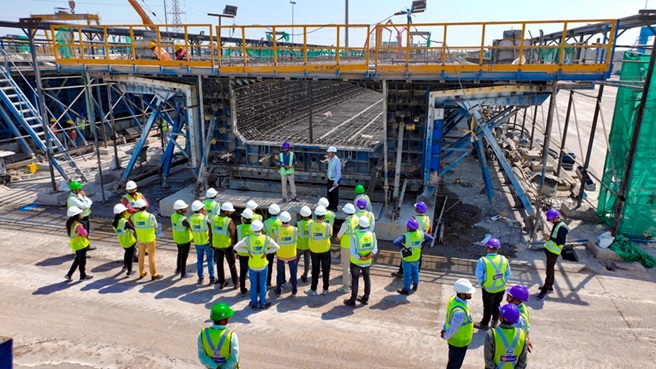
In a major initiative aimed at providing practical exposure to young engineers, the National High Speed Rail Corporation Limited (NHSRCL) has invited technical institutions from across the country to visit construction sites of India’s first Bullet Train project between Mumbai and Ahmedabad. The initiative is designed to give students firsthand experience of one of the country’s most ambitious and technologically advanced infrastructure projects currently under development.
According to NHSRCL, the site visits will allow engineering, architecture and polytechnic students to closely observe the construction process of the Mumbai–Ahmedabad High Speed Rail corridor and understand the complexities involved in building a modern high-speed rail network.
The corporation stated that the programme has been specially designed to bridge the gap between classroom learning and real-world infrastructure execution. Students participating in the visits will get an opportunity to interact directly with engineers and technical experts working on the project and gain insights into cutting-edge railway construction technologies being implemented in India for the first time.
Officials said the visits would help young engineers understand various components of high-speed rail infrastructure, including the construction of elevated viaducts, bridges, stations and overhead electrification systems. Participants will also be introduced to advanced quality standards, safety protocols and project management practices followed at the construction sites.
The Mumbai–Ahmedabad Bullet Train project is India’s first high-speed rail corridor and one of the largest infrastructure projects currently under execution in the country. Once completed, the corridor is expected to significantly reduce travel time between Mumbai and Ahmedabad while introducing Japanese Shinkansen technology to India’s railway sector.
NHSRCL officials believe the project can also serve as a learning platform for future engineers who may contribute to similar high-speed rail and mega infrastructure projects in the coming years. Through these educational visits, students will gain exposure to modern engineering practices, large-scale construction management and international standards in railway development.
As part of the programme, participants will receive briefings and technical guidance from site engineers. Students will be taken to designated construction sites and project offices where they can observe various stages of infrastructure development on the ground.
The corporation has fixed a maximum batch size of 20 participants per visit to ensure better coordination and safety management. Eligible participants include students and young engineers from engineering colleges, polytechnic institutes, architecture institutions and other technical education centres.
NHSRCL clarified that transportation, lodging and boarding arrangements for participating groups will have to be made by the respective educational institutions. However, all site-related guidance and safety arrangements during the visit will be coordinated by NHSRCL officials.
Given the high-risk nature of active construction zones, the corporation has made strict adherence to safety protocols mandatory for all visitors. Participants will be required to follow site safety instructions and use Personal Protective Equipment (PPE) provided during the visit. Officials stated that safety remains a top priority at all Bullet Train construction sites.
The initiative is also expected to inspire students by giving them direct exposure to one of India’s most prestigious transport modernization projects. Experts believe that practical site visits play an important role in helping engineering students understand the real-world application of technical concepts, especially in sectors such as civil engineering, structural engineering, transportation planning and electrical systems.
The Mumbai–Ahmedabad High Speed Rail corridor spans across Maharashtra and Gujarat and involves the construction of advanced rail infrastructure including long viaducts, tunnels, river bridges and state-of-the-art stations. Several sections of the corridor are currently witnessing rapid progress, with large-scale civil works underway across multiple locations.
NHSRCL has established project offices at various locations along the route to coordinate construction activities and engage with stakeholders. Educational institutions interested in participating in the site visit programme have been asked to contact their nearest NHSRCL office for scheduling and further details. A copy of the communication is also required to be marked to the Principal of the High Speed Rail Training Institute (HSRTI).
The major project offices are located in Mumbai, Palghar, Surat, Vadodara and Ahmedabad. The High Speed Rail Training Institute, which functions as a dedicated training and knowledge centre for the Bullet Train project, is located in Vadodara, Gujarat.
Officials stated that the programme reflects NHSRCL’s broader vision of developing skilled manpower and creating awareness about high-speed rail technology among India’s future engineers. The corporation hopes that such initiatives will encourage innovation, technical learning and greater interest in infrastructure development among students.
India’s Bullet Train project has been viewed as a transformative step in the country’s transportation sector, introducing advanced engineering standards and new-age rail technologies. By opening construction sites to technical institutions, NHSRCL is also attempting to build a culture of experiential learning and technical engagement within the academic community.
With construction activity intensifying across the Mumbai–Ahmedabad corridor, the educational visits are expected to offer students a rare opportunity to witness the development of India’s first Bullet Train network from close quarters and understand the engineering expertise involved in shaping the future of high-speed transportation in the country.