
India-New Zealand Free Trade Agreement: A Strategic Win for Diversified Growth Amid Global Uncertainties

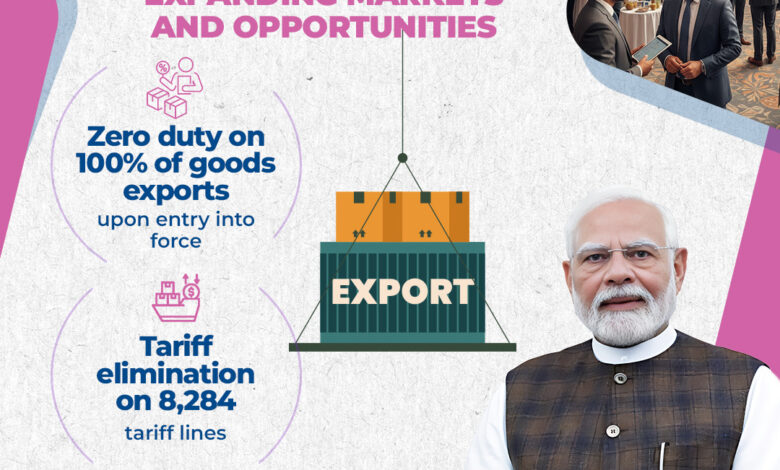
Prime Ministers Narendra Modi and Christopher Luxon jointly announced the successful conclusion of negotiations for a comprehensive Free Trade Agreement (FTA) between India and New Zealand, marking a landmark achievement after intensive talks launched just nine months earlier in March 2025.
This pact, India’s third FTA in 2025 (following deals with the UK and Oman), encompasses trade in goods, services, investment, and mobility of professionals—reflecting complementary economic strengths: India’s vast market, skilled workforce in IT and services, and New Zealand’s high-quality agricultural and horticultural exports.
Key Highlights of the Agreement
- Tariff Reductions: Eliminates or sharply reduces tariffs on 95% of New Zealand’s exports to India, with over half becoming duty-free immediately upon entry into force. This is among the most ambitious concessions India has offered in recent FTAs.
- Export Boost for New Zealand: Projections indicate Kiwi exports to India could rise from current levels to USD 1.1–1.3 billion annually over the next two decades, benefiting sectors like fresh fruits (apples, kiwifruit), wool, logs, timber, and potentially dairy (though sensitive areas like dairy saw careful handling).
- Gains for India: Enhanced market access for labor-intensive exports (textiles, pharmaceuticals, engineering goods, plastics, leather) to New Zealand’s open economy (average tariff ~2.3%). Strong commitments in services, including IT, education, tourism, and professional mobility—featuring improved visa pathways, post-study work options, and a working holiday scheme for Indian youth and skilled workers.
- Investment and Trade Targets: Both leaders expressed confidence in doubling bilateral trade within five years (from ~USD 1.3–3 billion currently) and attracting USD 20 billion in New Zealand investments into India over 15 years.
- Broader Cooperation: Provisions for skill mobility, supply chain resilience, and people-to-people ties, aligning with India’s push for talent export and New Zealand’s need for skilled professionals.
Analytical Insights
The swift conclusion—after a decade-long hiatus in talks—demonstrates strong political will on both sides, driven by shared democratic values and strategic convergence. For India, this FTA advances export diversification amid sluggish global demand and potential trade disruptions (e.g., ongoing delays in US and EU deals). It provides predictable access to a high-income market while securing services gains, crucial as services constitute a major part of India’s economy.
New Zealand, meanwhile, gains deeper penetration into India’s 1.4 billion consumer market—one of the world’s fastest-growing—supporting domestic jobs and wages in export-dependent sectors. The deal positions Kiwi businesses favorably against competitors, especially as India’s economy is projected to reach USD 7–12 trillion by 2030.
However, challenges remain: Sensitive issues like dairy market access for New Zealand and professional visa caps for India required balanced compromises. Implementation will be key—timely signing (expected soon) and ratification could see the FTA enter force by mid-2026.
Overall, this “new-generation” agreement strengthens economic resilience, fosters investment-led growth, and opens opportunities for MSMEs, innovators, and youth. It underscores India’s proactive trade strategy in the Indo-Pacific while enhancing New Zealand’s export diversification beyond traditional partners. As global trade fragments, such bilateral pacts offer stable pathways for mutual prosperity.