Railway Safety at Historic High: Annual Accidents Drop 93% as Investment, Technology Transform Indian Railways

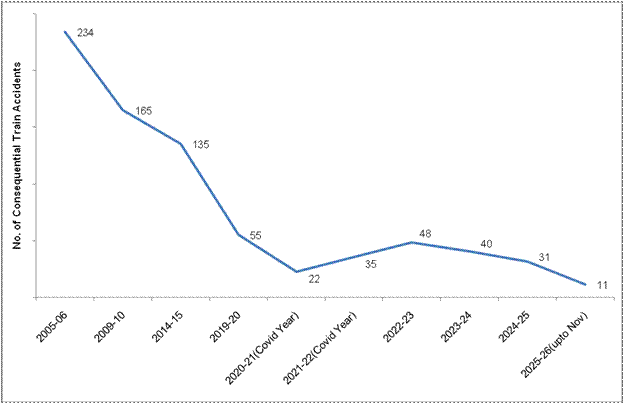
Indian Railways has recorded its safest operational year in history, with consequential train accidents plunging from an annual average of 171 (2004–14) to just 11 cases in 2025–26 so far. This unprecedented improvement comes on the back of massive investments, rapid technological upgrades, and intensified coordination between Railway Protection Force (RPF), Government Railway Police (GRP), state police forces, and national investigative agencies.
Union Minister for Railways, Information & Broadcasting, and Electronics & IT, Ashwini Vaishnaw, informed Rajya Sabha that multiple layers of surveillance, faster investigation of sabotage cases, deployment of advanced safety devices, and modernization of signalling and track systems have driven a structural shift in safety outcomes.
ACCIDENTS FALL TO LOWEST EVER
Between 2004 and 2014, Indian Railways recorded 1711 consequential accidents, averaging 171 per year. In comparison:
-
2014–15: 135 accidents
-
2024–25: 31 accidents
-
2025–26 (up to Nov): 11 accidents
This marks a 93% reduction over the decade.
SAFETY BUDGET TRIPLES IN A DECADE
The Railways’ dedicated safety expenditure has risen almost three-fold, enabling faster track renewals, automation of signalling systems, stronger bridges, modern rolling stock, and large-scale deployment of monitoring technologies.
Table 1: Safety Expenditure Growth
| Year | Expenditure (₹ Crore) |
|---|---|
| 2013–14 (Actual) | 39,463 |
| 2022–23 (Actual) | 87,327 |
| 2023–24 (Actual) | 1,01,651 |
| 2024–25 (Approved) | 1,14,022 |
| 2025–26 (Current) | 1,16,470 |
FOG SAFETY DEVICES MULTIPLY 288 TIMES
A striking improvement has been in the deployment of Fog Safety Devices (FSDs) — crucial for visibility in northern winters.
In 2014, Railways had just 90 devices. Today, they number 25,939 — a 288-fold increase.
These GPS-powered devices alert loco pilots about upcoming signals, speed restrictions and level crossings during low-visibility operations.
TRACKING SABOTAGE: COORDINATED VIGILANCE WITH STATES
All incidents of sabotage or tampering of railway tracks in 2023 and 2024 were registered and investigated by state police agencies, with arrests and prosecutions already underway.
The Railways’ approach includes:
-
Joint patrolling by RPF, GRP, state police and railway staff on vulnerable stretches
-
Special teams deployed for high-risk zones
-
Regular anti-obstruction drives to remove debris and material near tracks
-
Awareness campaigns for people living near railway lines
-
State Level Security Committee meetings, chaired by DGPs/Police Commissioners
-
Coordination with NIA, CBI, CIB and SIB wherever needed
This multi-agency collaboration has drastically reduced track sabotage attempts.
SIGNALLING MODERNISATION AT TOP SPEED
Over the last four months alone, Railways completed:
-
Centralised Electronic Interlocking at 21 stations
-
Complete track-circuiting at 21 stations
As of 31 October 2025:
-
6,656 stations have electronic interlocking
-
10,098 level crossings are interlocked
-
6,661 stations have complete track circuiting
This eliminates human errors and ensures automated verification of track occupancy.
KAVACH ROLLOUT ACCELERATES ON BUSIEST ROUTES
Kavach, India’s indigenous Automatic Train Protection (ATP) system, has seen rapid deployment:
-
Initial deployment: 1545 route km
-
Kavach 4.0 commissioned on Delhi–Mumbai and Delhi–Howrah routes
-
Work ongoing: 15,512 route km covering key Golden Quadrilateral, Golden Diagonal and High-Density corridors
Kavach prevents signal-passed-at-danger (SPAD) events and can automatically apply brakes to avoid collisions.
INFRASTRUCTURE UPGRADES: TRACKS, BRIDGES, COACHES
Railways have bolstered infrastructure through heavy renewal works, new track additions, and improved bridge safety.
Table 2: Technological Improvements (2004–05 to 2013–14 vs 2014–15 to 2024–25)
| Item | 2004–14 | 2014–25 | Growth |
|---|---|---|---|
| High-quality 60kg rails | 57,450 km | 1.43 lakh km | >2× |
| Longer 260m rail panels | 9,917 km | 77,522 km | 8× |
| Electronic Interlocking | 837 stations | 3,691 stations | >4× |
| Fog Safety Devices | 90 | 25,939 | 288× |
| Thick Web Switches | 0 | 28,301 | New |
Table 3: Better Maintenance Practices
| Item | Earlier Value | Current Value | Improvement |
|---|---|---|---|
| Primary rail renewal | 32,260 km | 49,941 km | 1.5× |
| USFD weld testing | 79.43 lakh | 2 crore | >2× |
| Weld failures | 3,699 (2013–14) | 370 (2024–25) | 90%↓ |
| Rail fractures | 2,548 (2013–14) | 289 (2024–25) | 88%↓ |
Table 4: Infrastructure & Rolling Stock
| Item | 2004–14 | 2014–25 | Growth |
|---|---|---|---|
| New Track Added | 14,985 km | 34,428 km | >2× |
| ROB/RUB built | 4,148 | 13,808 | >3× |
| Unmanned crossings | 8,948 | 0 (eliminated by 2019) | Complete elimination |
| LHB Coaches | 2,337 | 42,677 | 18× |
These improvements have significantly boosted passenger safety, train speed, and operational reliability.
ADVANCED SAFETY PRACTICES ACROSS OPERATIONS
Railways have institutionalized modern practices across signalling, tracks, rolling stock and crew training:
-
Vigilance Control Devices installed in all locomotives
-
Retro-reflective boards for fog visibility
-
Mechanised track laying using PQRS, T-28, TRT
-
Flash Butt Welding replacing older methods
-
Monitoring with TRC cars and OMS
-
Strict disconnection-reconnection protocols
-
Enhanced fire safety, including fire detection and suppression systems in new coaches
-
Rolling Block maintenance, planned 52 weeks in advance
Such measures reduce human error and ensure predictive maintenance.
BRIDGE SAFETY & COACH MODERNISATION
All bridges undergo regular inspection, with repairs based strictly on condition assessment. Production Units have accelerated manufacturing of modern LHB coaches, which are safer, more stable at high speeds and less prone to fire.
Fire-safety instructions, posters, and prohibitions on inflammable materials have been standardised across all passenger coaches.
COMMUNITY SAFETY & AWARENESS
People living near railway tracks are being sensitised about the dangers of:
-
placing objects on tracks
-
removing or tampering with rail components
-
trespassing in railway zones
Local communities are encouraged to report suspicious activity immediately.
A MULTI-LAYERED SAFETY SYSTEM
Railway’s evolving safety framework integrates:
-
Technology (Kavach, interlocking, FSDs, VCD)
-
Infrastructure upgrades (modern rails, long panels, bridges, LHB coaches)
-
Surveillance & coordination (RPF–GRP–Police, NIA, CBI)
-
Mechanical improvements (mechanised track renewal, high-quality welds)
-
Training & protocols (rolling block, crew counselling, inspections)
The reduction in accidents is thus the result of comprehensive reforms rather than isolated steps.
MINISTER’S ASSERTION
Union Minister Ashwini Vaishnaw told Parliament that the multi-pronged safety overhaul will continue, with Railways advancing toward zero accidents through technology-driven operations, robust policing, and rapid infrastructure expansion.