Indian Railways Deploys Multi-Tier War Rooms to Smooth Diwali-Chhath Travel Rush
Ashwini Vaishnaw: Over 1.2 Crore Diwali-Chhath Travellers Served by 13,000 Indian Railway Trains

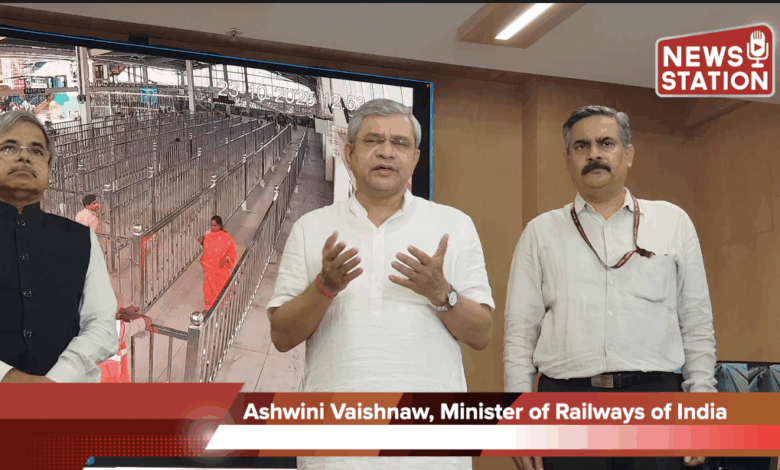
In a bid to manage the massive influx of passengers during the Diwali and Chhath festivals, Indian Railways has rolled out a sophisticated network of war rooms and real-time monitoring systems, ensuring seamless operations across the country, Railway Minister Ashwini Vaishnaw announced today.
Speaking to the media at the Railway Board headquarters, Vaishnaw detailed a three-tier command structure designed to handle the festive surge: operational war rooms at the division level, zonal level, and the apex Railway Board level. “All feeds from divisions and zones converge here at the board level,” he explained, adding that mini control rooms have been established at every major station for on-ground coordination.
This integrated setup provides a bird’s-eye view of every station’s status—what extra trains are needed, emerging bottlenecks, and passenger flows—allowing for swift, coordinated responses. “We can see the exact position of every station nationwide and address issues in real time,” Vaishnaw said.
Rapid Response to Sudden Surges
Vaishnaw highlighted real-world examples of the system’s efficacy. On October 18, Udhna station in Gujarat faced an unexpected passenger overload exceeding projections. Within just 7-8 hours, Railways mobilized parked special trains from nearby areas like Ratlam, Palghar, and Mumbai Central, successfully transporting nearly all waiting passengers to their destinations.
Similar agility was demonstrated at Ambala, where a sudden rush was met by rerouting additional trains from Jalandhar and other locations. “This war room mechanism made it all possible,” the minister noted, emphasizing how it prevents chaos by staging passengers in designated holding areas before they reach platforms.
At New Delhi station—one of the busiest hubs—innovative zigzag queuing systems and expanded holding zones ensure crowds don’t overwhelm platforms. Passengers arriving via regular trains can purchase tickets in these areas and board their specials within 30 minutes. “I’ve spoken to several travelers; this setup has cut boarding times in half,” Vaishnaw shared, crediting the “complete war room machinery” for the smooth experience.
Visual feeds from multiple camera angles across stations, including Anand Vihar and Pune, are live-streamed to the control center. These show inward passenger flows, ticketing counters equipped with automatic ticket vending machines (ATVMs), and pandal-style waiting areas. For instance, at Anand Vihar Terminal (ANVT), occupancy in shaded waiting zones with space for over 117 people is tracked in real time. If crowds build up, extra trains are deployed immediately.
Ambitious Train Deployment and Crowd Analytics
This year’s planning surpasses previous efforts, with 10,700 special trains pre-notified on the IRCTC website for advance reservations. An additional 3,000 trains are held in reserve for unreserved, last-minute surges, pushing the total toward 12,000-13,000. “The number could rise further as the season progresses,” Vaishnaw projected.
Destinations have been expanded significantly, particularly to Bihar, where seven major cities were covered last year. This Diwali, that has grown to 18 key locations, including beyond Patna to places like Muzaffarpur, Darbhanga, Purnea, Saharsa, and Bhagalpur. “A tweet yesterday captured it well—passengers no longer face the hassle of alighting midway; trains now go straight to their hometowns,” he said.
Crowd management relies on hourly heat maps for 35 high-traffic stations, color-coded for normal (green), crowded (yellow), and overcrowded (red) levels. Yesterday’s (October 22) data showed only two peak hours (noon to 1 p.m.) at New Delhi with elevated crowds; Pune and other stations maintained normal flows throughout the day. Today’s monitoring up to 11 a.m. across 25 stations remains green, but afternoon surges are anticipated on October 23 and 24—the second wave of peak travel following the initial rush on October 17-20.
A technical control chart updates every 10 minutes, tracking train movements nationwide. It flags delays instantly: as of now, only one train is delayed beyond six hours, with most specials running smoothly despite network congestion. Average delays hover at 3-4 hours for specials, largely due to high volumes.
Permanent Upgrades on the Horizon
Vaishnaw described the holding area experiment as a resounding success, calling it a “passenger facilitation center” that must become permanent. “Over 70 stations have been identified for this—New Delhi’s setup is already delivering straight benefits.” Yesterday, the Railway Board chairman issued orders to replicate it at 76 high-rush stations. Rights consultants will handle designs, while the Railway Land Development (RLD) arm oversees construction.
The minister estimated up to 1.2 crore (12 million) passengers will travel on special trains alone during the season, underscoring the scale of the operation. “We’re managing it all through this Overnall system—empty waiting areas today mean we’ve planned ahead effectively.”
As the festive exodus continues, Indian Railways’ tech-driven approach is proving instrumental in turning potential gridlock into efficient journeys home, setting a benchmark for future high-demand periods.