Hitachi Powers India’s Rail Boom: Make in India Success
From Mumbai Metro to Shinkansen: Exclusive Insights on Safety Tech and Freight Corridors

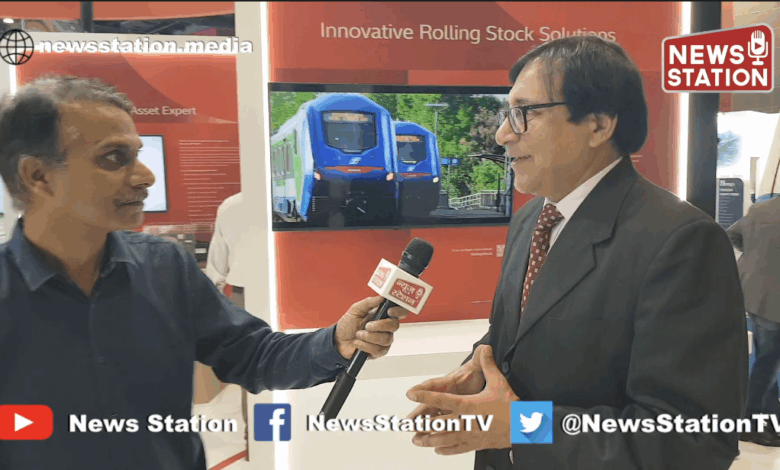
As India’s railway network surges ahead with ambitious projects—from the completion of the Udhampur-Srinagar-Baramulla Rail Link (USBRL) to rapid progress on Sikkim and Mizoram connectivity—the spotlight falls on long-standing collaborators driving this transformation. In an exclusive interview with NewsStation, Mangal Dev, Head of Hitachi Rail India South Asia (Mobility) and Director of Hitachi India Pvt Ltd, shared insights into the Japanese giant’s decades-long synergy with Indian Railways, emphasizing technology transfer, energy efficiency, and unwavering commitment to ‘Make in India’.

Hitachi’s tryst with India dates back to the early days of rail modernization. “The cooperation between India and Japan in railways started with the first steam locomotives and the turbines for Bhakra Nangal, which came from Japan,” Dev recounted. “Even today, those stories are legendary.” The company later supplied DC-DC locomotives that still operate in Warangal, with motors continuing to be manufactured by Bharat Heavy Electricals Limited (BHEL) and Chittaranjan Locomotive Works (CLW). However, as technology evolved from DC to more efficient AC systems, Hitachi pivoted seamlessly.
A prime example is Mumbai Metro Lines 2 and 3, where Hitachi’s power trains—manufactured at Bassein Assembly and Manufacturing Facility (BAMEL)—are powering the network. “These are first-class, world-class trains that Mumbai’s public loves traveling in,” Dev said, highlighting their energy efficiency. Compared to the Delhi Metro Rail Corporation (DMRC), which pioneered urban transit in India, Mumbai’s system stands out for its modernity amid the city’s heavy traffic. “While Delhi deserves full credit for starting the metro wave, Mumbai is special because of its metropolitan scale,” he added. “Our Japanese technology ensures the same distance is covered with significantly less energy consumption—a hallmark of Hitachi.”
This global integration shines through: Transformers are built in India, converters in Japan, and Train Control and Management Systems (TCMS) from Italy, all fitted into trains at BAMEL. Dev underscored Hitachi’s full-throated support for ‘Make in India’, positioning it as the company’s top priority in partnering with the Government of India.
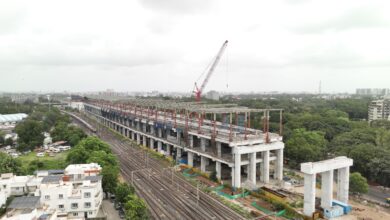
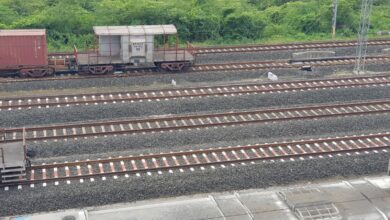
The collaboration extends to freight corridors. Hitachi’s technology underpins the entire 10,50 km Dedicated Freight Corridor (DFC) network between Rewari and Jawaharlal Nehru Port Trust (JNPT). “These high-speed freight trains will run at 100 km/h, with one departing every 10 minutes for the first time—complete with a timetable,” Dev explained. Overseeing this is a state-of-the-art Operational Control Centre (OCC) in Ahmedabad. “If you visit, you’ll see the entire network controlled from there—real-time visibility on train arrivals, performance, and even introducing new routes seamlessly.”
Safety remains paramount, with signaling systems at the forefront. While global standards vary—Europe champions ETCS Level 2, and India develops its indigenous Kavach—Hitachi’s Communications-Based Train Control (CBTC) is transforming urban metros. Deployed in Kolkata (underground sections), Noida, Navi Mumbai, and fully in Hyderabad, it’s now being implemented across Chennai Metro. “CBTC is the most modern, allowing maximum trains on the network with top safety,” Dev noted. Key features include a 60-second headway (train gap), enabling 2.5-minute frequencies at stations, adherence to SIL4 safety standards, and fully automatic operations.
Chennai’s upcoming lines will pioneer Unattended Train Operation (UTO)—beyond driverless, it’s “pilot-less,” Dev revealed. “Grade of Automation 4 means no attendants needed; it’s auto-pilot evolved.” This draws from Hitachi’s deep ties with Japan Railways (JR East, West, Central), where punctuality is non-negotiable. “Accidents? Non-existent there, thanks to the technology we’ve contributed to,” he said. Hitachi’s global footprint bolsters this: Centers of Excellence in Italy, France, Germany, and the USA focus on SIL4-compliant products for high-speed rails like Europe’s ERTMS.
In Indian Railways, Hitachi laid the foundation early. It introduced ETCS Level 1 on the Gatimaan Express (Nizamuddin-Agra) and Chennai’s suburban network, later expanding to Kolkata. The massive Kharagpur yard—the largest by routes—runs on Hitachi’s computer-based interlocking. “Track safety is foundational: Assessing routes, maintenance, and fail-safe signals,” Dev explained. Automatic Train Protection (ATP) layers like Kavach build on this. “We were here before Kavach—our systems interface with it for communication. Our contribution to safety endures, whether ETCS, Kavach, or beyond.”
Now the world’s largest signaling company post-acquisitions of European and American firms, Hitachi covers the full spectrum—from Japan to India. On high-speed rails, Dev teased the Shinkansen (E10 series). “It’s Japanese technology from JR, but Hitachi will contribute fully. Every country has its model—ours in Europe, the ETR 1000, hits 360 km/h.” India, he added, will soon develop its own platform, but for now, Japanese expertise fills the gap.
As Dev wrapped up, the interviewer reflected on the enduring bond: From steam engines to Bhakra Nangal turbines, Japan-India collaboration thrives, with Hitachi as a pivotal partner. “This isn’t just technology—it’s a legacy of trust and progress,” Siddhartha concluded from NewsStation’s Delhi studio.