Western Dedicated Freight Corridor Fully Completed, Double-Stack Trains to Transform Freight Movement

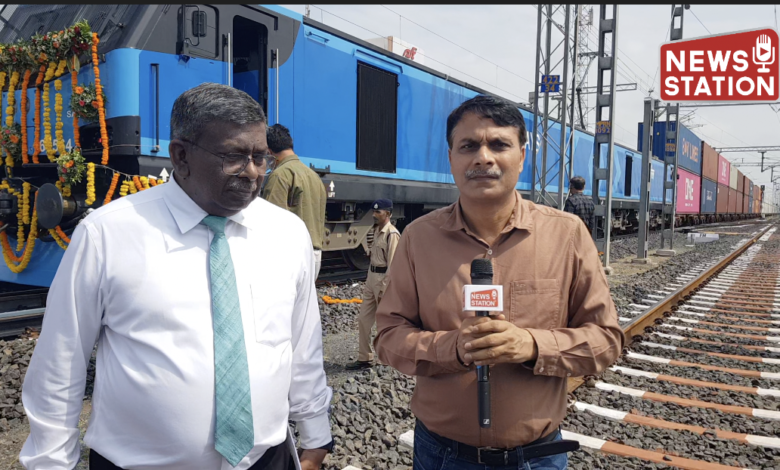
New Makarpura, Gujarat: India has achieved a major milestone in railway infrastructure with the Western Dedicated Freight Corridor (WDFC) now fully completed, enabling faster and more efficient movement of freight between Jawaharlal Nehru Port (JNPT) and the Delhi-NCR region.
Speaking exclusively to News Station, reporter Siddharatha interviewed Shobhit Bhatnagar, Director, Dedicated Freight Corridor Corporation of India Limited (DFCCIL), on the significance of the completion and the changes it is expected to bring to India’s freight transportation system.
Bhatnagar said the milestone is particularly significant because the foundations of both the Eastern and Western Dedicated Freight Corridors were laid in 2006, and both corridors have now been completed.
He said double-stack trains have started operating up to JNPT, marking a major advancement in India’s freight railway network. Four trains are being flagged off from different locations to mark the milestone, with all four designed as double-stack, long-haul freight trains.
Double-stack, long-haul capability
A key advantage of the Western Dedicated Freight Corridor is its ability to operate double-stack container trains. This means containers can be loaded one above another, allowing significantly more cargo to be transported in a single train.
Bhatnagar explained that the corridor’s long-haul capability further increases efficiency by coupling two train formations together. The combination of double-stack and long-haul operations enables a single train to carry cargo equivalent to several conventional freight trains.
According to Bhatnagar, these formations can carry approximately 7,000 tonnes of freight in a single movement.
The additional loading capacity also provides a cost advantage for freight operators. Bhatnagar said the upper deck of double-stack containers is transported at a lower freight rate, helping reduce logistics costs and making rail freight more competitive.
Dedicated freight network improves efficiency
Unlike conventional railway routes, where passenger and freight trains share the same tracks, the Dedicated Freight Corridor is designed exclusively for freight trains.
This separation allows freight trains to operate with fewer interruptions and eliminates the need to give regular priority to Mail, Express and other passenger services.
As a result, freight trains can achieve better average speeds and more predictable transit times.
Bhatnagar said the DFC network has an overall capacity of around 480 trains per day, while operations have reached approximately 460 trains per day.
Conventional railway routes to benefit
The benefits of the DFC are not limited to freight operators. The transfer of freight trains to dedicated tracks has also freed up capacity on existing Indian Railways routes.
According to Bhatnagar, this has enabled more passenger-carrying trains to operate on conventional routes. With fewer freight trains occupying railway paths, punctuality has also improved on several adjoining sections.
The shift is expected to provide passengers with more reliable train operations while allowing Indian Railways to make better use of its existing network.
JNPT-Delhi freight transit time reduced
One of the major operational benefits of the completed WDFC is the reduction in freight transit time between JNPT and the Delhi-NCR region.
Bhatnagar said the journey, which earlier took around 66 hours, now takes approximately 58 hours on average, representing a saving of nearly eight hours following the commissioning of the final section.
The faster connection is expected to strengthen the movement of containers and other goods between western ports, manufacturing centres and northern markets.
12,000-horsepower locomotives
The News Station report also highlighted the powerful electric locomotives being used to haul these massive freight formations.
12,000-horsepower locomotives are capable of pulling heavily loaded trains carrying thousands of tonnes of cargo. With double-stack and long-haul operations, large volumes of goods can be transported in a single movement from ports towards their final destinations.
The completion of the WDFC therefore represents more than the commissioning of another railway route. It marks a major shift towards high-capacity, dedicated and efficient freight transportation.
The project, whose foundations were laid nearly two decades ago, is expected to play an important role in reducing logistics constraints, improving freight movement and freeing conventional railway capacity for passenger services.
India is also looking at expanding its dedicated freight network. The News Station report highlighted work on another proposed freight corridor between Surat and Dankuni.
With the Western and Eastern Dedicated Freight Corridors now completed, India’s freight railway network is entering a new phase—one focused on longer trains, higher capacity, faster transit and improved logistics efficiency.
For India’s economy, the DFC network has the potential to become a major game changer, strengthening the country’s supply chains and improving the efficiency of rail-based freight transportation.