PM Modi Flags Off New Vande Bharat Express Connecting Karnataka and Goa; Bengaluru Gets Major Rail, Metro Infrastructure Boost

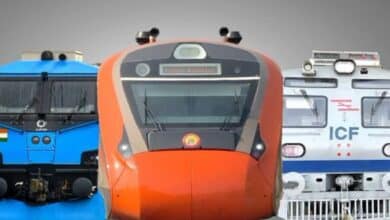
The new Vande Bharat service is expected to enhance rail connectivity along Karnataka’s coastal region, providing passengers, particularly those travelling from Mangaluru and other coastal areas, with a faster and more comfortable travel experience. Highlighting the importance of the new train, PM Modi said Karnataka had received its first-ever Vande Bharat Sleeper train just a few days ago and was now being connected to Goa through another Vande Bharat service.
“Just a few days ago, Karnataka received the state’s first-ever Vande Bharat Sleeper train. Today, another Vande Bharat train connecting Karnataka to Goa has been dedicated to the nation,” the Prime Minister said.
He added that passengers travelling along Karnataka’s coastal route, including those from Mangaluru, would benefit from the introduction of the semi-high-speed train.
The latest launch reflects the Centre’s continued emphasis on modernising Indian Railways, improving passenger experience and strengthening connectivity between important economic, commercial and tourism destinations.
Indian Railways Moving Beyond Colonial-Era Infrastructure
Addressing the gathering in Bengaluru, PM Modi said Indian Railways was moving away from its colonial-era mindset and building a new identity through modern trains, upgraded stations and improved passenger facilities.
He highlighted Vande Bharat trains and Amrit Bharat stations as important elements of this transformation. Karnataka has also witnessed the development of modernised railway stations under the Amrit Bharat Station Scheme, with more than 60 stations in the state being covered.
Stations including Chamarajanagar, Chikkamagaluru, Sakleshpur and Subrahmanya Road are among those being developed with improved passenger amenities.
The Prime Minister said the objective was to bring facilities previously associated with airports to railway stations so that ordinary passengers, including middle-class and economically weaker sections, could benefit from modern infrastructure.
He also pointed out that Karnataka’s railway budget allocation had increased ninefold over the past 10 to 12 years, reflecting the Centre’s focus on railway infrastructure development in the state.
As part of the latest initiatives, four Amrit Bharat stations and two projects involving railway track doubling and electrification were also dedicated to the state.
Bengaluru Metro Crosses 100-Km Milestone
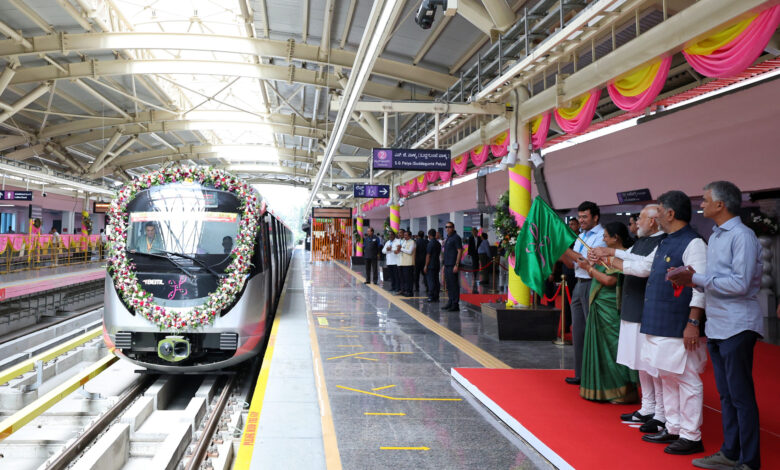
Apart from railway projects, the Prime Minister inaugurated the new Pink Line of Namma Metro, marking another significant development in Bengaluru’s urban transport infrastructure.
The Pink Line is expected to improve connectivity to several important destinations, including IIM Bengaluru, educational institutions, business districts and technology hubs.
PM Modi noted that Bengaluru had become the third city in India, after Delhi-NCR and the Mumbai Metropolitan Region, to achieve a metro network exceeding 100 kilometres.
He recalled that Bengaluru’s metro network had expanded from just 17 kilometres in 2014 to more than 100 kilometres today.
According to the Prime Minister, the expansion of Namma Metro represents India’s commitment to improving ease of living and ease of travel, while reducing commuting time and expenses for lakhs of residents.
Energy Security Projects Worthwhile for Karnataka
The development package also included three important energy infrastructure initiatives aimed at strengthening Karnataka’s energy security.
These include the Mangaluru LPG Project, which will add 80,000 metric tonnes of LPG storage capacity, the Devangonthi Marketing Terminal for improving the distribution of petrol, diesel and aviation fuel, and a compressed biogas (CBG) plant in Bengaluru.
The Bengaluru CBG plant is designed to produce 13 tonnes of biogas daily, helping improve waste management while reducing dependence on imported natural gas.
The Prime Minister also highlighted the importance of renewable energy, noting that India’s renewable energy capacity had crossed 300 gigawatts.
Under the PM Surya Ghar Muft Bijli Yojana, more than 60 lakh households across the country, including over 40,000 families in Karnataka, have installed rooftop solar systems with government assistance.
He also referred to the PM-KUSUM scheme, under which more than eight lakh solar pumps are being provided to farmers in Karnataka, helping reduce electricity expenses and create additional income opportunities.
Focus on Technology, Industry and Employment
Emphasising Bengaluru’s position as India’s Silicon Valley, PM Modi said the city contributes more than one-third of the country’s IT exports and remains a major centre of innovation and economic growth.
He said India was working towards global leadership in emerging technologies, ranging from semiconductor chips and artificial intelligence to data centres and quantum computing.
The Prime Minister stressed that reliable electricity, modern infrastructure and improved connectivity would play a crucial role in supporting industrial growth and generating employment.
Concluding his address, PM Modi said the projects launched in Karnataka would accelerate the state’s development journey and contribute to the national vision of Viksit Bharat.
With the latest Vande Bharat launch, expansion of Namma Metro and investments in railway and energy infrastructure, Karnataka is set to receive a significant boost in passenger connectivity, urban mobility and economic development.