New Pamban Bridge: Former RVNL Director Rajesh Prasad Explains Engineering Innovations, Corrosion Protection and Construction Challenges

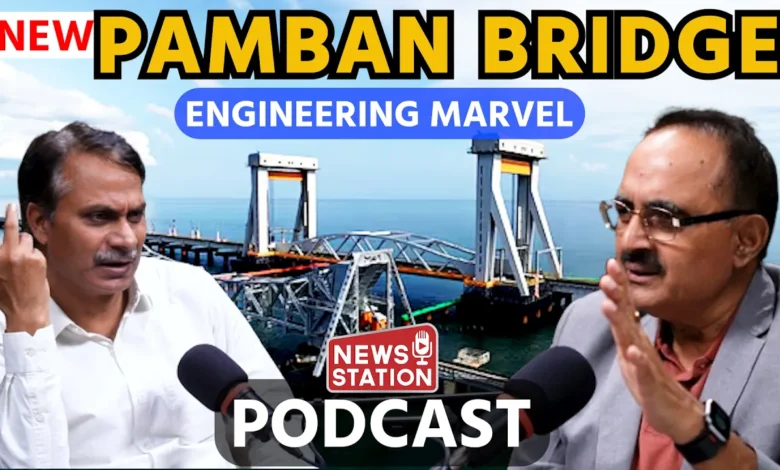
The New Pamban Railway Bridge in Tamil Nadu represents a major milestone in India’s railway engineering, combining advanced lifting technology, automated safety systems and specialised corrosion-protection measures to overcome the challenges of constructing a railway link in a harsh marine environment.
Completed in 2024 and inaugurated by Prime Minister Narendra Modi in April 2025, the bridge connects Mandapam on mainland India with Rameswaram Island. Its defining feature is a 72-metre vertical lift span that rises to allow ships and other vessels to pass through the navigation channel.
In a special News Station podcast, Siddharatha, Editor of The News Station Network Private Limited, spoke with Rajesh Prasad, former Director of Rail Vikas Nigam Limited (RVNL), about the engineering innovations, construction techniques, safety arrangements and project-management lessons behind the landmark structure.
Prasad, who was associated with the project’s execution, explained how the new bridge differs from its century-old predecessor and how indigenous technology, mechanisation and detailed planning helped overcome demanding construction conditions.
From the Historic Pamban Bridge to Modern Railway Engineering
The original Pamban Bridge, commissioned in 1914, was an important railway connection between mainland India and Rameswaram. Its iconic Scherzer rolling-lift span opened to permit maritime traffic to pass through the channel.
Prasad recalled that the original bridge formed part of the historic Boat Mail transport system, which connected railway journeys from Madras, now Chennai, towards Dhanushkodi, where passengers could continue their journey by sea to Ceylon, now Sri Lanka.
The original structure featured a 225-foot Scherzer span and numerous steel approach girders. Its movable section operated manually, requiring approximately 45 minutes to an hour to complete the opening and closing process.
The bridge faced a major test during the devastating cyclone of December 1964, when 120 approach spans were displaced. According to Prasad, the movable Scherzer span remained intact, enabling the bridge to be restored.
He highlighted the contribution of E. Sreedharan, who was then serving as a divisional engineer, in restoring railway connectivity within 46 days. The work involved using steam cranes mounted on boats to lift and replace the displaced girders.
The bridge was subsequently converted from metre gauge to broad gauge during a closure period in 2006–07.
However, decades of exposure to saltwater, increasing railway loads and corrosion gradually affected the ageing structure. Monitoring arrangements, including sensors installed with the involvement of IIT Madras, helped assess its condition. Speed restrictions were imposed before railway operations were suspended in January 2023.
These developments made a replacement bridge essential for maintaining a safe and reliable railway connection to Rameswaram.
Why the New Pamban Bridge Is Different
Explaining the fundamental engineering difference, Prasad said the old bridge used a Scherzer rolling-lift mechanism, whereas the new structure employs a vertical lift system.
In the old arrangement, the movable span operated through a rolling mechanism with cantilever action. The new design lifts the span vertically, providing a different structural configuration and more efficient operation.
The new bridge’s automated lifting mechanism can complete an opening or closing operation in approximately three to five minutes, compared with the considerably longer manual operation of the old structure.
Another major improvement is the increase in navigational clearance from approximately 19 metres to 22 metres. Prasad explained that the additional three metres also help reduce exposure to saline-water splashes, which contribute to corrosion.
The bridge incorporates provisions for railway electrification, modern signalling, interlocking and Supervisory Control and Data Acquisition (SCADA) systems.
The substructure and lift span have also been designed to accommodate a double-line configuration, although the existing railway connection operates as a single line. This provision could facilitate future capacity expansion without requiring the lift span itself to be rebuilt.
Advanced Corrosion Protection for a Marine Environment
One of the most important subjects discussed during the interview was corrosion protection. Salt-laden air, sea spray, high humidity and strong winds make marine structures particularly vulnerable to deterioration.
Prasad explained that the project adopted several measures to improve durability and reduce maintenance requirements.
A key innovation was the use of stainless-steel reinforcement throughout the bridge’s reinforced-concrete works, following the relevant approvals and technical provisions. The approach was intended to improve resistance to corrosion in the marine environment.
Specially rolled steel plates were used to reduce the number of joints in the approach girders. Fewer joints mean fewer potential locations for water ingress, deterioration and maintenance.
The lift span was constructed as a fully welded girder, while high-strength friction-grip bolts received zinc-flake coating for additional protection. The project also incorporated durable protective painting, rounded sharp edges and structural detailing intended to minimise stress concentrations and water stagnation.
Prasad said the bridge’s painting system was designed for a service life of approximately 30–35 years or more, subject to the applicable specifications, environmental exposure and maintenance.
The railway level was raised by three metres to reduce direct saltwater splashing. The design also included provisions to improve drainage and minimise localised stresses in structural members.
The broader objective was to address corrosion at the design stage rather than relying exclusively on repairs after deterioration occurs.
Automated Safety Systems and SCADA-Based Operations
The new Pamban Bridge incorporates modern signalling and interlocking arrangements designed to prevent train movements when the movable span is not correctly secured.
Prasad explained that SCADA-based control connects the lifting mechanism with the railway signalling system. Once the span returns to its designated position, the system verifies the required locking conditions before permitting train operations.
The bridge also incorporates wind-monitoring arrangements. Prasad said the system is designed to respond automatically when wind speeds exceed specified operational thresholds, including the threshold discussed during the interview of 54 metres per second.
Such automation reduces dependence on manual intervention and strengthens operational safety in an area vulnerable to severe winds and cyclones.
Structural health monitoring was another important feature. Rather than relying exclusively on imported solutions, the project team pursued an indigenous system with technical involvement from CSIR-SERC and other Indian institutions.
Prasad estimated that more than 90 per cent, potentially around 95 per cent, of the bridge’s components were sourced or manufactured domestically, reflecting the project’s emphasis on the Make in India initiative.
Protecting the Bridge Against Ship Collisions
The March 2024 collapse of Baltimore’s Francis Scott Key Bridge, after a cargo ship struck a supporting pier, highlighted the importance of protecting bridge infrastructure from vessel collisions.
Prasad said the New Pamban Bridge incorporated a fender-pile arrangement designed to reduce the risk of a ship directly striking its critical supporting piers.
The protective arrangement includes piles and a connecting plinth beam intended to absorb or redirect the impact of a vessel before it reaches the principal structural supports.
This provision is particularly important because the bridge’s movable span serves a navigational channel used by vessels.
Prasad explained that the protection system was part of the project’s safety considerations and reflected the need to assess potential marine hazards alongside conventional railway engineering risks.
Construction Challenges: Rough Seas, COVID-19 and Complex Logistics
The New Pamban Bridge was constructed amid difficult weather conditions and logistical constraints. Strong winds, rough seas and the region’s vulnerability to cyclones frequently interrupted work.
Prasad estimated that rough-sea conditions could prevent marine construction activities for approximately 80–90 days in a year. The COVID-19 pandemic created further difficulties during the project’s execution.
Moving massive structural components to the construction site was another challenge. The fabrication yard was located approximately 35 kilometres away, requiring careful coordination of road transport, marine movement, tides and specialised lifting operations.
The 72-metre movable span, weighing approximately 500 tonnes according to Prasad, required precise fabrication, trial assembly, dismantling, transportation and reassembly at the bridge site.
The two lifting towers and their associated equipment also required complex installation arrangements. Temporary steel-casing piers were constructed to support the installation process and were subsequently removed.
A floating concrete-batching plant mounted on a barge and movable piling equipment helped facilitate foundation construction in marine conditions. Special launching arrangements were developed for the approach girders and track-laying operations.
Prasad stressed that mechanisation, detailed planning and rapid problem-solving were essential to maintaining progress despite weather disruptions and logistical challenges.
The foundation stone was laid in 2019, and the bridge was completed in 2024 before its formal inauguration in April 2025. Prasad said the completion cost exceeded ₹500 crore, although he did not recall the original sanctioned estimate.
IITs and Technical Institutions Played Key Roles
The project involved several organisations responsible for design, execution, inspection and quality assurance.
According to Prasad, IIT Madras contributed to the superstructure design, while IIT Bombay undertook design proof-checking for key structural components. IIT Guwahati was involved in technical work relating to rail joints and sleepers.
The Welding Research Institute in Tiruchirappalli carried out third-party weld inspections, while design and project-management consultancy support was provided by TPF and STUP. RVNL served as the implementing agency, with Southern Railway acting as the railway client.
The Commissioner of Railway Safety (CRS), a statutory authority under the Ministry of Civil Aviation, conducted the safety inspection required before commissioning. Prasad noted that he retired in September 2024 and was therefore not directly involved in subsequent inspection-related developments. He described the reported observations and compliance process as part of the normal procedure for railway project commissioning.
Lessons for India’s Future Infrastructure Projects
Reflecting on the project’s legacy, Prasad said the most important lessons concerned project management in challenging environments, quality assurance, safety, indigenous innovation and knowledge-sharing.
He emphasised that experience gained from complex projects should be documented and transferred to future engineering teams. Maintenance manuals, structural monitoring systems and corrosion-control strategies are important elements of a bridge’s long-term management.
Prasad also revealed that he was preparing a book titled Rust, Risk, and Resilience: The Engineering Cost of What We Choose, which will examine corrosion, infrastructure risks and engineering decisions across the project life cycle.
He described the New Pamban Bridge as a collective achievement involving engineers, technical institutions, contractors, consultants and railway authorities.
The conversation concluded with a broader message: India’s infrastructure ambitions depend not only on building landmark structures but also on improving engineering practices, strengthening indigenous capabilities and applying lessons from completed projects.
For viewers of News Station, the New Pamban Bridge offers an insight into how modern railway engineering combines structural design, automation, corrosion protection and project management to address some of India’s most demanding infrastructure challenges.