IIT Delhi Hosts 2nd Women Faculty Meet, Focuses on Inclusive Academic Leadership and Institutional Collaboration

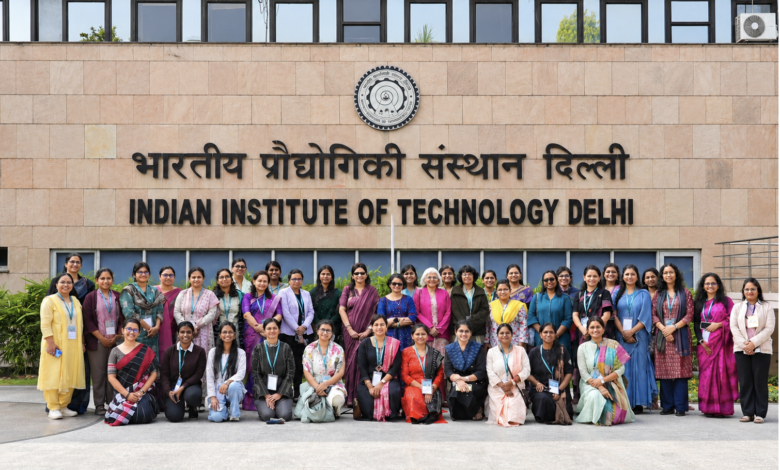
Organised through IIT Delhi’s Office of Academic Outreach and New Initiatives, the meeting focused on building inclusive academic institutions, strengthening inter-institutional collaboration, expanding mentorship opportunities and creating pathways for women faculty members to take up leadership positions.
The gathering provided a platform for participants to exchange experiences, discuss institutional challenges and explore practical measures to promote gender equality and professional advancement in India’s premier technical education institutions.
IIT Delhi Calls for a Stronger Collective Voice for Women in Academia
In her opening address, Prof. Shilpi Sharma, Associate Dean, Academics, Outreach and New Initiatives at IIT Delhi, welcomed the participants and outlined the objectives of the meeting.
Emphasising the need for sustained institutional efforts, she said that women faculty members needed a more organised and collective platform to strengthen their professional networks and leadership opportunities.
“We need a sustained and organised voice to connect and uplift women leadership,” she said.
Highlighting the broader objective of the initiative, Prof. Sharma added that discussions among women faculty members should translate into concrete institutional action rather than remain limited to academic exchanges.
“The idea is to take some shared dialogues to actionable progress,” she noted.
Her remarks underlined the importance of creating a collaborative platform through which women academics across IITs can collectively address common concerns, share successful practices and contribute to institutional policymaking.
IIT Delhi Director Emphasises Gender Parity and an Enabling Environment
Addressing the gathering, Prof. Rangan Banerjee, Director of IIT Delhi, reaffirmed the institute’s commitment to developing an academic environment that supports women’s participation and professional growth.
Acknowledging the progress made in increasing the representation of women among students, faculty members and institutional staff, he also pointed out that achieving gender parity remains a significant challenge.
“The share of women students, staff and faculty is increasing, but we have a long way to go to achieve gender parity,” Prof. Banerjee observed.
He emphasised that improving representation requires more than simply increasing the number of women entering academic institutions. It also calls for sustained efforts towards gender sensitisation, equality and the creation of an enabling institutional environment.
His remarks highlighted the need for IITs to examine their academic and administrative practices to ensure that women have equitable opportunities to participate in research, teaching, institutional decision-making and leadership.
The emphasis on gender sensitisation also reflected the importance of building an institutional culture in which professional opportunities and recognition are based on merit, while structural barriers to women’s advancement are addressed effectively.
IIT Madras Dean Highlights Global Opportunities and Changing Education Landscape
The keynote address was delivered by Prof. Preeti Aghalayam, Dean of Global Engagement at IIT Madras, who discussed emerging opportunities in Indian higher education and the growing importance of international academic engagement.
She highlighted the contribution of women achievers in academia and other professional fields, noting that today’s women leaders have benefited from the achievements and struggles of earlier generations.
“Global citizenry is now more important than ever. We have had women who are high achievers for a long time, on whose shoulders we stand,” she said.
Prof. Aghalayam also discussed how India’s evolving higher education landscape, particularly following the National Education Policy (NEP), is creating opportunities to rethink the skills and competencies expected from students and teachers.
According to her, contemporary education must move beyond conventional academic qualifications and incorporate a broader set of capabilities, including inclusivity, holistic learning, international alignment, critical thinking, analytical abilities, creativity and flexibility.
“In my view, very good winds of change that have come into higher education are that NEP has called out very unambiguously that the skill sets that we want to train our students and teachers in are changing,” she said.
She further emphasised the importance of developing 21st-century skills and preparing students and educators to operate in an increasingly interconnected global academic and professional environment.
Call for Greater International Research Collaboration
Prof. Aghalayam also highlighted the strengths of the IIT system, particularly its academic rigour, research capabilities and quality assurance mechanisms.
However, she stressed that maintaining academic excellence would increasingly require institutions and faculty members to develop stronger collaborative relationships, both within India and internationally.
Encouraging faculty members to expand their research partnerships and academic engagement, she said:
“The call is there with all our faculty to be more collaborative, to fuel our own research and other activities, genuinely be global in our outlook so we can partner with like-minded colleagues in institutions to synergise.”
Her observations highlighted the importance of international research networks, joint academic programmes and knowledge-sharing initiatives in strengthening India’s position in global higher education.
For women faculty members, such collaborations can also create opportunities to access wider research networks, international academic platforms and leadership roles beyond their respective institutions.
Faculty Members from 19 IITs Discuss Mentorship and Leadership
A major component of the second IIT Women Faculty Meet was the series of thematic discussions involving women faculty members representing 19 IITs.
The discussions covered several important areas, including mentorship, academic leadership, collaborative research and the adoption of inclusive institutional practices.
Participants exchanged experiences and explored ways to establish stronger professional networks that could support women academics at different stages of their careers.
The discussions also focused on developing sustained inter-institutional engagement through dedicated networks, thematic working groups and policy recommendations.
Building on the inaugural women faculty meet organised in 2025, the second edition sought to move towards a more structured framework for cooperation among IITs.
The proposed approach aims to ensure that the discussions and recommendations emerging from such gatherings translate into long-term initiatives capable of addressing common institutional challenges.
Towards a More Inclusive IIT Ecosystem
The 2nd IIT Women Faculty Meet reaffirmed the shared commitment of participating institutions to creating an academic ecosystem in which women faculty members can participate, collaborate and lead on equal terms.
The discussions also highlighted that achieving gender equality in higher education requires continuous institutional engagement, effective mentorship, leadership opportunities and stronger professional networks.
As India’s IITs continue to expand their research capabilities and global academic partnerships, ensuring greater representation of women in teaching, research and institutional leadership will remain an important part of their institutional development.
The success of the initiative will ultimately depend on how effectively the ideas discussed during the meeting are translated into measurable institutional changes, sustained collaboration and meaningful opportunities for women academics across the IIT system.
The second edition of the meet marks another step towards building a more connected, collaborative and inclusive academic community across India’s premier technical institutions.