
11.19 Lakh Pucca Houses Approved for Bihar with ₹13,427 Crore Allocation; Major Push for Farmers, Women and Rural Development

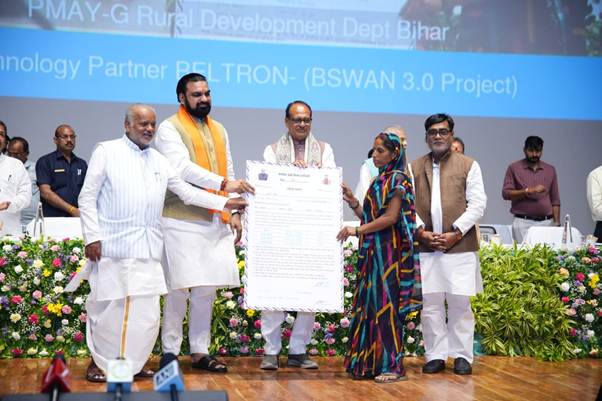
The Union Government has approved 11,18,937 pucca houses for poor families in Bihar under the rural housing programme, with an allocation of ₹13,427 crore. The announcement was made by Union Minister for Agriculture and Farmers’ Welfare and Rural Development Shivraj Singh Chouhan at a state-level Pradhan Mantri Awas Yojana programme in Patna on Thursday.
The programme was attended by Bihar Chief Minister Samrat Choudhary and senior members of the state government. Along with the housing package, Chouhan announced a series of measures aimed at strengthening agriculture, rural livelihoods, women’s economic empowerment and digital identification of farmers.
Chouhan said a pucca house was not merely a physical structure but represented dignity, security and confidence for a poor family. He said the newly approved houses would help protect families from harsh weather conditions and improve their overall quality of life.
The latest approval takes the total number of houses sanctioned for Bihar over the past two years to 24,30,327, involving expenditure of ₹29,164 crore. Chouhan said the figures reflected the government’s focus on ensuring that welfare schemes translated into tangible benefits for people on the ground.
He also emphasised transparency in the delivery of government assistance, saying funds under welfare schemes were being transferred directly to beneficiaries. He credited improved coordination between the Central and Bihar governments for accelerating the implementation of rural housing programmes in the state.
PM Fasal Bima Yojana to Strengthen Farmer Protection
A major announcement at the event was the implementation of the Pradhan Mantri Fasal Bima Yojana in Bihar. The scheme is expected to provide farmers with financial protection against crop losses caused by floods, drought, excessive rainfall and other natural calamities.
Chouhan said farmers remained central to India’s food security and needed protection against risks arising from unpredictable weather and natural disasters. Under the crop insurance framework, eligible farmers will receive compensation in accordance with the provisions of the scheme when their insured crops suffer damage.
He described the implementation of crop insurance in Bihar as an important step towards making agriculture more resilient and reducing the financial uncertainty faced by farmers.
The minister also highlighted the need to strengthen procurement, technology access and other agricultural support systems to improve farm incomes. He said a stronger agricultural sector would lead to stronger villages and contribute to Bihar’s overall development.
Focus on Women’s Economic Empowerment
Women’s economic empowerment was another major focus of the programme. Chouhan said Self-Help Groups (SHGs) were playing an important role in creating livelihood opportunities for rural women in Bihar, with many women progressing towards the Lakhpati Didi milestone.
He said the government was seeking to increase women’s incomes through self-employment, group-based enterprises, access to financial services and stronger market linkages.
According to Chouhan, empowering women economically has a wider impact on families and rural communities. Increased income and financial independence can improve the economic and social conditions of entire households.
She-Marts Planned to Expand Market Access
The minister stressed that increasing production by women’s Self-Help Groups would have limited impact unless their products received adequate market access.
To address this challenge, he said efforts would be made to establish She-Marts at the district level. These markets are intended to provide Jeevika Didis and women-led Self-Help Groups with dedicated platforms to sell their products.
The initiative is expected to focus not only on sales but also on product development, packaging and marketing. Better market access could help rural women expand their enterprises, increase earnings and become more economically independent.
Bihar Makes Progress in Farmer IDs
Chouhan also praised Bihar for its progress in creating Farmer IDs. He said 53,83,000 farmer identity cards had already been created in the state.
The Farmer ID system is expected to facilitate the identification of eligible beneficiaries and improve the delivery of government schemes and services. Digital identification can also help streamline farmer registration and make the process of accessing government benefits more efficient and transparent.
Chouhan expressed confidence that the registration of the remaining farmers would also be completed soon.
Roads, Houses and Agriculture as Pillars of Rural Development
The Union Minister highlighted rural connectivity under the Pradhan Mantri Gram Sadak Yojana, describing roads, houses and agriculture as three fundamental pillars of rural development.
Better roads can improve access to markets, schools, healthcare and other essential services, while pucca houses provide families with greater security. At the same time, stronger and more resilient agriculture can help improve rural incomes.
Chouhan said the Central and Bihar governments were working together to transform rural areas and ensure that the state became an integral part of India’s broader growth story. He also appreciated the efforts of the Bihar government and stressed that coordination between the Centre and state was essential for accelerating development.
Political Remarks on Vande Mataram
The event also saw Chouhan launch a political attack on the Congress over its decision to sing only a portion of Vande Mataram.
He described Vande Mataram as a matter of national pride and said the national song was not associated with any particular political party. According to him, the song had played an important role in inspiring Indians during the freedom movement and should be treated as a symbol of respect for the nation.
Chouhan accused the Congress of engaging in vote-bank politics and alleged that political interests should not be allowed to influence symbols associated with India’s unity, culture and national identity.
The programme was attended by a large number of beneficiaries, women, public representatives and officials. Bihar Deputy Chief Minister Vijay Kumar Choudhary, Agriculture Minister Vijay Kumar Sinha, Rural Development Minister Shravan Kumar, Revenue and Land Reforms Minister Vinod Kumar Jaiswal, Cooperation Minister Ramkripal Yadav, Minister Sunil Kumar, Rural Works Minister Savita Gupta and other public representatives were present.
The announcements collectively underline the government’s focus on housing, crop insurance, farmer identification, rural connectivity and women-led enterprises as key components of Bihar’s rural development strategy.