
BRICS Members Strengthen Cooperation in Ocean and Polar Science at Goa Meeting

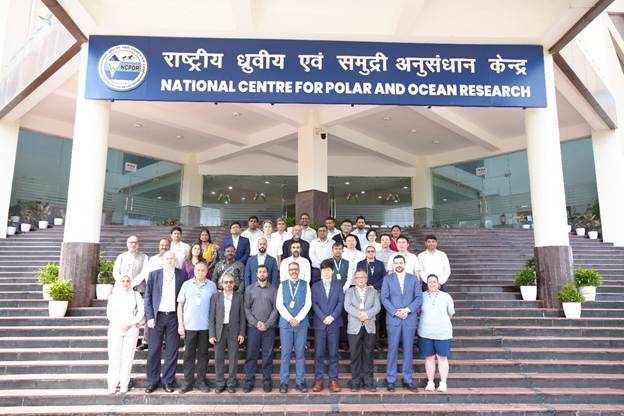
India hosted the 8th Meeting of the BRICS Working Group on Ocean and Polar Science and Technology (OPST) in Goa from August 12 to 14, 2026, bringing together senior officials, scientists and experts from eight BRICS member countries to strengthen collaboration in ocean and polar research.
The three-day meeting was organised by the Ministry of Earth Sciences (MoES) and hosted by the National Centre for Polar and Ocean Research (NCPOR), Goa, during India’s BRICS Presidency. The OPST Working Group operates under the BRICS Science, Technology and Innovation (STI) cooperation framework, with activities coordinated by MoES in association with the Department of Science and Technology (DST), Government of India.
Delegations from Brazil, China, Egypt, India, Indonesia, Russia, South Africa and the United Arab Emirates participated in the meeting and discussed areas of mutual interest in ocean and polar science and technology.
The meeting was inaugurated on August 12 by Dr. Thamban Meloth, Director, NCPOR. Dr. Madhavan Nair Rajeevan, Vice-Chancellor of Atria University and former Secretary of MoES, attended the inaugural session as the Chief Guest. The three-day programme was chaired by the Director, NCPOR. India’s delegation comprised officials and scientists from MoES and DST and was headed by Dr. Sandip Kumar Mukhopadhyay, Scientist G and Advisor, MoES.
Focus on Coastal and Ocean Resilience
The meeting provided a platform for BRICS countries to deliberate on scientific cooperation, knowledge exchange, capacity building and collaborative research in ocean and polar sciences.
A major focus was on the challenges facing coastal zones, particularly the need to strengthen the protection and resilience of coastal cities. Member countries also discussed strengthening the Global Ocean Observing System (GOOS) through collaborative contributions aimed at developing robust and resilient ocean information services.
The delegations explored opportunities for expanding joint polar research and promoting inclusive participation in Antarctic expeditions. Capacity building, particularly for young researchers, also emerged as an important area of cooperation.
During the deliberations, BRICS members jointly agreed to pursue collaborative initiatives aimed at building coastal resilience and undertaking joint studies on polar and ocean biodiversity. They also agreed to work towards setting milestones for the fifth International Polar Year and expanding capacity-building opportunities for young researchers.
Roadmap for Future Cooperation
As part of India’s BRICS Presidency, India will coordinate the finalisation of the ongoing roadmap for the OPST Working Group. The roadmap will include an action plan for implementing short-term priorities identified by the member countries.
The proposed cooperation is expected to encourage joint research initiatives, greater exchange of scientists and students, sharing of research infrastructure and stronger institutional partnerships among BRICS members.
Addressing the concluding session virtually, Dr. T. Srinivasa Kumar Tummala, Secretary, Ministry of Earth Sciences, appreciated the participating delegations for their contributions and the outcomes of the three-day meeting.
He said the meeting had provided a valuable platform for strengthening scientific cooperation in ocean and polar sciences. He also welcomed the consensus reached on key priority areas and urged member countries to translate the agreed outcomes into concrete collaborative actions.
The Secretary highlighted joint research, exchange of scientists and students, sharing of research infrastructure and strengthening institutional linkages as important areas through which the decisions of the meeting could be implemented.
The Goa meeting concluded with BRICS countries reaffirming their commitment to advancing ocean and polar science and technology through collaborative research, knowledge sharing, capacity building and stronger institutional partnerships. The outcomes are expected to provide further momentum to joint efforts addressing challenges related to coastal resilience, ocean observation, polar research and the development of young scientific talent.