IMD Predicts Below-Normal Monsoon Rainfall Across India in 2026, Heatwave Risk to Rise in June

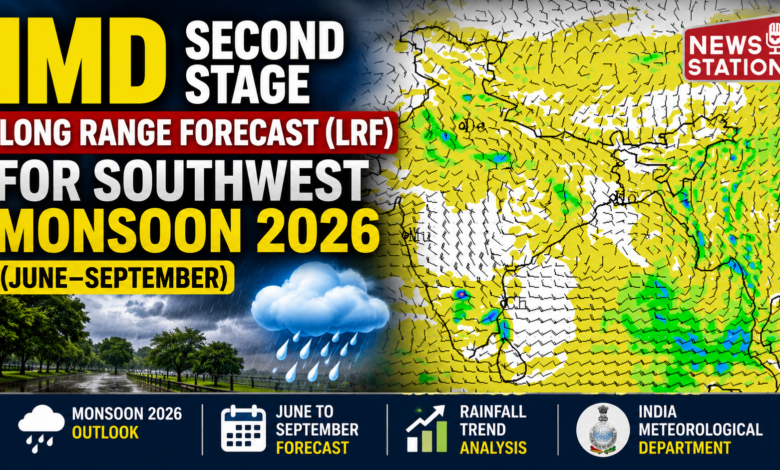
The India Meteorological Department (IMD), under the Ministry of Earth Sciences (MoES), has issued its updated Long Range Forecast (LRF) for the Southwest Monsoon season (June–September 2026), warning that the country is likely to receive below-normal rainfall during the crucial four-month monsoon period.
According to the forecast, the seasonal rainfall over the country as a whole is expected to be 90% of the Long Period Average (LPA) with a model error margin of ±4%. The IMD stated that there is a high probability of deficient or below-normal rainfall conditions across several parts of India during the monsoon season.
The forecast raises concerns for agriculture, water availability, hydropower generation, and heatwave management, especially in rain-fed farming regions.
Monsoon Rainfall Forecast for 2026
The IMD has predicted that most regions of the country are likely to witness below-normal rainfall during the southwest monsoon season.
National Seasonal Rainfall Outlook (June–September 2026)
|
Category |
Rainfall Range (% of LPA) |
Forecast Probability |
|
Deficient |
Less than 90% |
60% |
|
Below Normal |
90% – 95% |
24% |
|
Normal |
96% – 104% |
14% |
|
Above Normal |
105% – 110% |
2% |
|
Excess |
More than 110% |
0% |
The Long Period Average (LPA) rainfall for the country during the monsoon season is 87 cm based on the 1971–2020 data.
IMD officials noted that there is an 84% combined probability of deficient or below-normal rainfall across India during the monsoon season.
Regional Rainfall Outlook
The forecast indicates varying rainfall patterns across different regions of the country.
Forecast for Homogeneous Regions and Monsoon Core Zone
|
Region |
Below Normal Probability |
Normal Probability |
Above Normal Probability |
|
Northwest India |
46% |
33% |
21% |
|
Central India |
43% |
33% |
24% |
|
South Peninsula |
45% |
34% |
21% |
|
Northeast India |
33% |
35% |
32% |
|
Monsoon Core Zone (MCZ) |
43% |
33% |
24% |
The Monsoon Core Zone (MCZ), which includes most rain-fed agricultural regions of India, is also expected to receive below-normal rainfall. This could directly impact kharif crop sowing and agricultural productivity.
However, some parts of Northwest India, Northeast India, eastern areas of the south peninsula, adjoining east-central India, and isolated pockets of East India may receive normal to above-normal rainfall.
June 2026 Rainfall Likely to Remain Below Normal
The IMD has also released the monthly rainfall outlook for June 2026, predicting below-normal rainfall for the country as a whole.
The average rainfall during June is expected to remain below 92% of the Long Period Average. The LPA for June rainfall over India is 165.4 mm based on the 1971–2020 climatology.
Most parts of the country are likely to witness deficient rainfall during June, except some areas of Northwest India, Northeast India, parts of south peninsular India, and isolated areas of Central India where rainfall could remain normal or above normal.
Heatwave Threat to Intensify in June
Along with deficient rainfall, the IMD has warned of an increase in heatwave activity during June 2026.
States Likely to Witness Above-Normal Heatwave Days
|
High Heatwave Risk States |
|
Uttar Pradesh |
|
Haryana |
|
Punjab |
|
Bihar |
|
Odisha |
|
Chhattisgarh |
|
Gujarat |
|
Andhra Pradesh |
Additional isolated heatwave conditions are expected in:
- Maharashtra
- Telangana
- Himachal Pradesh
- Tamil Nadu
However, Rajasthan and Jharkhand are likely to witness below-normal heatwave days.
The IMD warned that prolonged heatwave conditions could affect public health, water availability, power demand, and essential services. Elderly citizens, children, outdoor workers, and people with existing medical conditions are considered most vulnerable.
State governments and district administrations have been advised to strengthen preparedness measures, including cooling shelters, drinking water facilities, health surveillance, and emergency response systems.
Temperature Outlook for June 2026
The weather agency has forecast above-normal temperatures over most parts of India during June.
Temperature Forecast Highlights
|
Parameter |
Forecast |
|
Maximum Temperature |
Above normal over most parts of India |
|
Minimum Temperature |
Above normal across most regions |
|
Cooler Regions |
Parts of Central, Northwest and East India may witness normal to below-normal temperatures |
The IMD stated that both daytime and nighttime temperatures are likely to remain above seasonal averages in most regions, increasing discomfort levels during the pre-monsoon and early monsoon period.
El Niño Conditions May Develop During Monsoon
The IMD has also highlighted the changing oceanic and atmospheric conditions over the Pacific Ocean.
Currently, neutral El Niño–Southern Oscillation (ENSO) conditions are transitioning toward El Niño conditions over the equatorial Pacific Ocean. Climate model forecasts indicate that El Niño is likely to develop during the southwest monsoon season.
Historically, El Niño conditions are associated with weaker monsoon rainfall over India.
At the same time, neutral Indian Ocean Dipole (IOD) conditions are prevailing over the Indian Ocean and are expected to continue during the monsoon season.
Impact on Agriculture and Water Resources
The IMD cautioned that below-normal rainfall may create challenges in several sectors, including:
- Agriculture and crop productivity
- Water storage and irrigation
- Hydropower generation
- Drinking water supply
- Ecosystem sustainability
The department recommended efficient water management, drought preparedness, water conservation measures, and increased use of early warning services to reduce the impact of rainfall deficits.
IMD to Release July Forecast in June-End
The India Meteorological Department said the forecast for July 2026 rainfall will be issued in the last week of June.
The agency also continues to provide extended-range forecasts, weekly updates, short-to-medium range forecasts, and impact-based warnings through its operational forecasting systems.