GST reforms soon to reduce taxes on essential goods, says Modi as “Diwali Gift”; calls upon industry to undertake next generation reforms

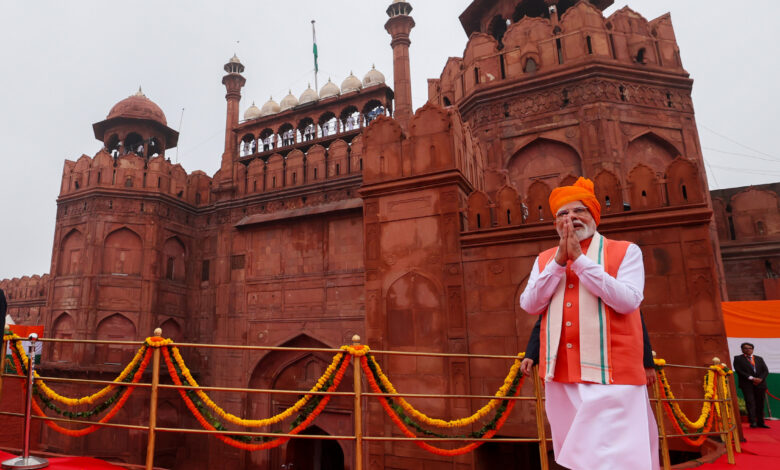
Eight years after its implementation, Prime Minister Narendra Modi today said the Government will soon announce next generation reforms in the Goods and Services Tax (GST) aiming to reduce burden on the common man on the daily use items.
Delivering his address from the ramparts of historic Red Fort on the 79th Independence Day, Prime Minister Modi announced the introduction of Next-Generation GST reforms by this Diwali, aimed at reducing taxes on daily-use items. “The government will bring Next Generation GST reforms, which will bring down tax burden on the common man. It will be a Diwali gift for you,” he said, ensuring that these reforms directly benefit citizens and stimulate economic activity.
“Next-generation GST reforms will be unveiled on Diwali, reducing taxes on essential goods and providing relief to MSMEs, local vendors, and consumers,” he announced.
The GST regime came into effect on July 1, 2017, replacing various existing indirect taxes levied by the Centre and state governments. It aimed to create a “unified” national market for goods and services by subsuming various indirect taxes like excise duty, service tax and Value Added Tax (VAT).
Reforms in the GST is a continuous process as the GST Council headed by the Union Finance Minister meets every two to three months to review and reduce or increase the GST rates. There is a basket of items which are still not in the GST purview. For example petrol/diesel is one of the major items which is still subject to Central and State government levies and that is the reason for varying petrol prices across states due to state-specific VAT and central excise duties.
PM Modi also announced the formation of a Task Force for Next-Generation Reforms, which will evaluate all current laws, rules, and procedures related to economic activities. The Task Force will work within a set timeline to – i) Reduce compliance costs for startups, MSMEs, and entrepreneurs; ii) Provide freedom from fear of arbitrary legal actions; and Ensure laws are streamlined for ease of doing business.
These reforms, he said, are aimed at creating a supportive ecosystem for innovation, entrepreneurship, and economic growth.
He also announced the creation of a dedicated Reform Task Force to drive next-generation reforms emphasising its mandate is to “accelerate economic growth, cut red tape, modernise governance, and prepare Bharat for the demands of a USD 10 trillion economy by 2047.”
Over the past years, the current BJP-led government has undertaken a number of reforms, abolishing over 40,000 unnecessary compliances and repealing more than 1,500 outdated laws. Dozens of other laws were simplified in Parliament, always keeping citizens’ interests at the forefront, PM Modi said adding in the recent session alone, over 280 provisions were removed, making governance simpler and more accessible for every Indian. He emphasized that reform is not just about economics, it is about transforming the everyday lives of citizens.
This government’s major focus has been to increase income at the hands of the common man. Keeping this in mind, the government in the last Union budget had announced major Income Tax Reforms making the system transparent and efficient by introducing Faceless Assessment. It had also made Zero Tax for annual income up to Rs 12 lakh.
This followed by two consecutive rate cuts by the Reserve Bank of India resulted in lower burden on common man and leaving more money in their hands .
PM Modi also highlighted replacement of outdated criminal laws with the Indian Justice Code, simplifying justice and legal procedures
“These reforms signal a modern, citizen-centric government where ordinary people can experience ease, fairness, and empowerment. He underscored that India is committed to structural, regulatory, policy, process, and procedural reforms, building a nation where governance works for the people, not the other way around.
The government’s reforms aim to reduce compliance costs for startups, MSMEs, and entrepreneurs, while ensuring freedom from the fear of outdated legal provisions. This creates a more conducive environment for business growth, encouraging innovation and economic self-reliance, he added.
Reducing dependence on imports for items like semiconductors, Modi said India will launch Made in India semiconductor chips by the end of 2025, reflecting the nation’s growing strength in critical technology sectors. He emphasized innovation in AI, cyber security, deep-tech, and operating systems for global competitiveness.
Recalling how attempts to set up semiconductor factories 50–60 years ago were “killed at birth” while other nations prospered, Modi announced that “India is now on mission mode. By the end of this year, the nation will roll out its first Made in India chip.”
The Prime Minister laid emphasis on two other big ticket reforms — Energy Independence and Made in India Jet Engines.
Pointing out that a large share of India’s budget still goes toward importing petrol, diesel, and gas, Modi announced the launch of the National Deepwater Exploration Mission to tap ocean resources, alongside major expansions in solar, hydrogen, hydro and nuclear power.
On the second big ticket item that is “Made in India Jet Engines”, he said this is a National Challenge. “….just like how we made vaccines during COVID, and UPI for digital payments, we should build our own jet engines too for our jet engines and asked our scientists and youth to take it up as a direct challenge.”