ECI Rolls Out Phase-II of Special Intensive Revision: Targets 51 Crore Voters in 12 States, Emphasizes Voter List Purity Amid Political Queries

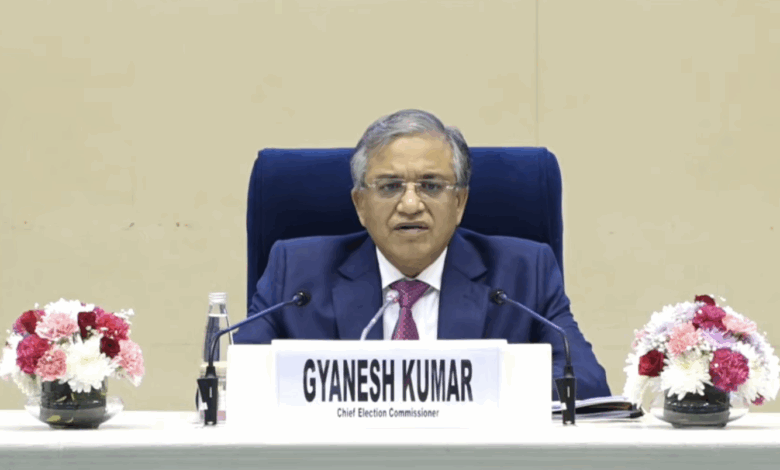
The Election Commission of India (ECI) launched the second phase of its nationwide Special Intensive Revision (SIR) of electoral rolls on Monday, aiming to verify and purify lists for approximately 51 crore voters across 12 states and Union Territories. Chief Election Commissioner Gyanesh Kumar, flanked by Election Commissioners Dr. Sukhbir Singh Sandhu and Dr. Vivek Joshi, unveiled the initiative at a press conference, hailing it as a milestone for electoral integrity—the ninth such comprehensive drive since Independence and the first in over two decades.
Dr. Sandhu, addressing the media, extended Chhath Puja greetings to Bihar’s 7 crore voters, crediting their enthusiastic participation in Phase-I for achieving “zero appeals” and establishing Bihar’s rolls as a model of accuracy. “The core objective of SIR is to include every eligible voter and exclude the ineligible,” he stated, underscoring the need to address issues like migration-induced duplicates, unremoved deceased entries, and erroneous inclusions of non-citizens.
Phase-II Coverage and Timeline
This phase covers Andaman & Nicobar Islands, Lakshadweep, Chhattisgarh, Goa, Gujarat, Kerala, Madhya Pradesh, Puducherry, Rajasthan, Tamil Nadu, Uttar Pradesh, and West Bengal—regions gearing up for key assembly polls. Around 5.33 lakh Booth Level Officers (BLOs), 7.64 lakh party-appointed agents, 10,000 Electoral Registration Officers (EROs), and 321 district collectors will drive the effort.
The detailed schedule is as follows:
|
Activity |
Timeline |
|
Printing, Training & Preparation |
October 28 – November 3, 2025 |
|
House-to-House Enumeration |
November 4 – December 4, 2025 |
|
Draft Rolls Publication |
December 9, 2025 |
|
Claims & Objections Period |
December 9, 2025 – January 8, 2026 |
|
Verification & Hearings (for notices) |
December 9, 2025 – January 31, 2026 |
|
Final Rolls Publication |
February 7, 2026 |
Voter rolls in these areas will freeze at midnight tonight, with BLOs distributing pre-printed unique enumeration forms to existing electors. These forms link to the 2002-2004 SIR rolls via voters.gov.in, minimizing documentation needs—only those without prior matches (a minority, per ECI estimates) will require indicative proofs like passports or ration cards during hearings. Aadhaar remains optional for identity verification only, not citizenship or domicile, aligning with Supreme Court rulings.
Process Highlights: From Enumeration to Appeals
BLOs—one per ~1,000 voters—will conduct up to three house visits, assisting with Form 6 for new 18+ registrants and flagging absences, deaths, shifts, or duplicates. Migrants and urban workers can submit online. Enumeration forms include pre-printed details (name, EPIC number, photo, QR code) and a new column for linking to previous SIR entries via self or relatives’ 2002-04 details, simplifying matching.
Post-enumeration, EROs (sub-divisional magistrate-level) will publish draft rolls, issue notices for unmatched cases, and handle claims/objections (Forms 6 for inclusion, 7 for objections, 8 for corrections). Appeals go first to district magistrates, then Chief Electoral Officers. Polling stations will be rationalized to cap at 1,200 voters each, with new booths in high-rises, gated colonies, and underserved areas like slums—ensuring family members vote at the same location.
ECI emphasized inclusivity: Volunteers (government staff, NCC/NSS) will aid elderly, disabled, or illiterate voters. Updated colored photos on forms will feature on new EPIC cards for those with changes in entries, addresses, or polling stations.
Q&A: Addressing Assam, West Bengal Concerns and Process Tweaks
The conference saw pointed questions on regional sensitivities. On Assam’s exclusion, Dr. Sandhu clarified: “Separate revision orders will apply due to unique citizenship provisions under the Citizenship Act and ongoing Supreme Court-monitored inquiries.” For Kerala, where local body polls loom, he affirmed no conflict as notifications are pending, with state governments constitutionally obligated (Article 324(6)) to provide staff.
West Bengal drew scrutiny over Chief Minister Mamata Banerjee’s reported opposition and TMC’s “bloodbath” warnings if deletions occur. “There is no impasse; constitutional bodies fulfill duties independently,” Dr. Sandhu responded, expressing confidence in state cooperation for law and order. No central security demands for BLOs have been received, he added.
Journalists probed Bihar lessons: Minimal documents needed upfront (unlike initial phases) reduces burden, with backend tech matching 50-70% of entries pre-SIR. On de-duplication, physical house-to-house verification obviates software needs—voters sign only one form, rendering multiples a legal offense. For foreign inclusions, unmatched cases trigger notices requiring 2002-04 linkages or proofs; no aggregate list of suspects will be publicized to avoid misuse.
Inter-state linking (e.g., Delhi voter with UP parents) is feasible via voters.gov.in searches by state/district. Administrative transfers post-announcement require ECI nod, though pre-SIR changes are states’ prerogative.
Broader Implications
Building on Bihar’s success—where 90,000 BLOs and 1.6 lakh agents collaborated seamlessly—Phase-II incorporates refinements like optional early Form 6 collection and enhanced forms for easier matching. ECI urged parties to appoint booth agents promptly and hold meetings with officials by October 29.
Subsequent phases will cover Maharashtra (per Supreme Court mandate for local polls by January 2026) and snow-bound areas like Jammu & Kashmir. With national rolls at 96 crore, SIR aims to boost participation among youth and marginalized groups, purging ~6% inaccuracies seen in Bihar. Critics like Tamil Nadu CM M.K. Stalin have voiced deletion fears, but ECI dismissed them as misinformation, vowing “no eligible left out, no ineligible included.”
Voters can track via Voters’ Services Portal; forms are available online or via BLOs. As polls approach in 2026, this tech-savvy overhaul signals ECI’s push for transparent, inclusive democracy.