CASTE CENSUS RETURNS AFTER 93 YEARS: Cabinet Approves ₹11,718 Crore for India’s First Fully Digital Census 2027

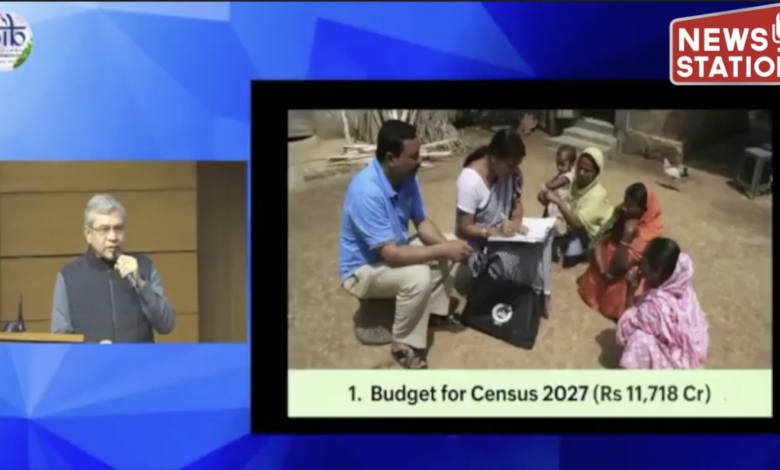
In a landmark decision, the Union Cabinet on Friday approved ₹11,718 crore for Census 2027 – India’s 16th decennial census, 8th since Independence, and the world’s largest administrative and statistical exercise. For the first time, it will be completely digital and will include caste enumeration of the entire population – the first such exercise since the 1931 census under British rule.
Briefing the media after the Cabinet meeting, senior ministers announced that the long-delayed exercise (originally due in 2021 but postponed due to COVID-19) is now firmly on track. The Gazette notification for Census 2027 was issued on 16 June 2025.
Timeline & Reference Dates
- Standard reference moment: 00:00 hours of 1 March 2027
- Snow-bound areas (J&K, Himachal, Uttarakhand, Ladakh, etc.): 1 October 2026
The census will be conducted in two phases:
- House Listing & Housing Census (April–September 2026)
States/UTs can choose any 30-day window. Captures data on housing conditions, household amenities (drinking water, electricity, toilet, cooking fuel, etc.). - Population Enumeration (February 2027)
Actual headcount with revisional round 1–5 March 2027. Snow-bound areas: September 2026 (revisional 1–5 October 2026).
Historic Firsts in Census 2027
- 100% digital: Enumerators will use a multilingual mobile app (Hindi, English + regional languages) for real-time data entry – ensuring higher accuracy and faster compilation.
- Self-enumeration portal: Citizens can fill their own details online from home, similar to income-tax filing.
- Full caste census: Every individual’s caste will be recorded (not limited to SC/ST as in previous censuses).
- Census-as-a-Service (CaaS): Real-time, machine-readable dashboards for ministries, state governments, researchers and planners.
- Geo-tagging: Every house listing block will be geo-referenced using a dedicated web-map application.
- Robust cybersecurity built into the Census Monitoring & Management System (CMMS) portal.
Massive Scale of Operations
- Over 30 lakh field functionaries (teachers, anganwadi workers, patwaris, etc.) will be deployed.
- Expected to generate 1.02 crore human-days of employment – a major rural jobs booster.
- Intensive nationwide publicity campaigns planned for awareness and last-mile participation.
Why the Census Matters
The decennial census remains the most authentic source for:
- Policy planning, budget allocation and welfare schemes
- Delimitation of Parliamentary, Assembly and local body constituencies (constitutional requirement)
- Reservation policies for SC/ST/OBC and women
- Tracking progress on poverty, education, health, sanitation, gender ratio and housing
- Academic research in demography, economics, sociology and anthropology
Legal Backbone
Census is a Union subject (Entry 69, Union List). It is governed by:
- The Census Act, 1948
- Census Rules, 1990
With India’s population having grown by over 370 million since the 2011 census (1.21 billion), Census 2027 will provide the first accurate post-COVID demographic, social and economic snapshot after a 16-year gap.
The approval of ₹11,718 crore signals the beginning of intense preparatory work across all states and Union Territories. Officials said training of master trainers will start in early 2026, followed by boundary demarcation and appointment of enumerators.
As India prepares for what will be the most technologically advanced and politically significant census in its history, the inclusion of caste data is already sparking nationwide debate on social justice, reservation and political representation.
Census 2027 is not just a headcount – it will redraw India’s policy and political map for the next decade.