India, Canada Unveil Renewed Strategic Partnership; Target CAD 70 Billion Trade by 2030

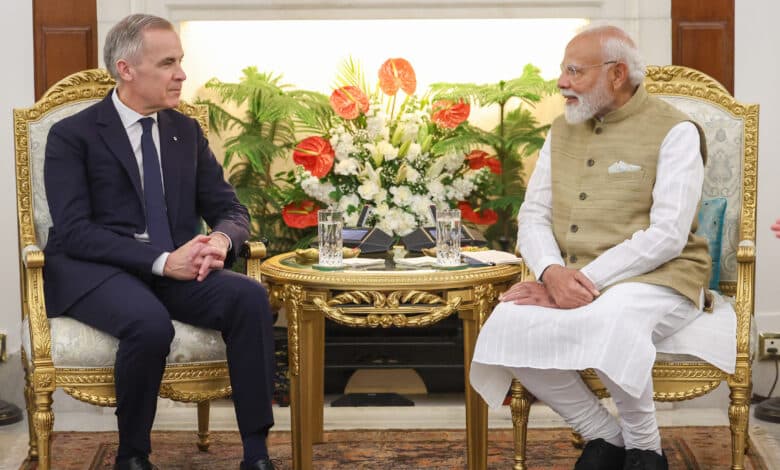
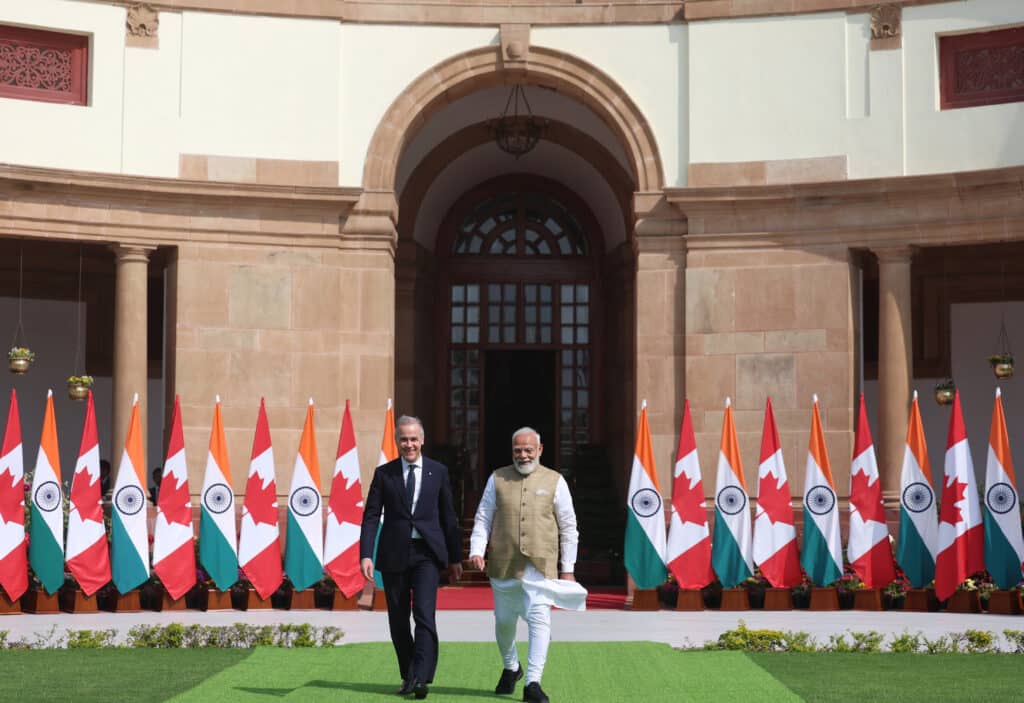
Prime Minister Mark Carney concluded his first official visit to India from February 27 to March 2 at the invitation of Prime Minister Narendra Modi, marking the first bilateral visit by a Canadian Prime Minister since 2018. The visit signalled a reset in ties as both leaders unveiled a renewed India–Canada Strategic Partnership anchored in shared democratic values, respect for sovereignty, and a commitment to global stability.
Commemorating 79 years of diplomatic relations, the leaders adopted the principle of “Vasudhaiva Kutumbakam” — One Earth, One Family, One Future — as the overarching framework for cooperation. They underscored alignment between India’s vision of Viksit Bharat and Canada’s Build Canada Strong agenda, pledging deeper collaboration in energy security, clean technology, food security, innovation, talent mobility, and resilient supply chains.
A major highlight of the visit was the relaunch of negotiations for a Comprehensive Economic Partnership Agreement (CEPA). Both sides finalized the Terms of Reference and committed to concluding negotiations by the end of 2026. The leaders set an ambitious target to expand bilateral trade to CAD 70 billion (approximately ₹4.65 lakh crore) by 2030. To accelerate commercial engagement, they announced reciprocal ministerial-led trade visits and reconstituted the India–Canada CEO Forum to boost private sector participation.
Energy cooperation emerged as a central pillar of the partnership. The two sides advanced the India–Canada Strategic Energy Partnership, covering conventional and clean energy, civil nuclear cooperation, and critical minerals. A significant development was the conclusion of a CAD 2.6 billion agreement between Cameco and India’s Department of Atomic Energy for long-term uranium supply, strengthening India’s clean energy generation capacity.
Both countries agreed to expand trade in liquefied natural gas (LNG), liquefied petroleum gas (LPG), crude oil, and refined petroleum products. Canada reaffirmed plans to significantly increase LNG production capacity by 2030 and 2040, while India expressed intent to diversify energy imports. Discussions are also underway for India’s first long-term LPG supply arrangement with Canada.
In the clean energy domain, the leaders signed a Memorandum of Understanding on Clean Energy Cooperation. The framework will promote collaboration in solar, wind, bioenergy, hydrogen, battery storage, and grid modernization. A dedicated Joint Working Group will oversee implementation, and a Renewable Energy and Storage Summit is planned for 2026 to foster industry-level partnerships.
Recognizing the strategic importance of critical minerals, the two countries signed an MoU to build secure and diversified supply chains. India endorsed the G7 Critical Minerals Action Plan, and both sides committed to reciprocal investment partnerships and cooperation in mineral stockpiling initiatives.
On climate and global clean energy platforms, Canada announced its intention to pursue membership in the International Solar Alliance and upgraded participation in the Global Biofuels Alliance. The leaders reaffirmed their shared commitment to science-based climate action, biodiversity conservation, and pollution reduction.
Education and talent mobility featured prominently in the discussions. A new Joint Talent and Innovation Strategy will promote two-way mobility of students and researchers. An MoU between India’s AICTE and Canada’s MITACS will expand research internships for Indian undergraduates in Canadian universities. The two sides also agreed to revitalize higher education collaboration and encourage offshore campuses of Canadian institutions in India.
In science and technology, the leaders relaunched the Joint Science and Technology Cooperation Committee to advance collaboration in critical and emerging technologies. Space cooperation will be strengthened through deeper engagement between ISRO and the Canadian Space Agency, including work in robotics, atmospheric sciences, and quantum communication.
On digital and AI cooperation, India and Canada will explore joint initiatives integrating artificial intelligence in space technologies, healthcare diagnostics for remote regions, and resilient energy grid management. They also welcomed progress under the Australia–Canada–India Technology and Innovation Partnership.
Security and defence ties are set to deepen with the institutionalization of an India–Canada Defence Dialogue and the launch of a Maritime Security Partnership. Both sides agreed to enhance cooperation on counterterrorism, cybercrime, organized crime, and immigration enforcement.
Reaffirming their commitment to a free, open, and inclusive Indo-Pacific, the leaders pledged closer coordination in regional forums and infrastructure initiatives.
Prime Minister Carney thanked the Government and people of India for their hospitality, expressing confidence that the renewed partnership would deliver long-term benefits and contribute to regional stability and global resilience.