


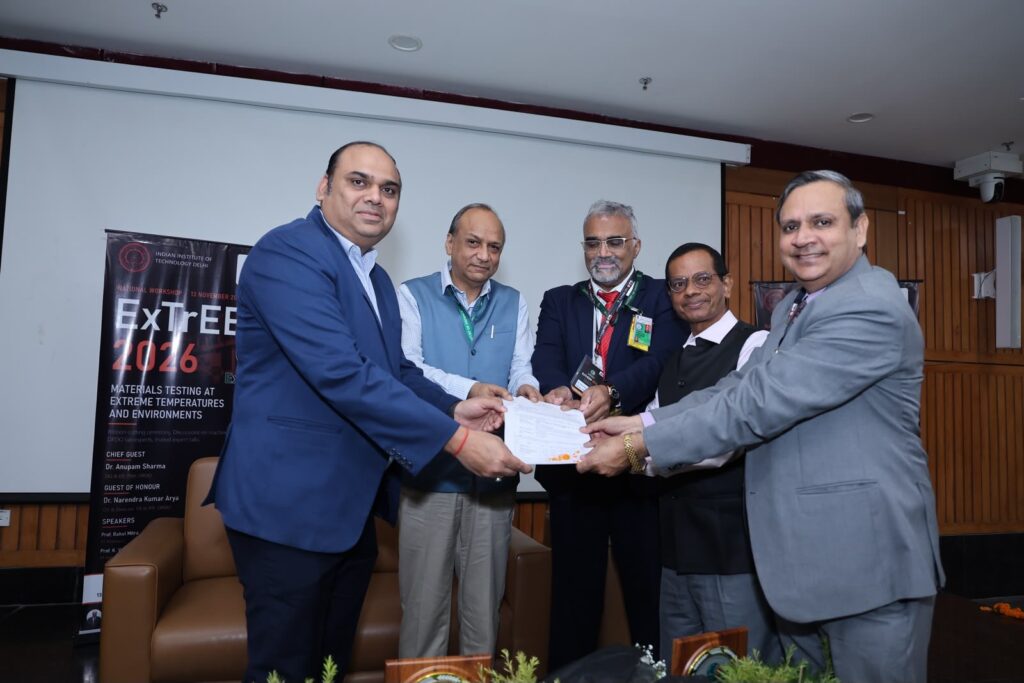
The Indian Institute of Technology (IIT) Delhi is set to establish a first-of-its-kind research facility, named Extreme Temperature and Environmental Evaluation of Materials (ExTrEEM), at its Sonipat campus in Haryana. Supported by the Defence Research and Development Organisation (DRDO), the facility will provide advanced testing and evaluation capabilities for materials exposed to extreme temperatures and challenging environmental conditions, including temperatures reaching and exceeding 2,500 degrees Celsius.
The proposed facility marks a significant step towards strengthening India’s indigenous research and testing infrastructure for advanced materials. It is expected to serve as a nationally accessible centre for materials testing and characterisation, supporting the development of technologies essential to India’s aerospace, defence, energy and manufacturing industries.
With the growing demand for materials capable of operating under increasingly demanding conditions, ExTrEEM is expected to address critical gaps in the country’s advanced materials research ecosystem. The facility will enable researchers and industries to evaluate the performance, durability and structural characteristics of specialised materials under extreme thermal and environmental conditions.
The project is also expected to accelerate innovation, facilitate the commercialisation of research outcomes and encourage startup development by strengthening partnerships between academic institutions, industries and national research organisations.
DRDO Extends Support to IIT Delhi’s Research Initiative
The sanction letter for the ExTrEEM facility was formally handed over to IIT Delhi by Dr. Anupam Sharma, Director General (Technology Management), DRDO, during a ceremony attended by Dr. Narendra Kumar Arya, Director, ER & IPR, DRDO, along with faculty members, researchers and representatives from the industry.
Speaking at the event, Dr. Anupam Sharma highlighted the increasing importance of indigenous testing infrastructure in achieving technological self-reliance. He emphasised that developing advanced materials for critical applications requires a strong domestic ecosystem capable of testing and validating their performance under demanding operating conditions.
He also underlined the need for closer collaboration among academia, industry and national laboratories to address critical technological gaps and develop materials capable of withstanding increasingly extreme temperatures.
The initiative aligns with India’s broader efforts to strengthen indigenous technological capabilities and reduce dependence on overseas testing and evaluation facilities for critical materials research.
Nationally Accessible Facility for Advanced Materials Research
Prof. Jayant Jain from the Department of Materials Science and Engineering (DMSE), IIT Delhi, is leading the ExTrEEM project along with eight other faculty members from the department.
Highlighting the significance of the initiative, Prof. Jain said that the facility would be the first comprehensive materials testing infrastructure of its kind in the country, designed to be accessible to researchers and industries nationally.
Its establishment is expected to provide scientists, engineers, industrial researchers and startups with access to specialised equipment and advanced testing facilities that are essential for developing next-generation materials.
The facility will also help bridge the gap between laboratory-level research and industrial applications by enabling systematic testing, performance assessment and material characterisation.
Advanced Equipment to Support Extreme-Temperature Testing
A major highlight of the ExTrEEM initiative is the range of advanced testing and characterisation systems planned for the facility.
These include high-temperature universal testing machines, high-temperature X-ray diffraction (XRD), high-temperature scanning electron microscopy (SEM), tribology and erosion testing systems, as well as computational materials design tools.
The high-temperature universal testing machines will enable researchers to study the mechanical behaviour and strength of materials under extreme thermal conditions. High-temperature X-ray diffraction systems will help examine structural changes and phase transformations in materials when exposed to elevated temperatures.
Similarly, advanced scanning electron microscopy will support detailed examination of material structures and microstructural changes. Tribology and erosion testing systems will help evaluate wear resistance, frictional behaviour and material degradation under demanding operating environments.
Computational materials design tools will further strengthen research capabilities by helping scientists model, analyse and develop materials with specialised properties for critical applications.
National Workshop Discusses Research Infrastructure and Standards
A national workshop on ‘Materials Testing for Extreme Temperatures and Environments’ was also organised alongside the announcement of the facility.
The workshop brought together experts from DRDO, academic institutions and industry to discuss the challenges and opportunities associated with advanced materials research and testing infrastructure.
Participants reviewed the proposed equipment and testing capabilities of the ExTrEEM facility and offered recommendations on instrumentation, calibration, maintenance, environmental control, accreditation and long-term operational sustainability.
The discussions focused on ensuring that the facility operates according to appropriate technical standards while providing reliable and internationally competitive testing capabilities.
Strengthening India’s Strategic Technology Ecosystem
The establishment of ExTrEEM at IIT Delhi’s Sonipat campus is expected to create new opportunities for collaboration between researchers, defence laboratories, industrial organisations and emerging technology startups.
Advanced materials play a crucial role in the performance and reliability of aerospace structures, defence systems, high-temperature energy applications and sophisticated manufacturing processes. The ability to test these materials domestically under extreme conditions is therefore important for developing critical technologies.
By creating a nationally accessible research and testing platform, IIT Delhi and DRDO aim to strengthen India’s advanced materials ecosystem, promote indigenous innovation and support the country’s long-term technological and industrial ambitions.