


The Ministry of Road Transport and Highways has notified the Central Motor Vehicles (Sixteenth Amendment) Rules, 2026, introducing revised validity periods for Pollution Under Control (PUC) certificates for different categories of motor vehicles. The new rules establish separate renewal schedules based on Bharat Stage (BS) emission standards, vehicle age and whether a vehicle is classified as a transport or non-transport vehicle.
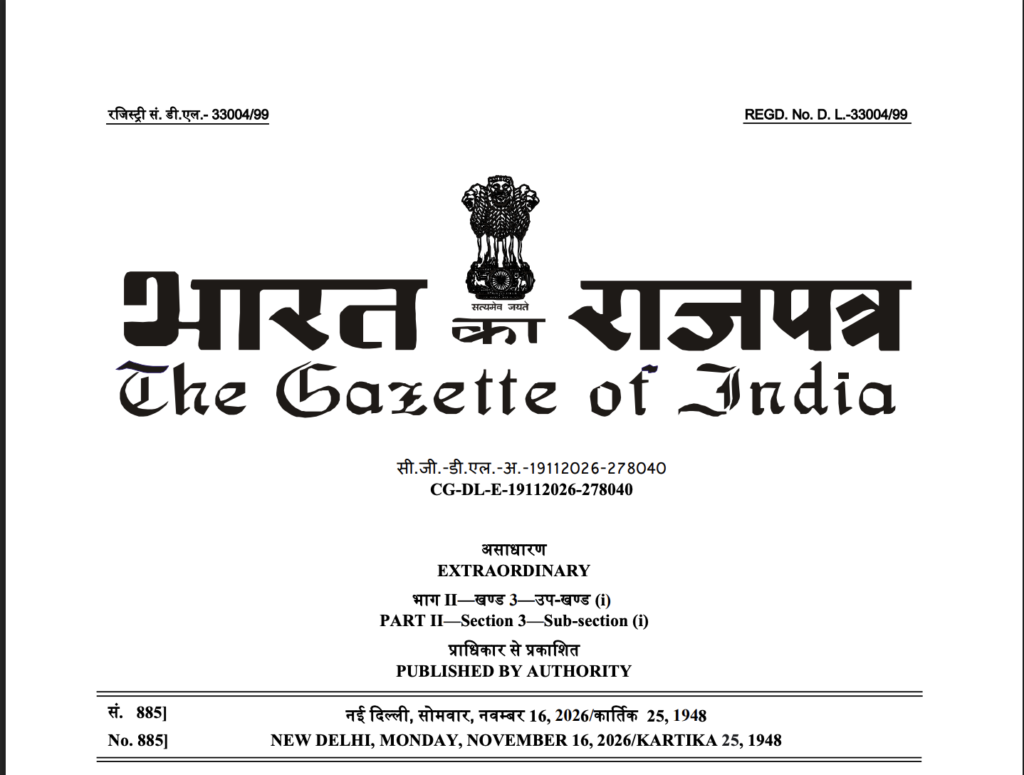
The amendment was notified through Gazette Notification G.S.R. 991(E), dated November 13, 2026, and published in the Gazette of India on November 16, 2026. The provisions will come into force from the date of publication in the Official Gazette.
Under the amended provisions, every motor vehicle must carry a valid PUC certificate issued or renewed by an agency authorised by the respective State Government. The certificate must be produced whenever demanded by officers authorised under Rule 116(1) of the Central Motor Vehicles Rules, 1989.
New PUC Certificate Validity Periods
The amendment replaces sub-rule (7) of Rule 115 of the Central Motor Vehicles Rules, 1989, with revised provisions under sub-rules (7) and (7A).
According to the notification, Notification MoRTH- PUC Reg (1) the validity of PUC certificates will depend on the vehicle’s emission category and, in the case of BS-VI vehicles, its age from the date of first registration.
The revised validity schedule is as follows:
| Vehicle Category | PUC Certificate Validity |
|---|---|
| BS-I, BS-II and BS-III vehicles | 3 months |
| BS-IV vehicles | 6 months |
| BS-VI non-transport vehicles up to 6 years old | Once every 3 years |
| BS-VI non-transport vehicles above 6 years and up to 10 years | Once every year |
| BS-VI non-transport vehicles above 10 years | Once every 6 months |
| BS-VI transport vehicles up to 6 years old | Once every 2 years |
| BS-VI transport vehicles above 6 years and up to 10 years | Once every year |
| BS-VI transport vehicles above 10 years | Once every 6 months |
The revised framework provides different renewal frequencies for private and commercial vehicles meeting BS-VI emission standards.
Different Rules for BS-VI Private and Commercial Vehicles
For BS-VI non-transport vehicles, the PUC certificate will remain valid for three years for vehicles up to six years old from their first registration.
Vehicles older than six years but not exceeding 10 years will require PUC certification once every year. Once a vehicle crosses the 10-year mark, its certificate will need renewal every six months.
For BS-VI transport vehicles, the renewal schedule is comparatively more frequent during the initial years.
Transport vehicles up to six years old will require PUC certification once every two years. Vehicles above six years but not exceeding 10 years will need renewal annually. Those older than 10 years will have to renew their certificates every six months.
This means that both BS-VI transport and non-transport vehicles will follow a six-month renewal cycle after completing 10 years from their first registration.
Existing PUC Certificates to Remain Valid Under Transitional Provision
The notification also clarifies how the revised validity periods will apply to PUC certificates issued before the commencement of the Sixteenth Amendment Rules, 2026.
For certificates issued before the new rules come into force, the revised validity schedule will become applicable only when the existing certificate is renewed for the first time after the commencement of the amendment.
This transitional provision ensures that the new validity framework is not applied retrospectively to existing certificates immediately upon notification.
New Provisions for Renewal of Expired Certificates
The amendment also specifies when a renewed PUC certificate will become effective, depending on the date on which the renewal application is made.
Two situations have been outlined:
- Renewal within 10 days before expiry: If an application for renewal is made within the 10 days immediately preceding the expiry date of the existing certificate, the renewed certificate will take effect from the original expiry date.
- Renewal after expiry: In all other cases where renewal is sought after the existing certificate has expired, the renewed certificate will become effective from the actual date of renewal.
This provision clarifies the effective date of renewed certificates and distinguishes applications submitted before expiry from those made after the certificate has lapsed.
Amendment Follows Public Consultation
The Ministry stated that the amendment process was initiated through a draft notification, G.S.R. 664(E), dated July 22, 2026, which was published in the Gazette of India on July 24, 2026.
The draft rules invited objections and suggestions from members of the public and other stakeholders likely to be affected by the proposed changes. The consultation period was 30 days from the date the notification was made available to the public.
The Central Government subsequently considered the objections and suggestions received before finalising the amendment.
The new rules have been framed under Section 110 of the Motor Vehicles Act, 1988, which empowers the Central Government to make rules relating to motor vehicles.
The notification was issued by the Ministry of Road Transport and Highways under File No. RT-11036/94/2020-MVL and signed by Additional Secretary Mahmood Ahmed.
What Vehicle Owners Should Know
With the revised rules coming into force upon publication in the Official Gazette, vehicle owners will need to follow the applicable renewal schedule according to their vehicle’s BS emission category, registration date and transport classification.
The changes particularly establish clear renewal intervals for BS-VI vehicles, distinguishing between private and commercial vehicles and introducing more frequent certification requirements for vehicles exceeding 10 years of age.
The amendment forms part of the government’s regulatory framework under the Central Motor Vehicles Rules, 1989, governing vehicle emissions and pollution compliance.