


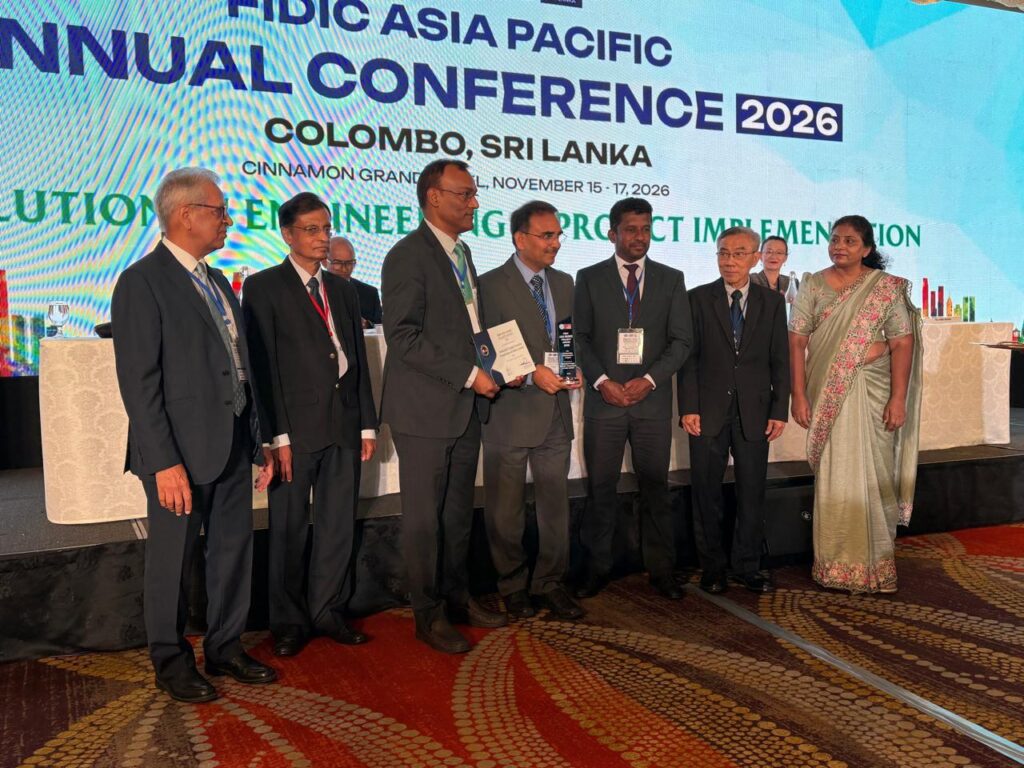
India’s Dedicated Freight Corridor (DFC) project has earned prestigious international recognition for its engineering excellence, modern railway infrastructure and contribution to strengthening the country’s freight transportation and logistics ecosystem. The Dedicated Freight Corridor Corporation of India Limited (DFCCIL) has received the FIDIC Asia-Pacific Project Award 2026 in the Large Project Category at the FIDIC Asia-Pacific Conference held in Colombo, Sri Lanka.
The award recognises DFCCIL’s outstanding contribution to developing the Eastern and Western Dedicated Freight Corridors, incorporating advanced engineering technologies and establishing modern railway infrastructure designed to transform freight transportation in India.
Alok Tiwari, Managing Director, DFCCIL, received the prestigious award at the international conference on Monday. He was accompanied by Pawan Kumar, Executive Director, DFCCIL.
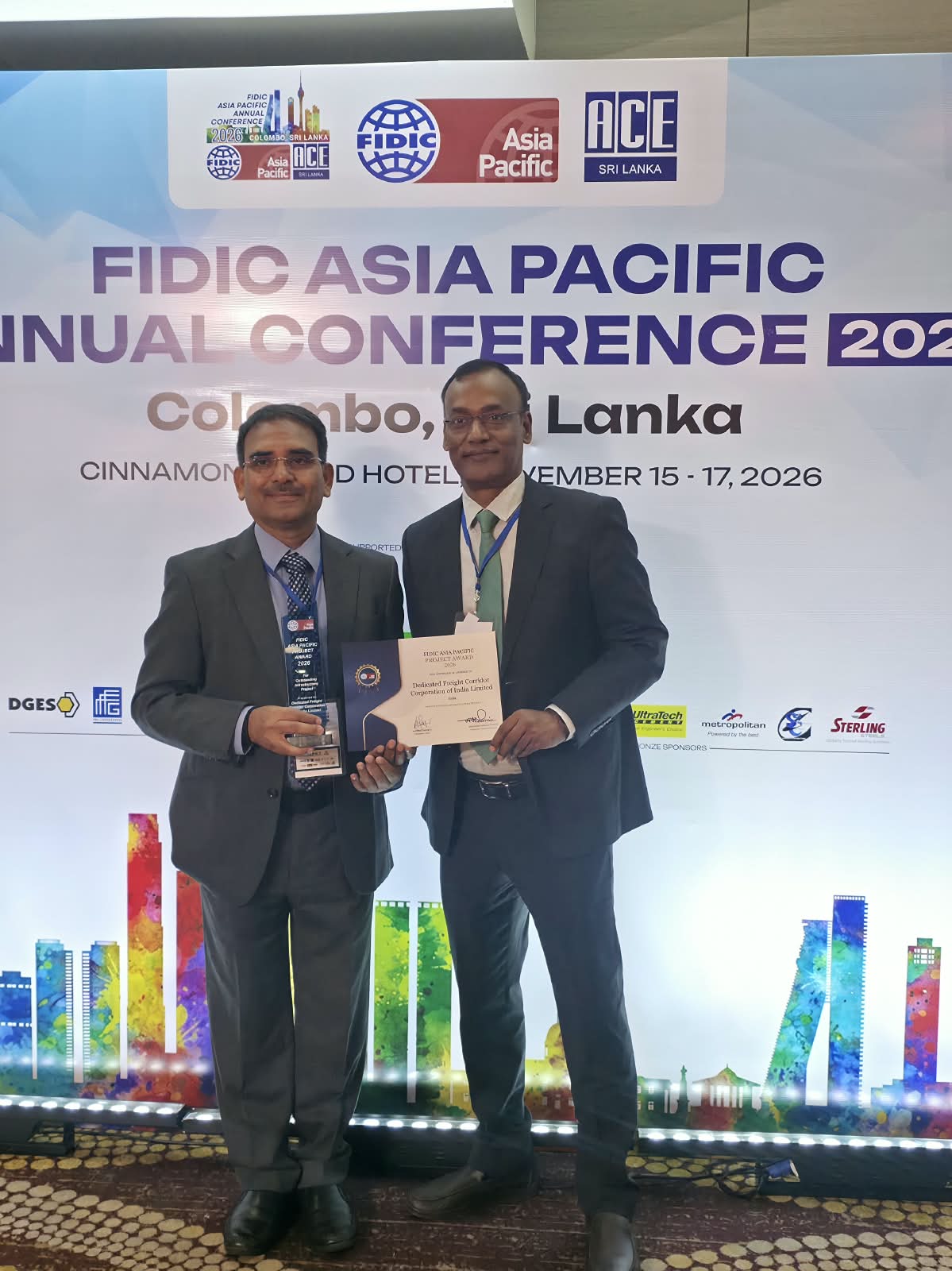

The international recognition highlights India’s growing engineering capabilities and its commitment to developing efficient, sustainable and technologically advanced transportation infrastructure.
2,843-km Dedicated Freight Corridor Network
The FIDIC Asia-Pacific Project Award acknowledges the scale, complexity and engineering achievements of India’s Dedicated Freight Corridor programme. Developed with an investment of approximately Rs 1.24 lakh crore, the 2,843-km network comprises two major corridors connecting important industrial centres, production hubs, freight terminals and ports.
The two corridors are:
| Corridor | Route | Length |
|---|---|---|
| Eastern Dedicated Freight Corridor (EDFC) | Ludhiana to Sonnagar | 1,337 km |
| Western Dedicated Freight Corridor (WDFC) | Dadri to Jawaharlal Nehru Port (JNPT) | 1,506 km |
| Total | 2,843 km |
The modern electrified double-track network has been designed to accommodate longer and heavier freight trains, operating at speeds of up to 100 kmph. Its major technological features include the operation of freight trains up to 1,500 metres in length and double-stack container trains, particularly on the Western Dedicated Freight Corridor.
These capabilities have significantly enhanced the capacity of India’s railway freight transportation system, enabling faster and more efficient movement of goods across major industrial and commercial centres.
Boost to India’s Logistics and Manufacturing Sectors
The Dedicated Freight Corridor project is playing a significant role in improving the efficiency of India’s logistics ecosystem. By providing dedicated railway infrastructure for freight transportation, the project has helped reduce transit delays, improve operational efficiency and lower transportation and storage costs.
Improved connectivity between manufacturing centres, mining regions, agricultural production hubs and major ports is facilitating the movement of raw materials and finished goods. This is supporting industrial development, domestic trade and India’s international export-import operations.
The corridors are also encouraging the development of freight terminals, logistics parks and warehouses along their routes. These facilities are creating fresh opportunities for private investment, industrial expansion and employment generation.
Better connectivity to major ports, particularly through the Western Dedicated Freight Corridor, is strengthening India’s multimodal logistics network and facilitating more efficient cargo movement for international trade.
Dedicated Tracks to Improve Passenger Train Operations
One of the important benefits of the Dedicated Freight Corridor programme is the separation of freight and passenger train operations on major railway routes.
By shifting a substantial volume of freight traffic to dedicated tracks, the project is helping reduce congestion on the existing Indian Railways network. This creates additional capacity on conventional railway routes, supporting improved passenger train operations, better punctuality and more efficient utilisation of railway infrastructure.
The DFC network is therefore not only transforming freight transportation but also contributing to the overall modernisation and operational efficiency of Indian Railways.
Adoption of International Contract Management Standards
DFCCIL has also adopted internationally recognised contract management practices for implementing its major infrastructure projects. The organisation has incorporated the principles of FIDIC’s 1999 Yellow Book into its major contracts.
These standard contractual provisions help establish clear responsibilities between project stakeholders, improve transparency and facilitate effective management of complex infrastructure contracts.
The adoption of internationally recognised standards reflects DFCCIL’s emphasis on professional project execution, accountability and quality in large-scale railway infrastructure development.
FIDIC: A Global Organisation for Consulting Engineers
Established in 1913, the International Federation of Consulting Engineers (FIDIC) is a globally recognised organisation representing national associations of consulting engineers.
Its international network encompasses more than 10 lakh engineering professionals and approximately 40,000 companies across nearly 100 countries. FIDIC promotes quality, integrity, sustainability and professional standards in infrastructure development.
Its standard contract documents are widely used in major construction and infrastructure projects worldwide, including projects financed by international development banks.
FIDIC Asia Pacific is the organisation’s regional group, bringing together member associations from more than 20 countries to promote cooperation and excellence in engineering consultancy and infrastructure development.
International Recognition for India’s Railway Infrastructure
The FIDIC Asia-Pacific Project Award 2026 marks an important milestone for DFCCIL and India’s railway infrastructure development programme. The recognition places the country’s Dedicated Freight Corridor project among internationally acknowledged large-scale engineering and infrastructure initiatives.
With its modern electrified network, advanced freight-handling capabilities and improved connectivity to industrial centres and ports, the DFC project is emerging as a critical component of India’s logistics transformation.
The award also reinforces India’s growing position in the development and execution of complex infrastructure projects, demonstrating the country’s engineering capabilities and commitment to building a more efficient, competitive and sustainable freight transportation system.